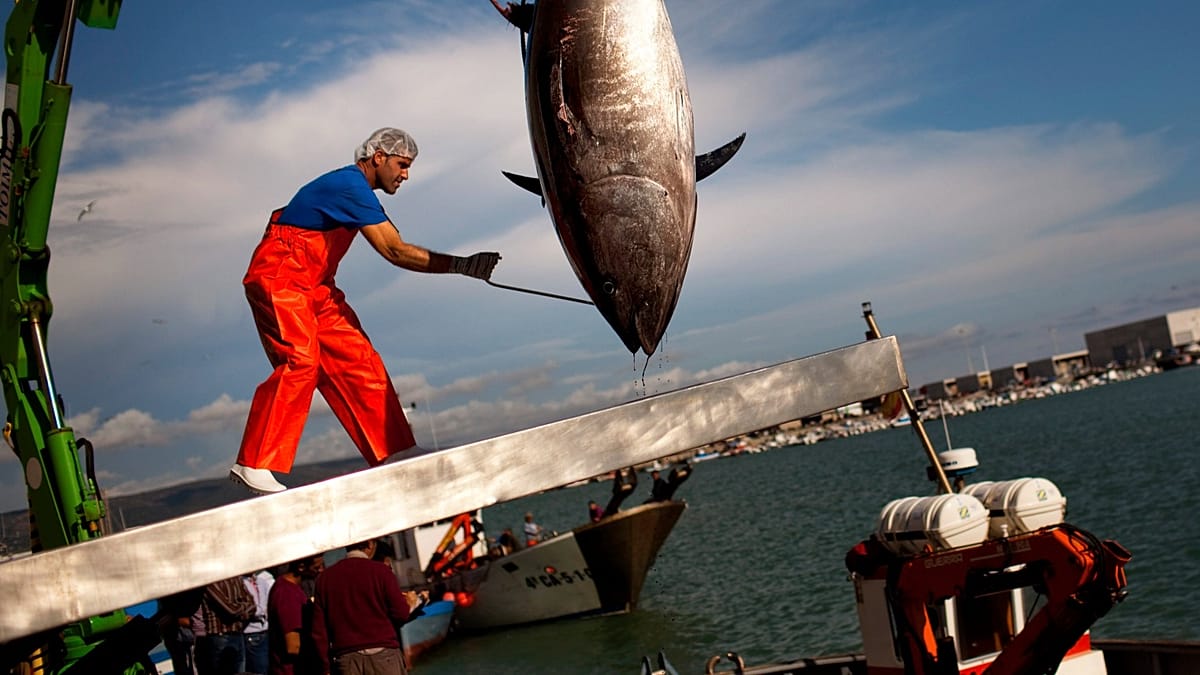
BRUSSELS — The European Parliament has opened a fresh debate on the working conditions of fishers, after an Indonesian crew member described what he called “modern slavery” aboard a Chinese vessel. Speaking at a Fisheries Committee hearing on 30 September, Fredi Seprizal recounted 16 months of near-constant work, spoiled food, and drinking water that was little more than filtered seawater.
“The food was in very poor condition and I could only drink seawater that had been filtered. I had no other choice, it was never properly clean,” Seprizal told MEPs. He said he worked 16 to 20 hours a day, sometimes 24 hours straight, with only three to six hours of rest. He also described missing safety equipment and said he feared for his life while at sea.
The hearing, titled “Boosting the social dimension of sustainable fisheries,” was organised by Carmen Crespo (EPP), chair of the Parliament’s Committee on Fisheries, and Virginia Battu-Henriksson, a member of the cabinet of Costas Kadis, the EU Commissioner for Fisheries and Oceans. It brought together survivors, trade unions, international organisations and industry representatives to examine how to combat forced labour in the sector.
Europe’s standards as a competitive advantage
Crespo argued that the EU should not compete by lowering its standards but by making them a selling point. “Europe cannot compete by lowering its standards, but by turning them into its greatest asset,” she said. “Defending a competitive fishing sector also means defending its workers against unfair competition and ensuring supply chains that are transparent, responsible and free from exploitation.”
The testimonies align with research presented by Sallie Yea, a professor at Charles Sturt University, who interviewed 121 fishers and 32 family members from the Philippines, Indonesia, Cambodia and Fiji. Her findings were stark: 94% of fishers had at some point not been paid their wages, and all had seen their contracts changed to less favourable conditions. One in four had witnessed the death of a fellow crew member, and deaths were recorded on one in four vessels analysed.
Yea called for a shift from formal compliance to real protection. “We need to move from purely formal compliance to the effective protection of labour rights, including checks on contracts and wages, arbitration mechanisms to resolve labour complaints, protection against reprisals and accountability mechanisms for recruitment agencies, and not only for fishing fleets and seafood companies,” she said.
Representatives from the International Labour Organization (ILO), the European Transport Workers’ Federation (ETF), the Environmental Justice Foundation (EJF) and Oxfam urged stricter enforcement of existing rules. Tariq Haq, an ILO economist, noted that the Work in Fishing Convention sets minimum standards for onboard work but has been ratified by only 27 countries worldwide.
The EU is phasing in a regulation on forced labour that will be fully applicable by December 2027. The Organisation of Associated Producers of Large Frozen Tuna Vessels (OPAGAC), which co-organised the hearing with the NGO Hands for the Oceans, wants market access to be conditional on meeting the same standards as the European fleet.
“We hope that the EU rules on due diligence and forced labour can become a turning point,” said Julio Morón, OPAGAC’s director-general, so that European consumers do not unknowingly eat fish caught using forced labour.
Seprizal’s account left a lasting impression. “The thought of jumping off the ship or setting it on fire crossed my mind; but I could not escape because the captain kept hold of my documents. I even had to pay to get them back,” he said.
The debate comes as the EU also faces broader questions about labour rights and supply-chain transparency, from student protests over working conditions to warnings of a harsh winter. The fisheries hearing signals that the European Parliament is increasingly willing to scrutinise the human cost behind the seafood on European plates.