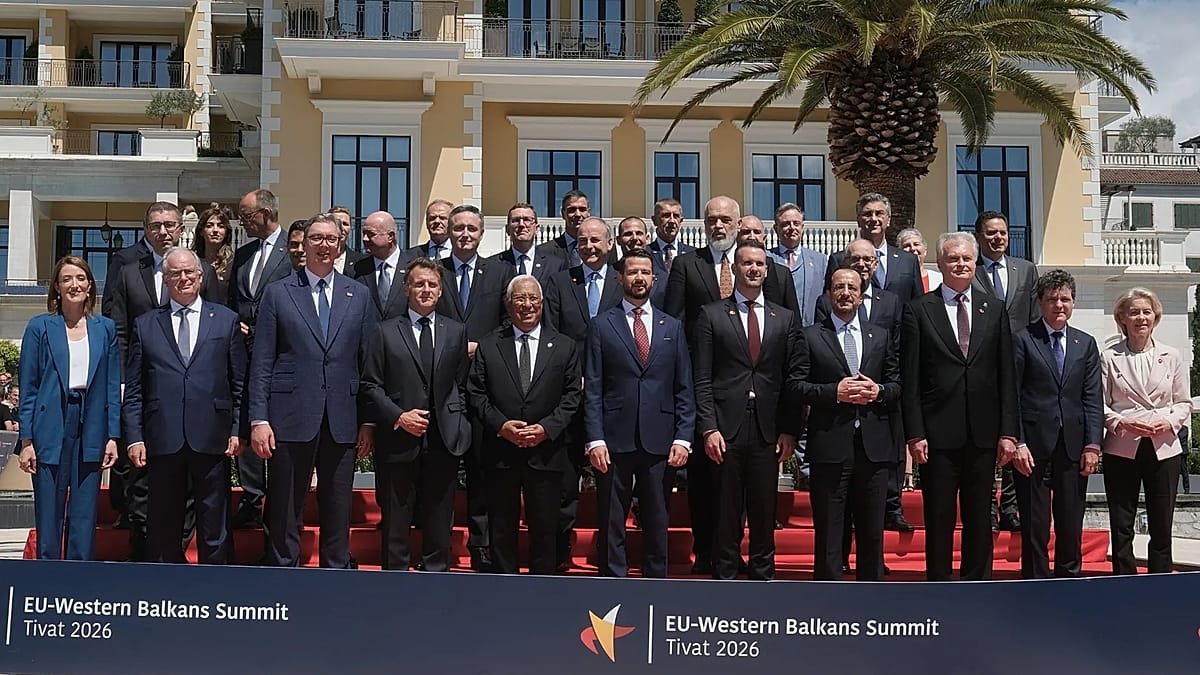
Reporting from a flat in Tivat, on Montenegro's coast, after minimal sleep and with a keyboard that feels like it's on fire, I can confirm that the EU-Western Balkans summit was anything but routine. The gathering in Porto Montenegro brought together leaders from the twenty-seven member states and the wider continent, including the UK, Switzerland, Norway, and the Balkans, for discussions that ranged from geopolitical strategy to unexpected avian casualties.
Enlargement Momentum After Hungary's Veto Lift
European Council President António Costa set the tone on the eve of the summit, telling me there is real momentum for enlarging the European Union. This is a significant statement in the Balkans, where accession has been associated for two decades with lost promises and missed deadlines. Hungary's decision to lift its veto on Ukraine—and by extension Moldova—to formally open accession negotiations has revitalised the process and lifted the mood in Brussels. For Costa, this signals a new entente cordiale among Europeans, and the upcoming EU summit in June will be used to demonstrate that unity. It is also a personal victory for Costa after he proclaimed that no one—in a clear reference to Viktor Orbán—would blackmail the Council under his watch.
However, questions remain. Many details of the deal between Budapest and Kyiv over the rights of the Hungarian minority in Ukraine are still unclear. Péter Magyar has indicated he will maintain a hard line on Ukraine's accession, rejecting any fast-track and doubling down on a referendum on membership. Ukraine is expected to open the first set of negotiations this month, but diplomats in Tivat told me the remaining five clusters could drag beyond July, with a period of three additional months seeming more realistic. Costa remains optimistic, noting that given the amount of work done in parallel, Ukraine should be able to close them swiftly.
Montenegro's 2028 Target and Gradual Integration
Montenegro is firmly on track to join the EU in 2028. The addition of a pro-European, NATO member that is relatively small and easy to manage would signal that enlargement is alive without too many complications for the 27. Costa told me joining the EU is "merit-based and will always be merit-based," but conceded that the process needs to be simplified. His tone echoed a proposal by France and Germany for a "more structured gradual integration" for aspiring countries. The idea is simple: the more reforms a candidate implements, the more EU perks it can unlock, including access to the single market. On the sidelines, Albanian Prime Minister Edi Rama told me enlargement needs a "political boom" beyond technicalities.
Rama, alongside Serbian President Aleksandar Vučić, earlier this year penned an op-ed suggesting they could give up full membership rights for a quick seat at the table. When I asked if that op-ed may have inspired Macron and Merz, Rama told me his plan was better. Classic Rama.
Protests Over Kushner-Linked Resort in Albania
Rama was also dealing with fallout from a planned luxury resort linked to the Kushner-Trump clan on the Adriatic. The project on Sazan island—which seemingly triggered a spiritual moment for Ivanka Trump—has led Albanians to the streets in protest. Rama told me he hears the concerns but pointed to a darker plot fuelled by antisemitism, "hostile" external forces, and an army of bots. "We are under a hybrid attack," he said. Protesters in Tirana insist what's really under attack is the natural habitat of Albania's coastline. For more on this, see our piece on Albanian PM Claims Hybrid War Behind Protests Over Kushner-Linked Resort.
Serbia's Balancing Act and Security Concerns
Vučić did show up at the summit after much speculation he would skip it following a week of tensions with Montenegro, which celebrated the 20th anniversary of its independence from Serbia. Vučić suggested his intelligence services had advised against going to Tivat, citing a high-level security threat. Montenegro's Prime Minister Milojko Spajić told me in a sit-down interview that he was proud of his police and intelligence services for keeping all leaders safe. The venue was high on security, with a helicopter hovering above the hotel, much to the dismay of our sound team. Notably, Giorgia Meloni and Péter Magyar did not attend.
On Serbia, exasperation is growing. Chancellor Merz told reporters after the meeting that Vučić's three-way balancing act between the EU, China, and Russia is simply not possible. "Serbia must clearly define where this country sees its future," he said. Costa added, "Serbia knows what it has to do; if they do, we move forward. If not, we stay blocked," noting the country has not opened a single new cluster since 2021 over what the Commission calls serious backsliding in fundamental issues like judicial independence and media freedom. The Commission is hopeful the Vučić government will undo a judiciary overhaul approved at the start of the year, seeing it as a real test of goodwill. As one diplomat told me, you simply cannot ignore Serbia—it's too risky.
The Dead Flamingo Incident
Amid the political drama, an unexpected symbol emerged: a dead flamingo found near the summit venue. While not officially on the agenda, the bird's demise became a talking point, highlighting the environmental and cultural tensions that often simmer beneath the surface in the Balkans. The incident served as a reminder that even in the midst of high-stakes diplomacy, the region's natural heritage remains a fragile and contested asset.
My takeaway? There is real momentum, forced by rough geopolitics, with Montenegro offering a clear path forward. But the protests in Albania, Serbia's balancing act, and the dead flamingo all underscore that the road to EU integration is anything but straightforward. For more on Montenegro's ambitions, see Montenegro's PM Calls Country the 'Cookie of the Balkans' as EU Entry by 2028 Gains Momentum.