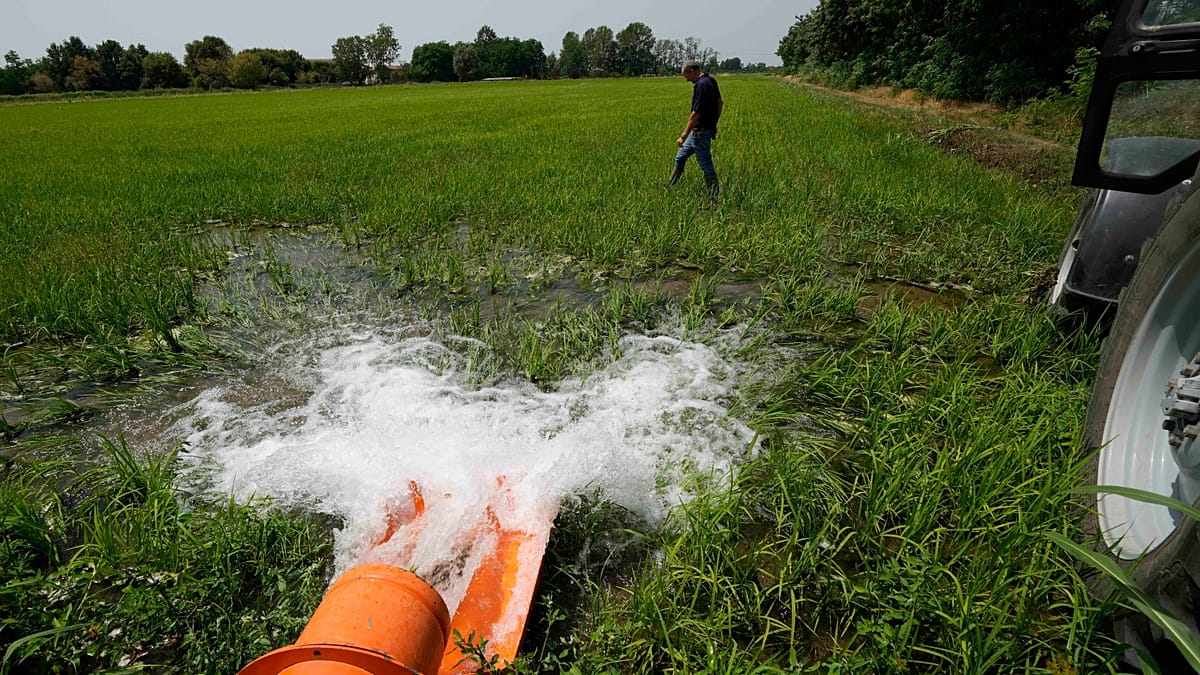
As droughts become more frequent and severe across Europe, the continent's aging water infrastructure is quietly undermining efforts to secure supply. Nearly a quarter of the water that is treated and pumped into the network never reaches a tap, lost to leaks in pipes that in many cases date back to the post-war reconstruction era.
According to Water Europe, a Brussels-based research and innovation platform, the bloc loses on average 23 percent of its non-revenue water (NRW)—water that is extracted, treated, and distributed but never billed. The figures vary widely: the Netherlands loses only 6 percent, while Bulgaria loses 45 percent. Such inefficiencies force utilities into costly reactive repairs and worsen the impact of droughts.
In 2024, monitoring by the Finnish company Smartvatten found that 67 percent of EU properties surveyed had leaks, losing 772 million litres—enough to fill 300 Olympic swimming pools—at a cost of over €3 million. In 2025, of 19.3 billion litres monitored, 1.47 billion (equivalent to 9.8 million bathtubs) were lost to leaks.
Out of sight, out of mind
Europe's water networks are extensive—4.4 million kilometres of drinking water pipes and 2.6 million kilometres of sewers—but much of this infrastructure is old and deteriorating. Temperature shifts, ground movement, and water chemistry have weakened pipes, leading to failures. Yet the problem is often ignored because it is hidden underground.
“Much of Europe’s water infrastructure is underground, so it remains politically and publicly invisible until something fails,” said Durk Krol, Executive Director of Water Europe. “Pipes are also long-lived assets, often expected to remain in service for many decades, while tariffs and public budgets have not always covered the full cost of operating, maintaining and renewing them.”
Hildegard Bentele, a German MEP from the European People's Party and chair of the Parliament's Water Group, argues that the root cause is a long-standing failure to value water. “Water was not previously considered a strategic priority—an issue that the Water Resilience Strategy is now addressing,” she said.
That neglect is now compounding the effects of climate change. “Droughts are principally driven by prolonged rainfall deficits and higher temperatures. But leaks reduce the amount of usable water available, making the effects of droughts more severe and causing them to translate into water scarcity more quickly,” Krol warned.
Investment is rising, but still falls short
The latest EurEau report, due in 2026, shows a slight improvement: water losses have dropped to about 23.5 percent, down from 24 percent in the 2021 report. Utilities now invest around €36.6 billion annually in infrastructure, a 17.5 percent increase from 2021. That works out to just €82.38 per person per year.
Despite the increase, member states still face maintenance backlogs, competing priorities, poor cost recovery, and limited project capacity, according to Krol. Low tariffs—as low as €1.5 per cubic metre in Romania—make it harder to fund necessary upgrades. Bentele notes that water pricing is politically sensitive because water is a human right, but “keeping tariffs artificially low can defer necessary investment and transfer higher costs and risks to future users.”
Fragmentation adds another layer of difficulty. Germany and France each have more than 5,000 water providers, many of which are too small to finance major projects alone. Krol suggests that regional cooperation, shared services, and common data systems could help smaller utilities pool resources and expertise.
The question of who should pay now is central. For Krol, the answer is not simply higher bills but recognising water's true value to the economy, health, and energy security. “This involves using tariffs, taxes, and public funding in infrastructure, industrial, and investment decisions to ensure reliable services and protect vulnerable households,” he said.
AI makes the invisible visible
Digitalisation offers a practical path forward. The core benefit, according to Krol, is that “digitalisation can make invisible losses visible.” Leaks are often subtle and continuous, and their cost accumulates precisely because they go unnoticed.
Real-time leak-detection systems can flag failures as they happen. Acoustic monitoring listens for the sound of escaping water underground. AI-powered pressure management automatically adjusts pipe pressure to reduce bursts, while district metered areas (DMAs) divide networks into smaller zones to pinpoint leaks more precisely.
AI also helps utilities prepare for droughts. “AI can improve drought preparedness by combining satellite observations with data from weather stations, ground sensors, groundwater monitoring and reservoirs. It can provide probabilistic warnings weeks or, under suitable conditions, months ahead,” Krol said.
To unlock the full potential of AI, Water Europe advocates for an EU-wide Digital Single Market for Water Data and Water Operations. This would create a “trusted single source of truth at river-basin level,” Krol explained, without centralising everything in one database. A federated system connecting reliable data held by different organisations would allow authorities, utilities, and businesses to work from consistent information.
But digitalisation is not without risks. Bentele warns that water utilities are critical infrastructure and must be protected against cyberattacks and algorithmic bias. “Digitalisation undoubtedly offers significant opportunities, but it also brings certain risks,” she said.
The potential savings are substantial. Water Europe estimates that AI-driven upgrades could generate around €3 billion in annual savings and create more than 13,000 jobs across the continent. The exact impact depends on each network's condition, but the direction is clear: embracing digital tools is essential if Europe is to plug its leaks and secure water for the future.