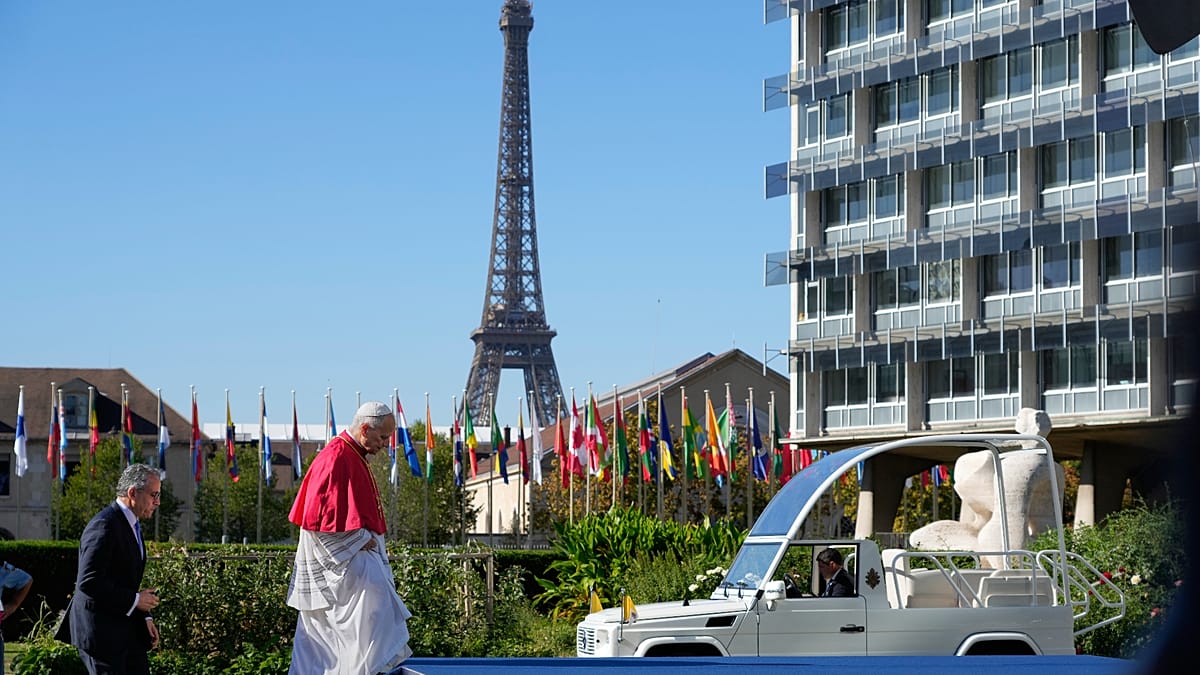
Speaking at UNESCO's headquarters in Paris on Friday, Pope Leo XIV issued a stark warning about the trajectory of artificial intelligence, insisting that new technologies must remain at the service of the human person rather than mutate into "yet another instrument of domination and injustice." The address, delivered in both French and English, formed the centerpiece of the pontiff's four-day visit to France.
The Pope argued that AI risks impoverishing human "ideas and relationships" through a "process of dehumanisation," and he took aim at the growing emphasis on productivity in modern societies. Judging people by the "criterion of efficiency," he said, undermines respect for human dignity and leads to the rejection of "those who are no longer productive."
Artificial intelligence has become a defining theme of Leo XIV's pontificate. In May, he published his first encyclical, Magnifica humanitas, a 42,300-word document that examined the dangers of unchecked AI and called for stronger regulatory oversight. Friday's speech reinforced that message, stressing the need for safeguards to protect children, whose "vulnerability" must "never become an opportunity for exploitation."
European policymakers have been wrestling with how to shield minors online, with measures such as school phone bans already in place in several member states. The European Commission has proposed the Kids Act, which could restrict social media access for children under 13, a proposal that is gaining increasing attention in Brussels and national capitals.
War and the limits of scientific progress
The Pope also turned to the subject of war, invoking UNESCO's motto that "since wars begin in the minds of women and men, it is in the minds of women and men that the defences of peace must be constructed." His remarks come as conflicts rage in the Middle East and Russia continues its full-scale invasion of Ukraine.
"Humanity has come to realise that scientific progress, when it's severed from wisdom, can turn into a weapon of destruction," the pontiff declared. He reflected on the mixed reputation of international institutions, which are seen both as bodies tackling challenges that "no single state can face alone" and as organizations "undergoing a crisis of effectiveness, especially when dialogue is seen as an obstacle to action."
In response, he called for greater "trust" — trust that differences do not necessarily pose a threat, and that "sincere dialogue can bring about a greater good than what each person could achieve alone." The appeal lands at a time of growing strain on multilateral cooperation. In July 2025, the Trump administration announced the United States would withdraw from UNESCO, branding the organization as "woke" and "out-of-step" with American voters; the exit is set to take effect in December 2026.
A morning at the Élysée
Earlier in the day, French President Emmanuel Macron welcomed the Pope to the Élysée Palace, alongside diplomats, firefighters who had intervened during the Notre-Dame-de-Paris blaze, and representatives of various religious communities. In his address, the pontiff reaffirmed the human right to life as "the indispensable foundation to every other human right," a point that carries particular weight in France, where the right to abortion was enshrined in the constitution in 2024 and a controversial assisted-dying law was passed earlier this year.
The Pope also reiterated the Vatican's staunch opposition to nuclear weapons, condemning the "mistaken belief" that nuclear deterrents offer viable solutions to global security challenges. His comments echo concerns raised by other European leaders about the risks of an escalating arms race, particularly in light of recent warnings about Russian drone activity near southern Europe.
Leo XIV's visit to Paris underscores the Vatican's growing engagement with technology policy, a field where the European Union is already a major regulator. The Pope's call for human-centered AI aligns with the bloc's efforts to pass the AI Act, though critics argue that enforcement remains uneven across member states. As the continent navigates the digital transition, the pontiff's message serves as a reminder that innovation must be anchored in ethical principles, not just economic efficiency.