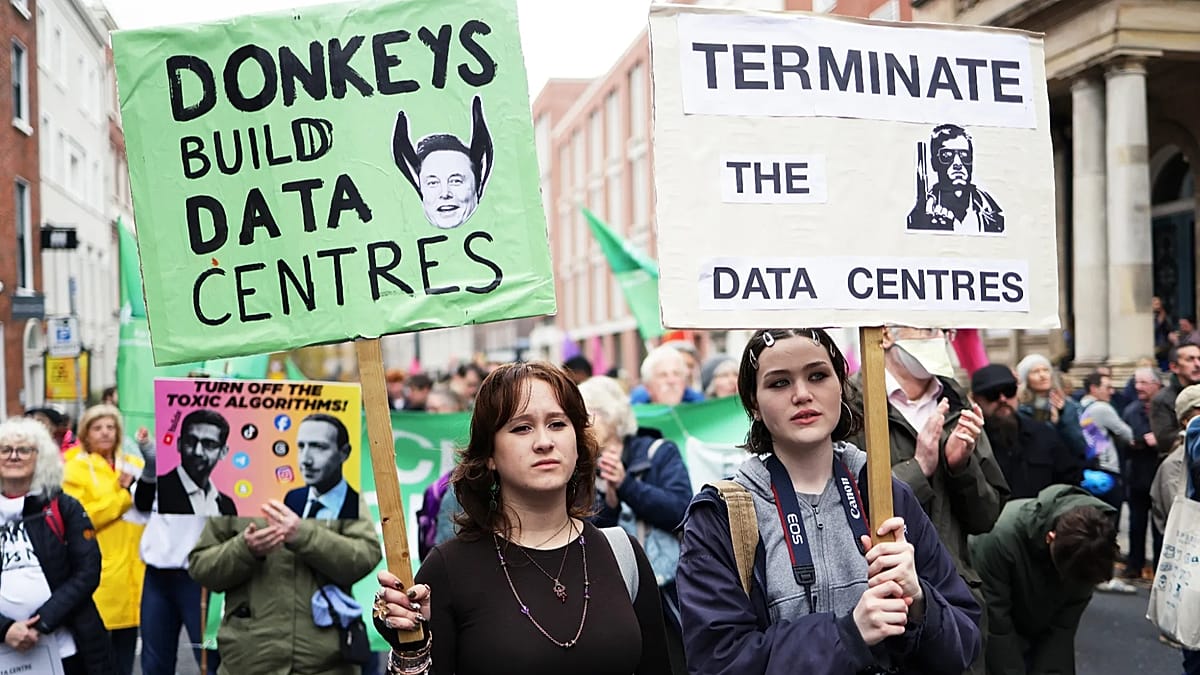
Brussels has set its sights on tripling Europe's data centre capacity within the next five to seven years, a move designed to bolster the continent's own artificial intelligence capabilities and lessen its dependence on American tech giants. Yet this ambition is colliding with grassroots opposition from Dublin to Warsaw, where residents and environmental campaigners are taking to the streets to demand a moratorium on new projects.
Protests have erupted in Ireland, Poland, Denmark, Finland, Spain, the Netherlands, France, and the United Kingdom. The concerns are concrete: data centres are voracious consumers of electricity and water, and they occupy land that could otherwise be used for housing or agriculture. In Ireland, where data centres already account for a significant share of national electricity demand, the strain on the grid has become a political flashpoint.
“They're really concerned about the impact on land, on water, the huge energy use that data centres demand, as well as the impact that that energy use could take away from housing,” said Owen Espley, coordinator of Stop Dirty Data Centres.eu, in an interview with Euronews Verify.
Industry representatives counter that data centres are essential infrastructure for the digital economy and that modern facilities are increasingly efficient. Michael Winterson, secretary general of the European Data Centre Association, argues that the sector is committed to sustainability and that the EU's climate goals can be met with the right investments in renewable energy and grid upgrades.
Climate neutrality vs. energy reality
The data centre debate is unfolding against the backdrop of the EU's broader pledge to become the world's first climate-neutral continent by 2050. EU ministers insist they remain committed to the green transition, even as energy prices soar and supply concerns persist. But voters are increasingly sceptical, and the political balance is delicate.
According to recent polling, 76% of people in the Netherlands, 72% in France, and 68% in Germany believe their country is unlikely to make meaningful progress towards net zero. In the Netherlands, 54% say environmental policies have left ordinary people worse off. These figures highlight the tension between long-term climate goals and immediate economic pressures.
Sven Haremling, head of climate at CAN Europe, told Euronews Verify that honesty is key. “People also appreciate it if they're told the truth and what needs to change, as long as there's someone who works with them for solutions and there are changes in government regulations,” he said.
The challenge for European policymakers is to reconcile the need for digital infrastructure with the imperative of a just transition. As the EU pushes ahead with its data centre expansion, it must also address the legitimate concerns of communities that fear being left behind. The outcome of this balancing act will shape not only the continent's digital future but also its credibility on climate action.
For more on the broader geopolitical context, see our coverage of Europe's role in Ukraine talks and the AI data centre boom.