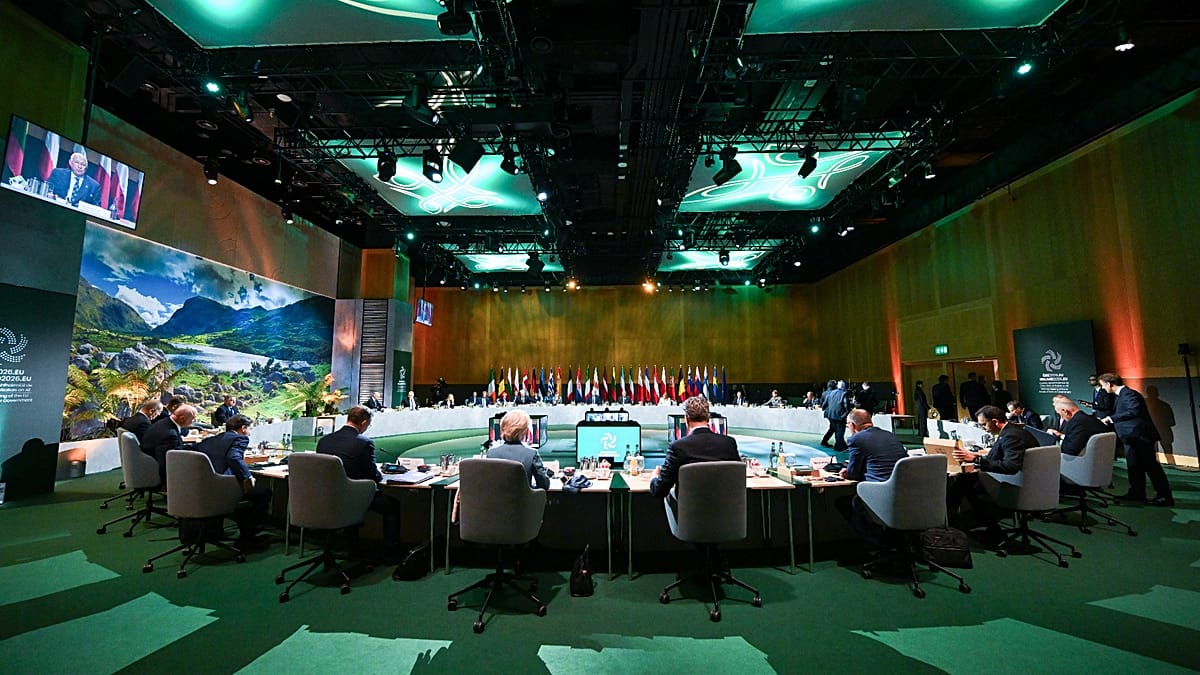
Foreign ministers from across the European Union are converging on Brussels today for a ministerial meeting ostensibly focused on continued support for Ukraine and the bloc's approach to the Middle East. But the formal agenda is likely to be overshadowed by the lingering question of who speaks for Europe in any future peace negotiations.
The meeting follows a week of shuttle diplomacy that took Swedish Foreign Minister Maria Malmer Stenergard from Abu Dhabi to Dublin and finally to the Belgian capital. Speaking to Europe Today, Stenergard said her conversations with Ukrainian counterpart Andrii Sybiha in Abu Dhabi had reinforced her conviction that Moscow is not serious about ending the war. "Russia is not interested in peace," she said. "We need to focus on what really matters."
For Stenergard, that means addressing the looming budgetary shortfall for Ukraine in 2027 and reviving the debate over the use of Russia's frozen assets. She expressed hope that the European Commission would soon present a proposal to move those assets out of Belgium, sharing the risk more fairly among member states. "I hope that if we have a concrete proposal, the EU member states would be ready for a new discussion on this," she said.
Who speaks for Europe?
The urgency of the envoy question was underscored by the US-Russia-Ukraine talks held in Abu Dhabi on 10-11 November, which produced little beyond a prisoner swap. European leaders have spent months trying to secure a seat at the table, but the biggest stumbling block has been agreeing on who should occupy it.
Ukrainian President Volodymyr Zelenskyy had set a tentative deadline of 19 November for his allies to decide on European representation, coinciding with a Berlin meeting of the Coalition of the Willing. After an informal European Council summit in Dublin on Friday, leaders settled on a seven-member team comprising France, Germany, the UK, Italy, Poland, the EU institutions, and NATO.
But Latvian Prime Minister Andris Kulbergs warned that the debate over an envoy was a distraction. "He wants us to talk about things which are not important," Kulbergs said, referring to Russian President Vladimir Putin. "We should discuss supporting Ukraine, finding ways to ensure they can survive the winter, and how the peace talks can be of their benefit."
His comments echo a sentiment gaining traction in Brussels: that the continent's focus should be on substance, not style. As one ambassador put it, "It's really important that we focus on the message and not on the person who represents Europe."
Estonian Foreign Minister Margus Tsahkna, whose country recently uncovered an alleged Russian sabotage plot against a defence company, stressed the need for continued support. "Nearly five years on, Putin is still making the demands he made in 2021, seeking to dictate Europe's security arrangements. We cannot allow him to gain through peace negotiations what he has failed to achieve on the battlefield," he wrote on X.
Beyond Ukraine: Middle East and enlargement
The ministerial meeting will also touch on the Middle East, with one diplomatic source expecting discussions on France's accusation that Iran was behind cyber attacks targeting European appliances. There is also interest in stepping up European engagement in Syria to support the political transition following the fall of Bashar al-Assad.
Meanwhile, the European Commission's EU Enlargement Forum kicks off today, with a line-up featuring EU officials and leaders from candidate countries including Ukraine, Albania, Montenegro, and Moldova. A notable participant is Serbia's Student List, making its Brussels debut in a public appearance that EU officials hope could improve relations with Belgrade.
The forum's opening concert, however, struck a sour note. Kosovo's Ambassador to Belgium, Agron Bajrami, complained online that the event featured a "Serbian nationalist song" titled 'Oh, Kosovo, Kosovo'. "The song advances explicit political claims over the territory of the Republic of Kosovo," he said, demanding an "immediate clarification" from the Commission and enlargement chief Marta Kos.
Looking ahead, the European Commission is expected to propose a new €45 billion support loan for Ukraine on Wednesday, covering two-thirds of the country's €70 billion shortfall for next year. The EU budget would provide the guarantee and cover annual interest, but the scheme would not involve Russian assets. At least four member states—Slovakia, Hungary, the Czech Republic, and Bulgaria—have signalled they want to opt out of the common borrowing, with Slovak Prime Minister Robert Fico seizing on the peace talks to question the approach.
As the debate over representation continues, the core challenge remains: ensuring that Europe's voice is heard in negotiations without losing sight of the urgent needs on the ground. The coming weeks will test whether the continent can move beyond the question of who sits at the table and focus on what it wants to achieve there.