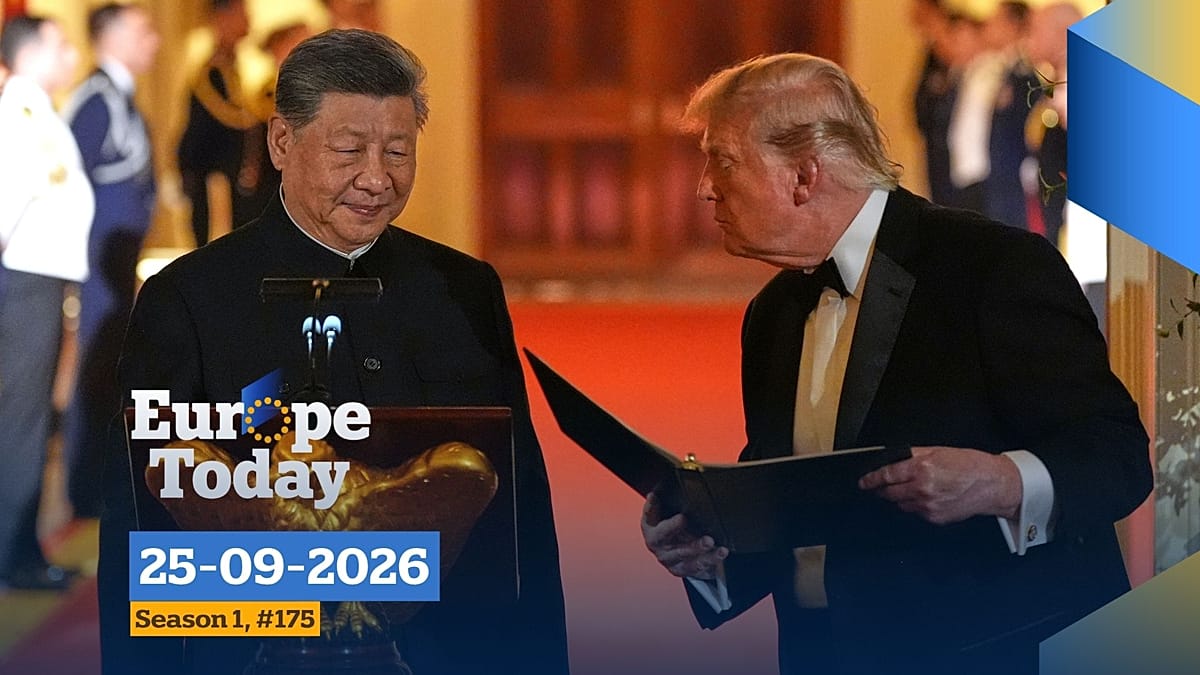
The meeting between US President Donald Trump and China’s leader Xi Jinping in Washington was followed closely across European capitals, where any meaningful agreement between the two superpowers is understood to have direct consequences for the European Union. The discussions, which touched on trade, technology, and security, were seen as a test of whether the transatlantic relationship can still influence the global balance.
EU Commissioner Stéphane Séjourné and Ian Lesser, a distinguished fellow at the German Marshall Fund of the United States, offered their assessments of the talks. Séjourné stressed that Europe must not be a bystander in US-China dynamics, while Lesser noted that the EU’s ability to shape outcomes depends on its internal cohesion. Their comments reflect a broader anxiety in Brussels about being sidelined in great-power negotiations.
Greenland deal eases tensions
In a separate development, Denmark and the United States have signed an agreement on Greenland, defusing a diplomatic crisis that had simmered for months. The deal came after President Trump’s threats to seize the Arctic territory by force, which had alarmed Copenhagen and other European allies. Danish Minister Martin Lidegaard, in an interview with our correspondent Lauren Walker, described the agreement as a pragmatic step that preserves Danish sovereignty while allowing for increased US engagement in the region.
“This is not about giving up anything,” Lidegaard said. “It’s about managing a complex relationship with our most important ally while protecting the interests of Greenlanders and the wider Arctic.” The deal is expected to include provisions for joint infrastructure projects and scientific cooperation, though details remain under wraps. European observers see it as a model for handling future US demands on European territories.
Ceuta migration surge
Meanwhile, the migration crisis at the Spanish enclave of Ceuta has returned to the forefront of European politics. A mass surge of migrants from Morocco has overwhelmed local facilities and reignited debates about border management and solidarity among EU member states. French far-right MEP Marion Maréchal, niece of Marine Le Pen, visited Ceuta and spoke with our reporter Maia de la Baume. Maréchal argued that the EU’s current approach is unsustainable and called for stricter external border controls.
“What we see in Ceuta is a preview of what will happen across Europe if we do not act decisively,” she said. Her visit underscores how the issue continues to polarize European politics, with southern member states bearing the brunt of arrivals while northern countries debate burden-sharing. The European Commission has proposed a new pact on migration, but divisions remain, as seen in clashes over 'Made in Europe' standards that reflect deeper disagreements on integration.
Pope Leo XIV in France
In a moment of symbolic importance, Pope Leo XIV has begun his first apostolic visit to France, a country that has historically been a challenging stage for the papacy. Our Paris correspondent Estelle Nilsson-Julien reports that the visit is an opportunity for the Pope to test his vision for the Church in a nation where secularism is deeply entrenched. The Pope is expected to address issues such as the decline in religious practice, the role of the Church in public life, and the need for dialogue with a largely secular society.
His itinerary includes meetings with President Emmanuel Macron at the Élysée Palace and a mass at Notre-Dame, which was rebuilt after the 2019 fire. The visit comes as the Church faces internal debates over reform, and observers will be watching for any signals about the direction of his papacy. For more on the visit, see our coverage of the Pope's French itinerary.
The convergence of these events—US-China talks, the Greenland deal, the Ceuta crisis, and the papal visit—highlights the interconnectedness of European concerns. From Arctic security to migration and religious diplomacy, Europe is navigating a complex landscape where external pressures and internal divisions shape its future. As the EU seeks to assert itself on the world stage, the coming weeks will test its ability to act collectively.
For now, European leaders are watching Washington and Beijing with a mix of hope and caution, aware that the outcomes of such summits will ripple across the Atlantic. Meanwhile, the Pope’s visit to France serves as a reminder that Europe’s cultural and spiritual dimensions remain as vital as its political and economic ones.