Keeping money in a bank account has a hidden cost, and new data from Revolut's European Wealth Drain Index puts a precise figure on it. The study, which surveyed 20,007 adults across 20 EU member states and combined official deposit and inflation data, finds that the average European loses €294 in purchasing power for every €10,000 held in savings. Across the continent, that adds up to €6.3 trillion sitting in low-yield deposits, a sum that Brussels is increasingly eyeing as a source of growth capital.
Deposit rates lag inflation
In 12 of the 20 markets studied, average one-year deposit rates fail to keep pace with inflation. Across the sample, deposits pay an average of 2.76% while inflation runs at 2.94%, meaning even savers who lock their money away are losing ground in real terms. The opportunity cost is even steeper: benchmarked against the MSCI Europe ETF's ten-year annualised return of 9.06%, households forgo an average of €638 per €10,000 each year by staying in cash. Scaled across the €6.3 trillion, that amounts to €422 billion annually that could be flowing into European businesses but isn't.
Why do savers remain so passive? The study points to three main factors. Two-thirds of Europeans have never switched banks for a better rate, with 26% saying they simply prefer their existing bank, 18% considering the difference negligible, and 15% not knowing where to look. Nearly half (46%) misjudge their inflation-adjusted returns, and 19% are unaware that inflation affects their cash at all. Over half use multiple financial apps, and among those, 45% say the fragmentation actively hinders investing. To make matters worse, one in five Europeans has no savings at all.
Inertia or intervention?
If inertia runs that deep, the obvious question is whether better products can overcome it or whether something more forceful is needed, such as the automatic enrolment used to lift pension participation. Rolandas Juteika, Revolut's head of wealth and trading, rejects that approach. "Forced enrolment doesn't tackle the root causes of inertia: perceived risk (29%) and a lack of knowledge (27%)," he told Euronews. "With our median first-time EU investment at just €18, we see firsthand that lowering the barrier to €1 naturally empowers consumers to act."
Revolut, which has more than 80 million customers, has a clear commercial interest in the answer, as it sells the investment products the research says Europeans should be using. The company reports that active EU retail investors on its platform grew 56% year on year. Among those who do not invest, the survey found perceived risk was the main barrier for 29% and a lack of knowledge for 27%.
Asked whether folding banking, savings and investing into a single app genuinely reduces fragmentation or simply moves it somewhere else, Juteika argued the difference is structural. Consolidating those functions "removes the administrative wall between a person's salary, savings and capital markets," he said.
A continent divided three ways
The regional patterns are stark. Central and eastern Europe faces the widest gaps between inflation and deposit rates, led by Bulgaria at 2.3%, Slovakia at 1.7% and Lithuania at 1.3%. Yet, appetite for investing small sums is highest there, with 51% in both Bulgaria and Romania willing to start. Western and southern Europe holds the largest piles of idle cash, with Germany at €1.9 trillion and France at €588 billion, and faces an opportunity gap of 6% to 7%. Northern Europe has deposit rates that broadly match inflation but the weakest awareness, with fewer than 40% of respondents in Denmark and Sweden understanding how inflation affects long-term wealth.
Brussels wants the same money moved
The findings land in the middle of a live political argument. Addressing French business leaders in Paris last month, European Commission President Ursula von der Leyen made almost identical points, framing idle deposits as a problem of European competitiveness rather than personal finance. "In Europe, there is no shortage of technology or savings," von der Leyen declared, adding that "there is still a shortage of capacity to scale up Europe's businesses." Companies that start in Europe too often leave to find funding, she added, shifting their centre of gravity or being bought outright.
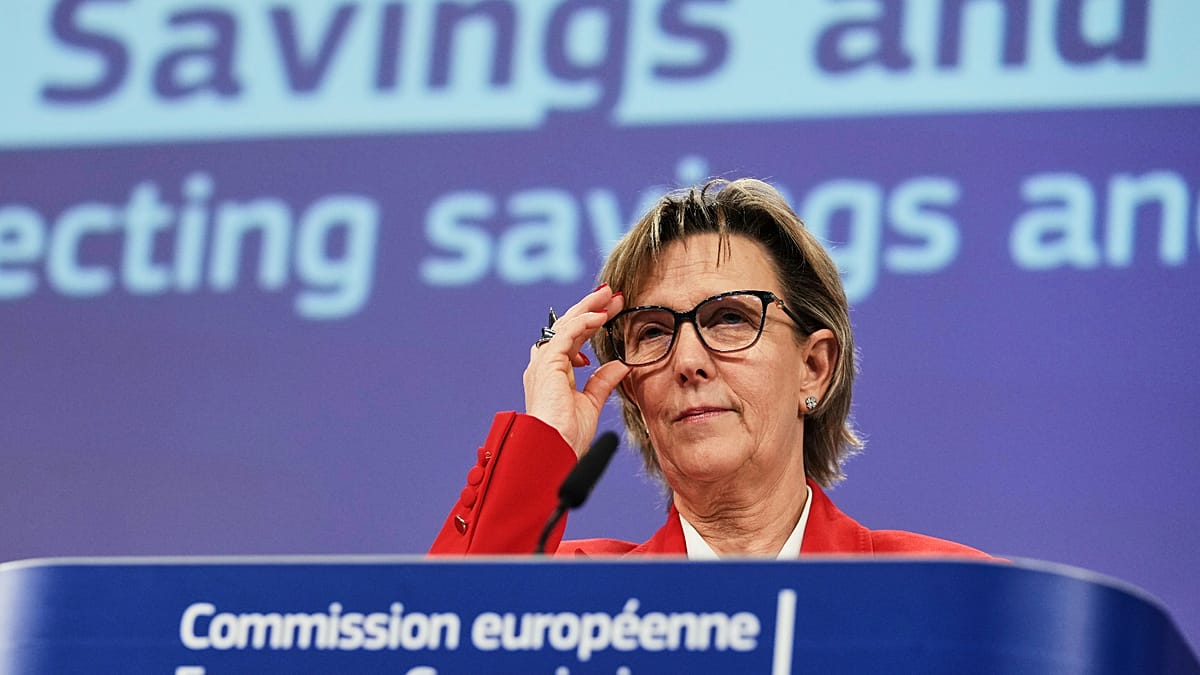
"Europe has savings. And unfortunately, those savings are sitting idle," she continued. "Today, €10 trillion in household savings are kept in bank accounts. And a large share of Europe's savings is invested outside our continent. Europe now needs to put these savings to work for its companies. This is the goal of the Savings and Investments Union."
The Commission's €10 trillion and Revolut's €6.3 trillion measure different things. The Commission figure covers household savings held in bank accounts across the whole EU, while Revolut counts only liquid deposits in the 20 markets it surveyed, which excludes seven member states.
The arithmetic behind Brussels' interest is straightforward. The Draghi report put Europe's additional investment needs at €750 billion to €800 billion a year by 2030 to fund digitalisation, energy, defence and infrastructure, a sum member states cannot raise through borrowing. Public debt stood at 82.9% of EU GDP in the first quarter of this year and 88.9% across the eurozone, according to Eurostat. If the money is not going to come from governments, it has to come from somewhere else.
The Savings and Investments Union, adopted as a strategy in March 2025 and overseen by Financial Services Commissioner Maria Luís Albuquerque, is the vehicle. It is not a mechanism for touching anyone's deposits, and confers no power to do so. Instead it works through incentives and plumbing with a recommendation on savings and investment accounts giving member states a template to encourage long-term investing. The broader push also ties into other EU efforts to ease household financial pressures, such as repair rules aimed at cutting appliance waste and saving consumers money.
For now, the gap between where European savings sit and where Brussels wants them to go remains wide. Whether the answer is better products, better education, or a nudge from policymakers, the cost of doing nothing is becoming harder to ignore.