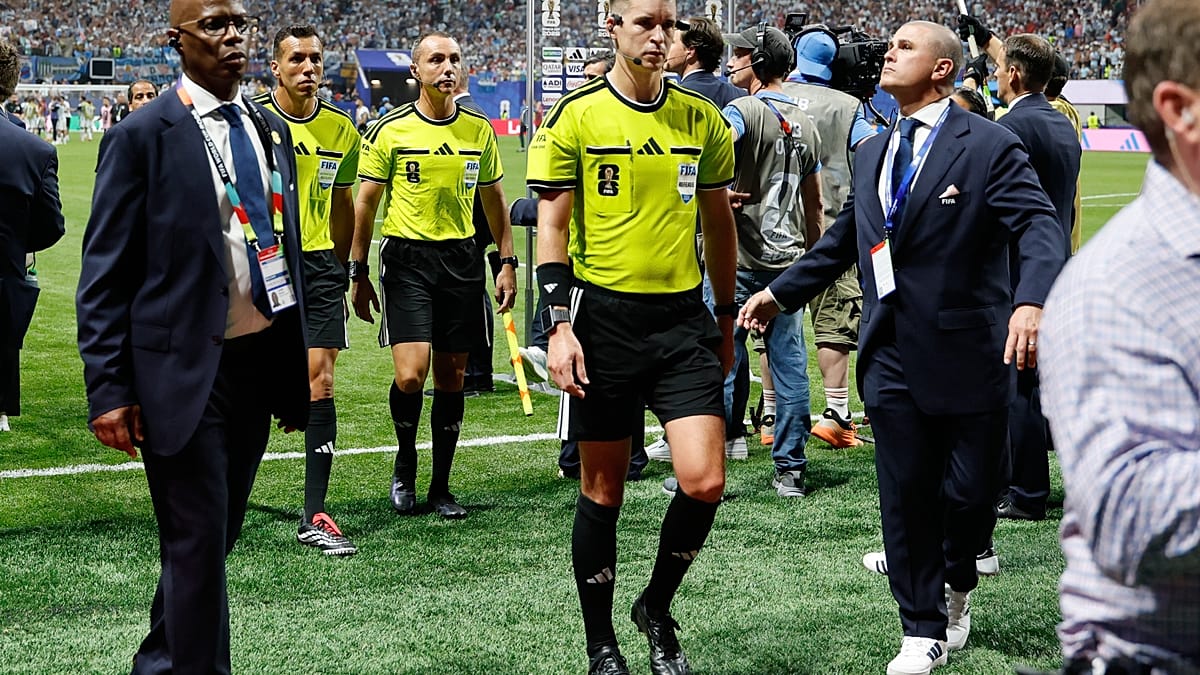
As the 2026 FIFA World Cup progresses, misinformation from earlier rounds continues to circulate online. Following Egypt's elimination on 7 July, a wave of unsupported social media posts targeted French referee François Letexier, who officiated their round-of-16 match against Argentina.
The match ended 3-2 in Argentina's favour, with Egypt initially leading 2-0 before a comeback. Controversial decisions included a disallowed Egyptian goal after VAR penalised midfielder Marwan Attia for stepping on Lisandro Martínez's foot, and a perceived foul on Mohamed Salah in the penalty area just before Argentina's winning goal. Egypt's Football Association filed a formal complaint with FIFA, accusing Letexier and his team of serious refereeing errors and calling for his removal from the tournament.
Criticism quickly escalated into conspiracy theories online. Some users claimed, without evidence, that Letexier's alleged Jewish background indicated Israeli influence on the match outcome. Others argued FIFA had manipulated the tournament in Argentina's favour. These narratives gained traction through manipulated screenshots of Letexier's Wikipedia page.
Wikipedia Edits as Misinformation Tools
Posts on X and TikTok shared screenshots showing that Letexier's Wikipedia page had been edited to claim he was born into an Orthodox Jewish family in Bédée, Brittany. The edit, added on 8 July, referenced an article from French magazine Le Point. However, that article focuses solely on Letexier's refereeing career and contains no mention of his religion, ethnicity, or family background. No reliable reporting supports this claim.
Other temporary edits falsely stated Letexier had been paid by Argentina and FIFA, and that the match was bought. These edits were quickly removed, but screenshots taken before deletion gave them a veneer of credibility, allowing them to spread widely.
Beyond Wikipedia, a post with over two million views claimed authorities investigated Letexier's bank account and found a mysterious payment of more than $500,000 before the match. These posts, circulating in French, Spanish, and English, provided no sources. The Cube found no corresponding announcement from FIFA, French authorities, or any established news organisation.
Another viral claim asserted Letexier had been removed from the tournament following Egypt's complaint. FIFA confirmed receiving the complaint but has not announced any investigation into Letexier or his team.
FIFA's head of referees, Pierluigi Collina, defended the officials, stating: 'Constructive discussion about decisions will always be part of football, but unfounded allegations have no place in our sport. Nobody can question the integrity of the FIFA World Cup match officials.'
These allegations are part of a broader pattern of online conspiracy theories claiming FIFA is biased toward Argentina, often citing inconsistent rule application. However, no evidence supports these claims against Letexier. For more on how misinformation spreads in European contexts, see our fact-check on viral claims about the European Parliament demanding a FIFA probe.
The incident underscores how easily manipulated platforms like Wikipedia can be weaponised to spread falsehoods, particularly in high-stakes sporting events. As the World Cup continues, readers are urged to verify claims through official sources and reliable reporting.