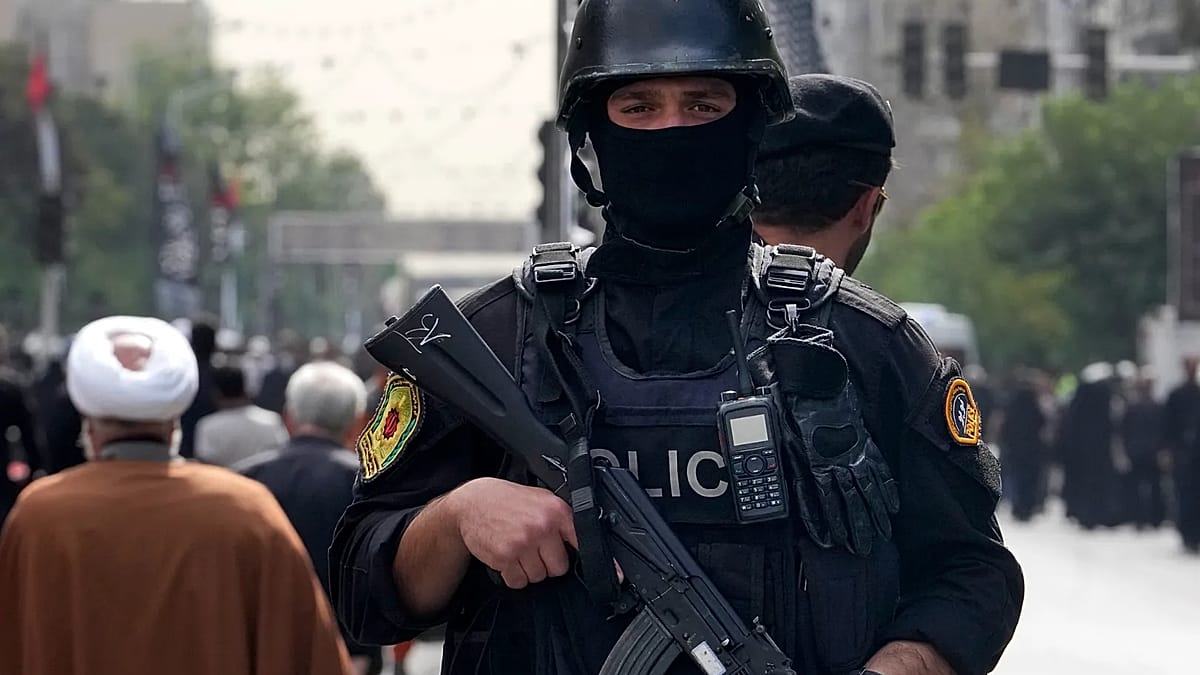
Iran executed a man convicted of setting fire to a government building during the January 2026 protests, the judiciary's Mizan news agency reported on Wednesday. Mohammad Amini Dehaghani was hanged after the Supreme Court upheld his death sentence, marking the latest in a series of executions linked to the wave of unrest that has left thousands dead.
The judiciary said Amini Dehaghani threw a Molotov cocktail at the governor's office in Dehaghan, Isfahan province, on 9 January 2026, set the building on fire, attacked a police station, blocked roads, and damaged public property. Investigators cited CCTV footage and what they described as the defendant's confessions as evidence. He was also accused of distributing anti-government propaganda, contacting social media accounts linked to the Pahlavi royal family, and communicating with anti-government activists online.
He was sentenced to death on charges of moharebeh — a legal category meaning "waging war against God" — and efsad-e fel-arz, or "corruption on Earth." The charges included allegations that he used a Kalashnikov rifle allegedly taken from security forces during what Iranian state media call the "Dey Coup Attempt," a term used by authorities to describe the January protests.
Escalating Crackdown Amid Disputed Death Toll
Large-scale protests sparked by sudden hyperinflation in December 2025 spread across the country the following month, prompting a bloody crackdown by the Tehran regime. The death toll remains impossible to independently verify. Iranian authorities have put the figure at 3,117, while the rights group HRANA says it has verified 7,007 dead. Unofficial, unconfirmed estimates have gone as high as 40,000.
Human rights organisations have repeatedly said defendants in protest-related cases are tried in opaque proceedings, often without access to independent legal representation, and that convictions frequently rest on confessions allegedly extracted under torture. Amnesty International said Iranian authorities were using "wartime conditions" as a pretext to intensify their crackdown through mass arrests, accelerated trials, politically motivated executions, and asset confiscations.
The United Nations said earlier this year that Iran had executed at least 40 people in the first half of 2026, including 18 in cases related to national security. The execution of Amini Dehaghani is the latest in a series of state-sanctioned killings that have drawn international condemnation.
For European observers, the situation in Iran underscores broader concerns about human rights and the rule of law. While the European Union has imposed sanctions on Iranian officials over the crackdown, the bloc's ability to influence Tehran's behaviour remains limited. The ongoing unrest and executions also highlight the risks for European companies and investors operating in Iran, particularly in sectors such as mining and energy, where ties to the regime can become controversial. For instance, Israeli mining giant ICL faces protests in Catalonia over white phosphorus ties, illustrating how corporate links to conflict zones can spark public backlash in Europe.
The Iranian regime's use of capital punishment as a tool of political repression has also drawn comparisons to other authoritarian states. As Europe grapples with its own debates over free speech and protest, the case of Amini Dehaghani serves as a stark reminder of the stakes involved. In the UK, for example, Tommy Robinson's Oxford Union appearance sparked protests and free speech debate, highlighting the delicate balance between expression and security.
Meanwhile, the international community continues to monitor Iran's human rights record. The European Parliament has passed resolutions condemning the crackdown, but concrete action remains elusive. As the death toll mounts, the need for a coordinated European response becomes ever more pressing.