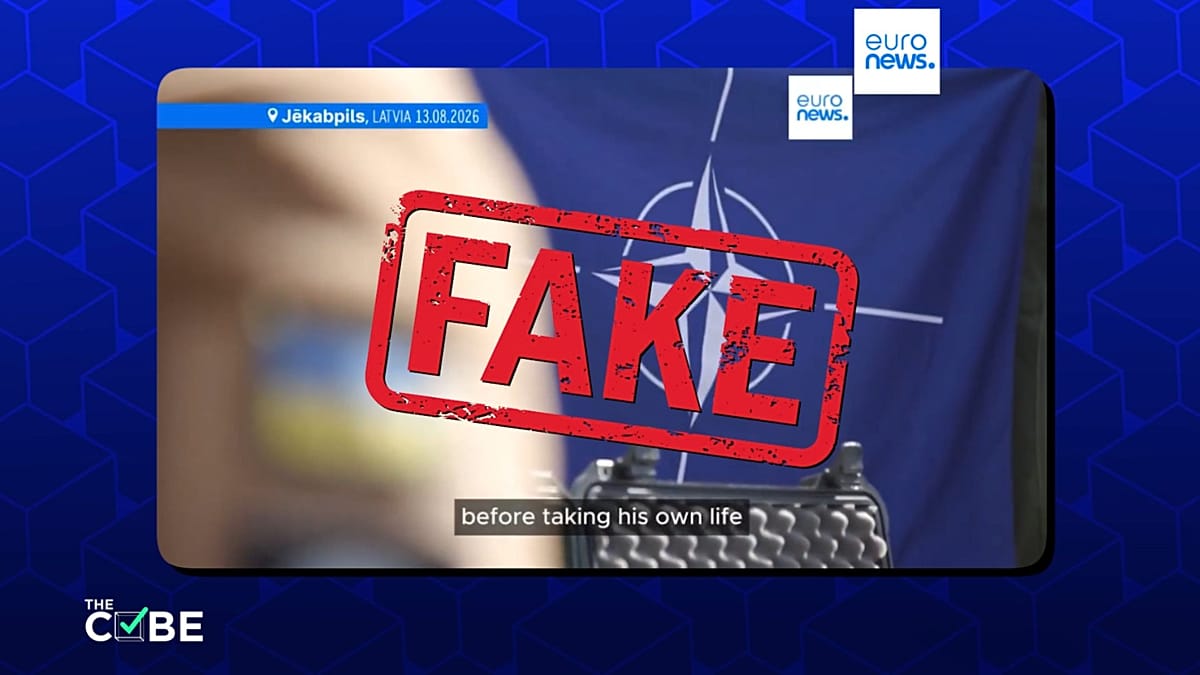
A fabricated video mimicking Euronews has been circulating online, falsely alleging that a Ukrainian soldier shot and killed three NATO servicemen during a military exercise in Latvia. The clip, which gained over two million views on X, uses Euronews' name and visual style to lend credibility to the invented story.
The video claims that a soldier opened fire during NATO's Baltic Trust 2026 exercise, killing three servicemen before taking his own life. However, no such shooting occurred, and the video was not produced or published by Euronews. A search of Euronews' official website and social media channels found no corresponding report, and no credible news coverage of the alleged deaths exists.
Genuine details mixed with fiction
The fabricated report incorporates a real element: NATO's Baltic Trust exercise, which took place in Riga, Latvia, from 3 to 14 August. The exercise focused on training and testing technology for detecting and countering unmanned aircraft systems, or drones.
Latvia's National Armed Forces explicitly denied the alleged shooting after the fake video gained traction online. In a statement published on its official X account on 14 August, the military said: "Such an incident has not occurred, and the exercises are taking place without incident."
The statement further described the video as part of a "coordinated disinformation campaign," adding the hashtag #RussiaAlwaysLies. This is not the first time Euronews' identity has been exploited in Russian-linked disinformation efforts, many of which target Ukrainians.
During the Milan-Cortina Winter Olympics, a series of doctored Euronews videos falsely accused Ukrainian refugees and athletes of criminal or antisocial behaviour. One video, viewed more than 114,000 times on X, falsely claimed that Ukrainian refugees had robbed a Euronews crew covering the Games. Another alleged that Ukrainian supporters vandalised cultural sites in Milan following the disqualification of skeleton athlete Vladyslav Heraskevych.
In a separate case, doctored clips shared by a pro-Russian Telegram channel used apparent AI-generated voiceovers based on the voices of real Euronews journalists. One manipulated report claimed that European pension systems were suffering because of government spending on Ukrainian refugees.
The spread of such disinformation underscores the ongoing challenges posed by fake news, particularly in the context of the war in Ukraine. As European nations continue to support Ukraine, including through sanctions against Russia, the need for media literacy and vigilance against manipulated content becomes ever more critical.
Euronews has not commented on the latest fake video, but the incident highlights the importance of verifying information from official sources. For those seeking reliable news, it is advisable to check multiple outlets and be wary of content that appears to come from established media but is not published on their official platforms.