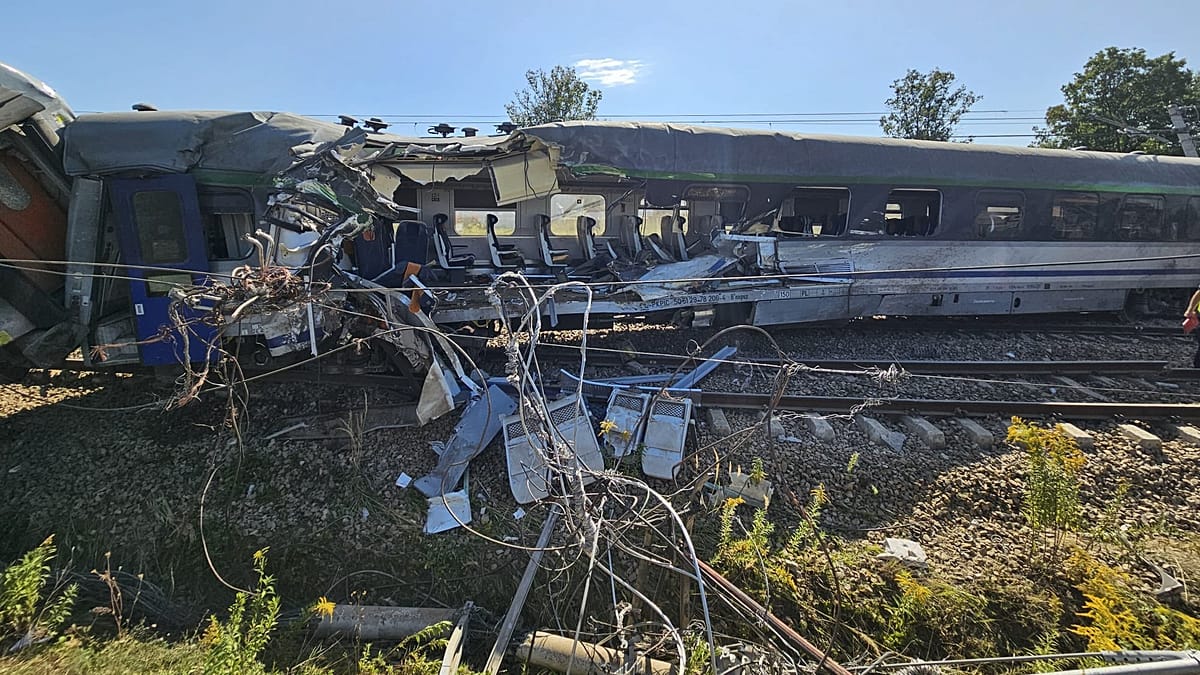
A passenger train collided with a truck at a level crossing near Sokolniki Suche, about 60 kilometres east of Warsaw, on Tuesday, killing one person and injuring 20 others. The impact derailed six carriages and the locomotive, according to police.
The train, operated by PKP Intercity, was carrying 120 passengers when it struck the truck shortly before noon. Emergency services, including air ambulances, were dispatched to the scene. Karolina Jaworska, a press officer for the Warsaw State Fire Service, confirmed the death of a female passenger. “We know of four people who were seriously injured, one of whom has died. The injured include the train driver, the truck driver and two passengers,” she told Euronews.
Eight people with minor injuries were taken to hospital. “A medical triage of the injured was carried out. Four people were handed over to emergency medical teams, including two who were transported by air ambulance helicopters,” the fire service said in a statement.
Rescue and investigation underway
PKP, Poland's railway infrastructure operator, said in a statement that “emergency services and railway representatives are working at the scene. Adam Wawrzyniak, a member of the PKP Intercity Management Board, has also travelled to the site. Replacement transport is being arranged for passengers, with three buses ordered.” The company added that PKP Intercity tickets would be accepted on ŁKA and Polregio trains on designated routes.
Train services on the line have been suspended while investigators work to determine the causes and exact circumstances of the accident. The level crossing, which is equipped with barriers and warning lights, is at the centre of the inquiry.
Polish Prime Minister Donald Tusk reacted swiftly, vowing to tighten regulations for drivers who ignore crossing signals. “We will begin work on tightening regulations for those who enter level crossings despite barriers and red lights. This has to stop,” he said.
The incident has reignited concerns about rail safety in Poland, where level-crossing collisions remain a persistent problem. According to the Polish railway office, dozens of such accidents occur each year, often with serious consequences.
This is not the first recent disruption on Poland's rail network. In May, a drone factory fire in the country was investigated for possible sabotage, highlighting broader security concerns around critical infrastructure.
For European travellers, the accident serves as a reminder of the importance of rail safety. While Poland has invested heavily in modernising its rail network, including new rolling stock and upgraded lines, level crossings remain a vulnerable point. A recent live map tracking trains across France, Spain and Belgium shows how such incidents can disrupt cross-border services.
The Polish government's pledge to review crossing regulations is likely to be welcomed by rail safety advocates. However, experts note that enforcement and driver education are equally crucial. As Tusk indicated, the focus will be on preventing drivers from circumventing barriers and signals.
Meanwhile, the injured are receiving medical care, and the families of the deceased have been informed. The investigation is ongoing, and further details are expected in the coming days.