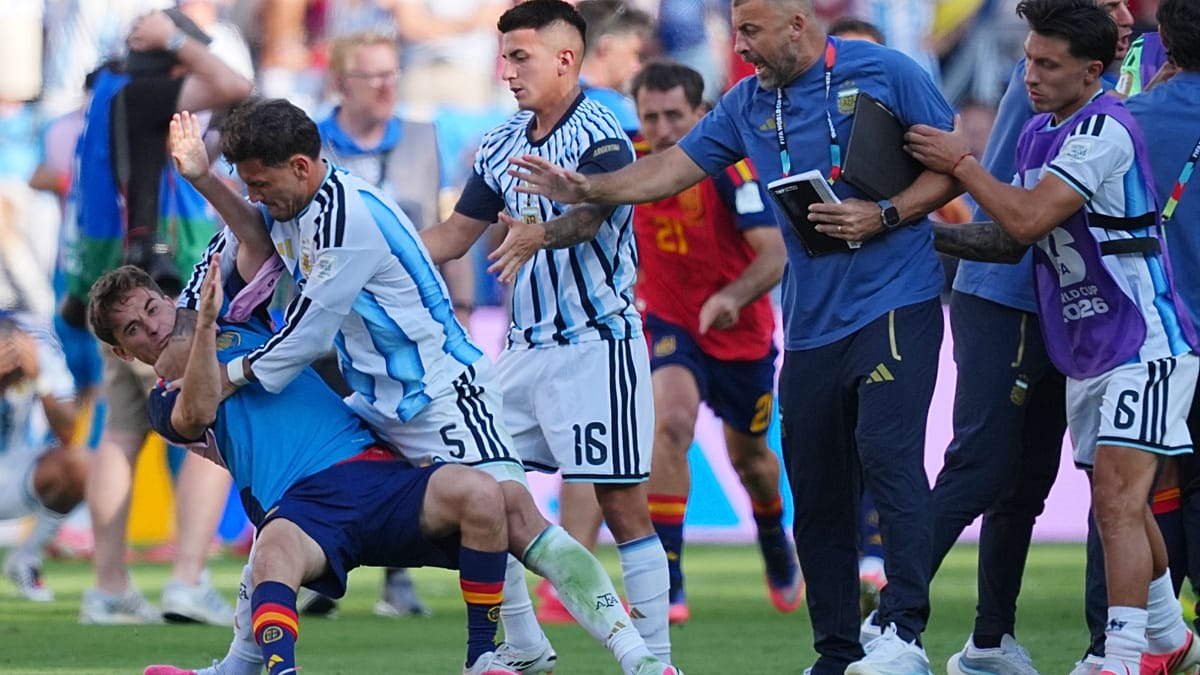
FIFA has imposed heavy sanctions on three Argentina players following the violent scenes that marred the World Cup final in July. Midfielder Leandro Paredes received a 10-match suspension, one of the harshest penalties in the tournament's history, for grabbing Spain's Eric Garcia by the throat and pushing Gavi to the ground moments after Argentina's defeat.
The ban, which effectively rules Paredes out of international football for a year given the sparse national-team calendar, is comparable to the four-month suspension handed to Uruguay's Luis Suarez in 2014 for biting Italy's Giorgio Chiellini. Argentina defender Nahuel Molina was given a seven-game ban, while Thiago Almada received a one-game suspension. FIFA also fined Paredes and Molina €76,000 each, and Almada €25,000.
Spain's Gavi, who was involved in the altercation, was banned for one match, which will see him miss the Nations League clash against England at Wembley on 26 September. Argentina's assistant coach Roberto Ayala was also suspended for three games and fined €25,000.
Federation fined for multiple offences
The Argentine Football Association (AFA) was fined €94,000 for a range of incidents during the tournament, including players displaying a political banner referencing the Falkland Islands after the semifinal win over England, and discriminatory chants from fans. FIFA also ordered the federation to spend €85,500 on anti-racism initiatives. Argentina received €29 million in prize money from FIFA for reaching the final.
The sanctions come after FIFA charged the on-field clashes as assault cases. The final itself was a tense affair, with Argentina largely outplayed by Spain and creating few clear chances. The post-match violence overshadowed what was otherwise a dominant performance by the Spanish side, who lifted the trophy in a match that will be remembered for both their football and the ugly scenes that followed.
The AFA can appeal the longer bans and fines to FIFA, and likely later to the Court of Arbitration for Sport in Lausanne. Such appeals are common in high-profile disciplinary cases, and the federation may argue that the punishments are disproportionate.
This is not the first time Argentina has faced disciplinary action at a World Cup. In 2014, the team was fined for a similar political banner, and the federation has a history of clashes with FIFA over player conduct. The latest sanctions highlight the governing body's determination to crack down on on-field violence and political statements, even as it faces criticism over its own governance and human rights record.
The 10-match ban for Paredes is particularly significant because it sidelines him for all of Argentina's upcoming fixtures, which are likely to be friendlies. With no competitive matches scheduled until the next World Cup cycle, the suspension effectively removes him from the squad for a year, a severe blow for a player who was a regular under coach Lionel Scaloni.
For Spain, the focus now shifts to their Nations League campaign, with Gavi's absence a notable loss for the midfield. The young Barcelona star has become a key figure for the national team, and his ban adds to the challenges facing coach Luis de la Fuente as he looks to build on the World Cup triumph.
The incident has also reignited debate about the pressures of international football and the need for stricter measures to prevent such outbreaks. While FIFA's sanctions are among the toughest in World Cup history, some observers argue that more needs to be done to address the root causes of player frustration and aggression in high-stakes matches.
As the dust settles, the focus will be on whether the AFA appeals and how the bans affect Argentina's preparations for future tournaments. For now, the message from FIFA is clear: violence and political gestures on the pitch will not be tolerated.