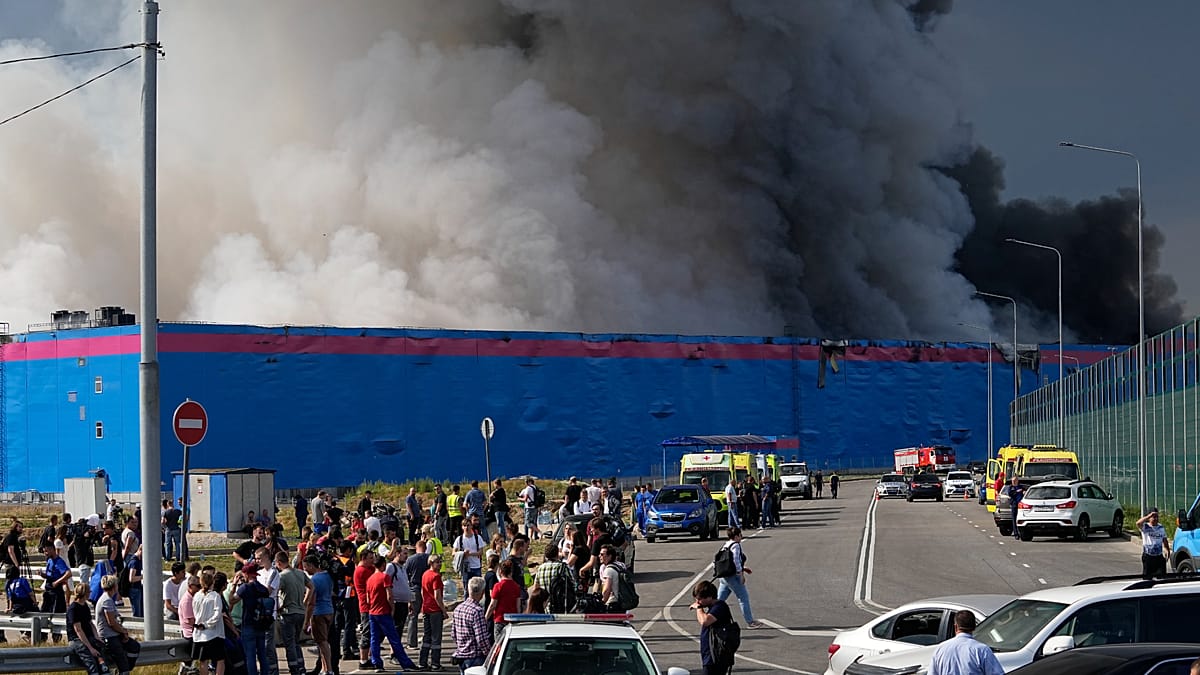
Fire crews spent hours containing a blaze at a logistics complex on the outskirts of St Petersburg on Wednesday, in an incident that Ukrainian officials linked to their expanding campaign against Russian e-commerce infrastructure. The fire broke out in a warehouse adjacent to a distribution centre operated by Ozon, one of Russia's largest online retailers.
Videos circulating on social media showed thick black smoke rising above the facility, located in the industrial zone of Shushary, about 20 kilometres south of the city centre. Local emergency services said no casualties were reported, but the scale of the fire forced road closures and disrupted rail freight in the area.
Ukraine's military intelligence has not officially claimed responsibility for this specific incident, but a statement from the defence ministry in Kyiv said the operation was part of a broader effort to degrade Russia's logistics networks. The ministry noted that e-commerce hubs are being used to store military supplies, including drones and electronic components, alongside civilian goods.
Expanding the drone campaign
The St Petersburg fire comes days after Ukraine announced it was widening its long-range drone strikes to target Ozon and other Russian online retail warehouses. Kyiv argues that these facilities have become integral to Moscow's war effort, serving as staging points for equipment and spare parts.
Ozon, which operates a network of fulfilment centres across Russia, has seen several of its sites hit in recent weeks. The company has not commented on the latest incident, but earlier this month it reported temporary disruptions at some of its sorting hubs due to what it called "external factors".
Military analysts say the strikes are designed to pressure the Russian economy and complicate supply chains, while also sending a message to businesses that support the Kremlin's war machine. "These are legitimate targets under the laws of armed conflict," said Dr. Elena Kovtun, a defence researcher at the Estonian Foreign Policy Institute in Tallinn. "They are being used for military purposes, even if they also serve civilian customers."
The campaign has drawn criticism from some human rights groups, who warn that attacks on dual-use infrastructure risk harming civilians. However, Ukrainian officials insist they are taking precautions to minimise collateral damage.
In a related development, Ukraine's drone strategy against Ozon has been discussed in Brussels, where EU diplomats are weighing further sanctions on Russian logistics firms. The European Union has already imposed restrictions on several companies linked to the Russian defence sector, but e-commerce operators have so far escaped direct measures.
The fire near St Petersburg also coincides with heightened diplomatic activity around Ukraine's independence anniversary. European leaders gathered in Kyiv to show solidarity, while the EU approved a new €6.1 billion package for air defences. The timing underscores the escalating nature of the conflict, as both sides seek to gain leverage ahead of winter.
For residents of St Petersburg, the blaze is a reminder that the war is no longer confined to the front lines. "We see drones over our city more often now," said a local shopkeeper who asked not to be named. "It's frightening, but we've learned to live with it."
Russian authorities have not commented on the cause of the fire, but state media have blamed Ukrainian sabotage. The Investigative Committee has opened a criminal case under the article on terrorist attacks.
As the drone campaign expands, questions are being raised about the effectiveness of such strikes. Some experts argue that while they cause disruption, they are unlikely to alter the course of the war. Others point to the psychological impact on the Russian public and the business community.
In the meantime, Ozon has announced it is reinforcing security at its facilities, including additional firefighting equipment and drone detection systems. The company's shares fell by 3% on the Moscow Exchange following the news.
The situation remains fluid, and further strikes are expected in the coming days. Ukraine's military has vowed to continue targeting infrastructure that supports the Russian war effort, regardless of international opinion.