When Cristian Mungiu won the Palme d'Or in 2007 for 4 Months, 3 Weeks and 2 Days, he cemented his reputation as a chronicler of Romania's moral complexities. With Fjord, his second Palme d'Or at Cannes, he turns his lens on a different kind of confrontation: the clash between deep religious conviction and the liberal secularism that defines much of modern Europe.
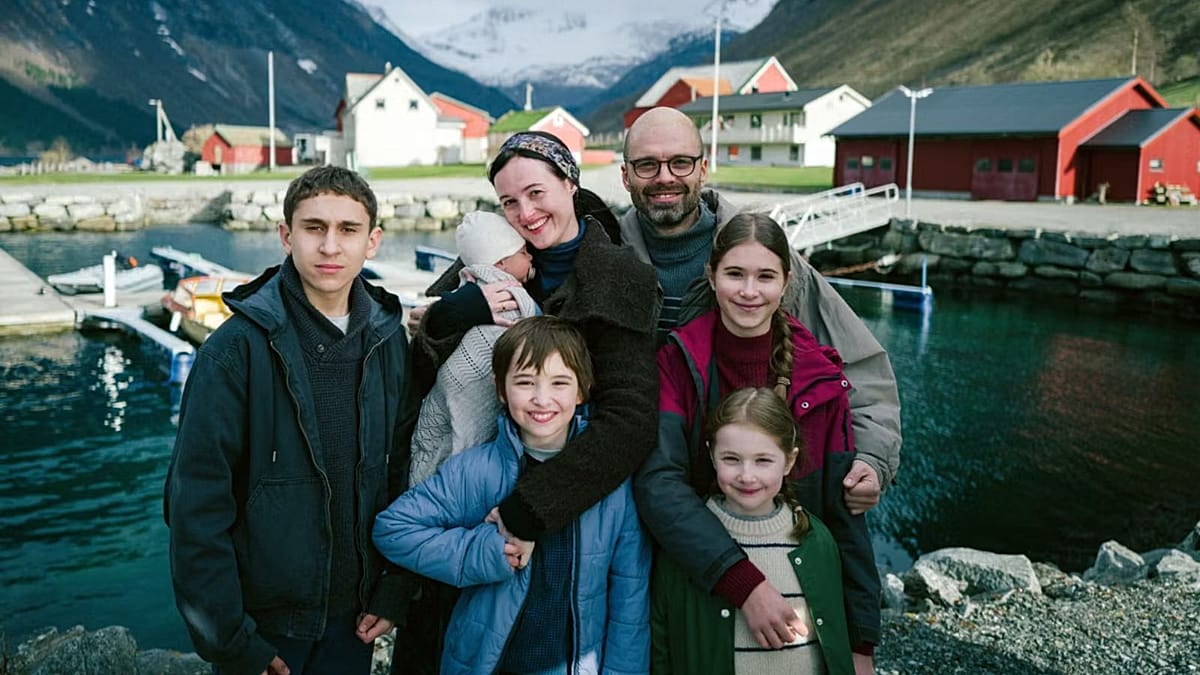
The film opens in Ålesund, a picturesque Norwegian port town where the Gheorghiu family has just moved. Mihai (Sebastian Stan), a Romanian aeronautical engineer, and his Norwegian wife Lisbet (Renate Reinsve) are devout Evangelicals raising five children. Their integration into the community is smooth until a teacher notices bruises on their eldest daughter, Elia (Vanessa Ceban). What follows is a swift and unsettling intervention by Norwegian Child Protection Services, who remove all five children, including a breastfeeding infant, and place them in foster care pending investigation.
Mihai admits to occasional corporal punishment—a slap on the buttocks—while Lisbet recalls pushing her daughter out of the way of a scalding pot. For the authorities, these admissions are enough to suspect abuse. The parents insist they are loving and disciplined; the state insists it is protecting the children. The film asks: where does discipline end and abuse begin? And can a society that prides itself on tolerance truly understand a culture it finds alien?
A mirror to European liberalism
Mungiu, who previously explored xenophobia in R.M.N., here examines the fault lines within Western Europe's self-image. Norway, often held up as a model of progressive governance, becomes the stage for a moral dilemma. The director deliberately avoids giving answers. Instead, he presents a series of questions: Are the Gheorghius victims of religious persecution, or are they guilty of harming their children? Is the state's intervention a safeguard or an overreach? Does liberal tolerance extend to those who reject liberal values?
The film's power lies in its refusal to take sides. Mungiu trusts the audience to grapple with these questions, showing that even the most well-intentioned beliefs can become oppressive when imposed on others. As one character says, "We're here to help," yet the help feels like a state-sanctioned abduction.
The performances are uniformly strong. Sebastian Stan, nearly unrecognizable as the stern patriarch, conveys a quiet desperation as his world collapses. Renate Reinsve, who broke through in The Worst Person in the World, delivers a nuanced portrayal of a woman whose faith is both her strength and her blind spot. Ellen Dorrit Petersen is chilling as Gunda, the child services agent whose clinical composure masks a rigid ideology.
The film's second half, however, loses some momentum. The courtroom drama that unfolds is familiar territory, and the dialogue occasionally feels stilted. A subplot involving the family's teenage neighbor Noora (Henrikke Lund Olsen) hints at deeper connections but remains underdeveloped.
Despite these flaws, Fjord is a worthy Palme d'Or winner. It is a film that will polarize audiences, and that is precisely its intent. In a Europe increasingly divided over questions of identity, religion, and state power, Mungiu's work serves as a necessary provocation. It reminds us that the most uncomfortable questions are often the most important ones.
For those interested in the broader context of European tensions, recent events such as the drone crash in Romania and the media crackdown in Belarus highlight the continent's ongoing struggles with sovereignty and freedom. Fjord adds a cultural dimension to these debates, asking whether Europe's commitment to liberal values can withstand the test of cultural difference.