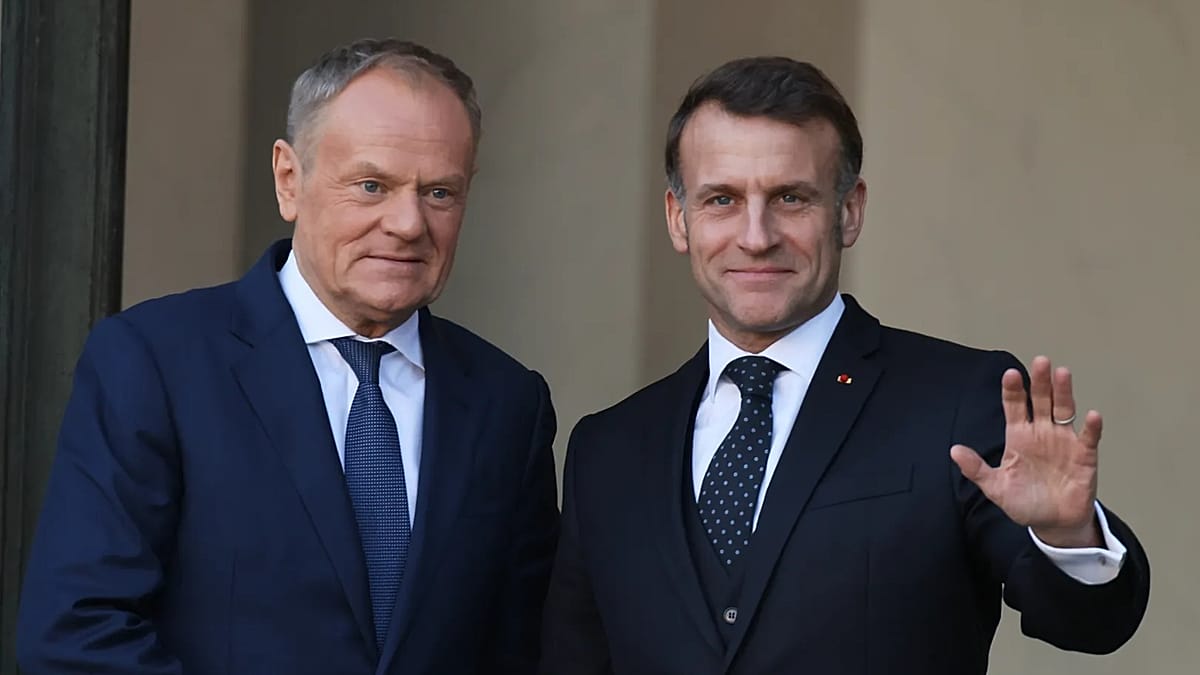
French President Emmanuel Macron and Polish Prime Minister Donald Tusk met in Gdańsk on Monday to announce a significant expansion of bilateral defence ties, a response to Russia's aggressive posture and growing uncertainty about the United States' role in European security.
Speaking at a joint press conference, the two leaders outlined plans that could include cooperation on nuclear deterrence, military satellite development, joint exercises, defence industry collaboration, and intelligence sharing. “Our cooperation, whether in the nuclear domain or in joint exercises…is a cooperation that knows no bounds,” Tusk said.
Macron indicated that concrete steps could be taken within months, particularly regarding nuclear deterrence. He suggested that French warplanes carrying nuclear warheads might be deployed to Poland, though France would retain sole authority over any decision to use force. Polish forces could contribute in areas such as early warning and air defence.
Adapting to a Shifting Alliance Landscape
The public display of closer Franco-Polish relations reflects a broader recalibration among European Union member states. US President Donald Trump has repeatedly disparaged NATO, calling allies “cowards” and the alliance a “paper tiger,” while toying with the idea of withdrawal. His frustration that NATO members did not join the US-Israeli war in Iran has further strained transatlantic bonds.
Russia’s full-scale invasion of Ukraine, which shares a border with Poland, and mounting concern among Baltic states that Moscow might use its wartime economy to threaten NATO’s eastern flank, are also driving the push for greater European self-reliance. Macron has long advocated for a “European preference” in military procurement to ensure the continent’s strategic independence.
That preference has sometimes caused friction with eastern European countries, including Poland, which have historically relied heavily on US-made weapon systems. Poland has invested massively in modernising its armed forces, with military spending among the highest in NATO—expected to exceed 4.8% of GDP in 2026. Yet it has placed “colossal orders for American F-35s, Apache attack helicopters, Patriot missiles, and Abrams tanks,” a European diplomat told AFP.
Poland participates in the EU’s SAFE (Security Action For Europe) programme, which provides loans for weapons purchases and defence manufacturing expansion. However, Tusk faces domestic opposition from nationalist President Karol Nawrocki, who has called SAFE a threat to Poland’s “independence.”
“Washington’s strategy has indeed changed” toward Europeans, Tusk acknowledged at the press conference. But he stressed that “Polish-American and Euro-American relations” remain “very important.”
The Gdańsk meeting followed the signing of a Franco-Polish treaty of friendship and enhanced cooperation in May last year. During the visit, Airbus, France’s Thales, and Poland’s Radmor group announced an agreement to develop military communications satellites for Poland’s armed forces, a deal signed in the presence of both defence ministers.
On the eve of Macron’s arrival, Tusk said Warsaw and Paris “have very similar views on how to build Europe’s strength.” The evolving partnership underscores a continent grappling with the need to secure its own defence while managing ties with a less predictable ally across the Atlantic.