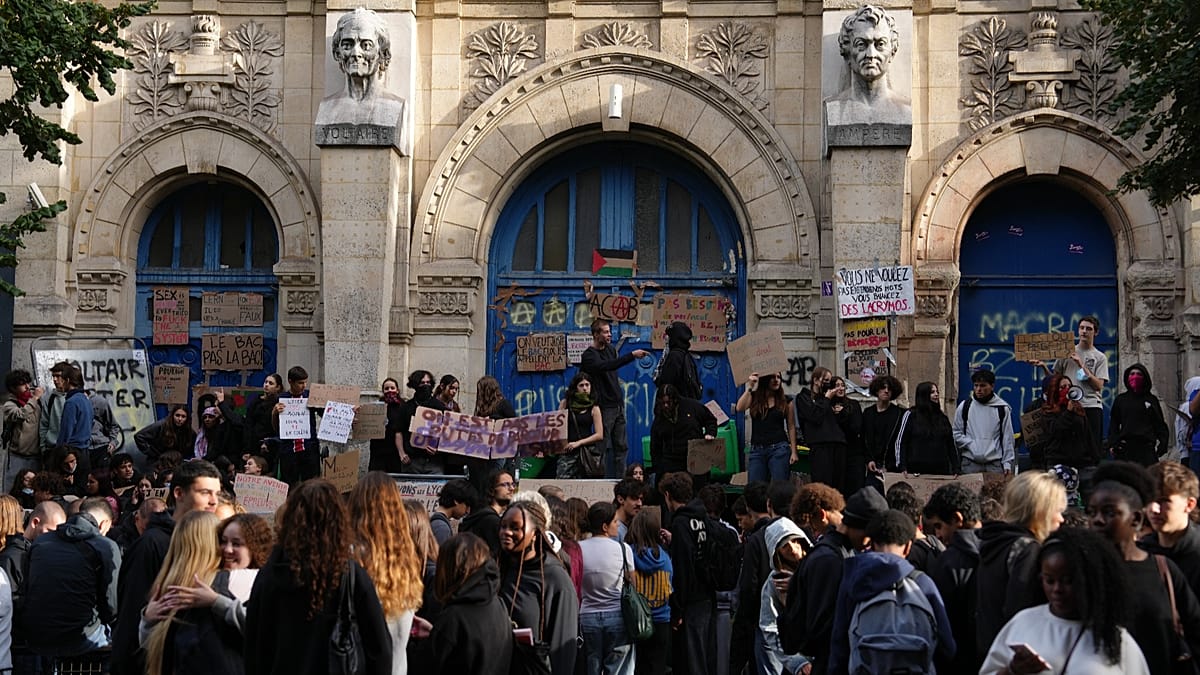
France faced a fifth day of nationwide student unrest on Friday, with nearly 400 high schools closed and violent clashes reported in several cities. The movement, which began in the Paris region and spread quickly across the country, has seen final-year students block entrances, light fires, and confront police.
In Paris, fire damaged the entrances of two lycées—Léonard de Vinci in the south and Gaston-Bachelard in the southeast—requiring firefighters to extinguish the blazes, according to an AFP photographer. Similar scenes unfolded in Lyon, Rennes, and Brest, where police fired tear gas to disperse crowds.
Students cite poor conditions and long hours
The protesters, many of them teenagers in their final year, say their school days are excessively long, classrooms are overheated, and staff absences are too frequent. They argue that these conditions undermine their education and well-being.
“Our school is closed this morning, so as far as we’re concerned, we’ve won,” said Lola, a 16-year-old student outside the Jean-Macé high school in Rennes, who declined to give her full name. She condemned the police response: “It makes us even angrier, the police have no right to hit us or use tear gas on us.”
Education Minister Édouard Geffray acknowledged that the grievances are legitimate but accused “ultra-violent fringe groups” of hijacking the movement. He told BFMTV that nearly 400 of the country’s 3,700 high schools were expected to be closed on Friday, and that many others, particularly in Marseille, had switched to remote learning.
Geffray reported that at least 65 staff members have been injured since the protests began, including 40 high school principals. Around 170 students have been wounded, and more than 100 schools have suffered “severe damage.” He urged parents to “clearly step up and tell their children not to go” to the protests, adding: “What matters now is ensuring our children are no longer out on the streets, because they are in danger.”
Government threatens legal action against parents
Justice Minister Gérald Darmanin said he has asked prosecutors to hold parents financially liable for damage caused by their children during the protests. “They will have to pay for repairs,” he told RTL. Since the movement began, around 2,000 people have been taken into police custody, 90% of them minors.
The unrest has taken on a political dimension just over half a year before the presidential election. The government has accused the hard-left party La France Insoumise (LFI) and its leader Jean-Luc Mélenchon, who is again running for the presidency, of being behind the movement. Mélenchon has denied any orchestration, but the protests have become a rallying point for opposition to the government’s education policies.
In Rennes, tension was palpable outside the Jean-Macé school, where students dressed in black and wearing balaclavas stood near a heavy police presence. Similar scenes were reported in Brest, where police used tear gas at the Kerichen high school.
The protests come amid broader concerns about France’s fiscal health. The government recently unveiled an austerity budget as national debt hits record highs, and borrowing costs have reached a 22-year high. Some observers see the school unrest as a symptom of wider discontent with public services under financial strain.
While the immediate trigger is school conditions, the movement has tapped into a deeper frustration among young people about their future prospects. As one student in Lyon put it, holding a sign reading “Stop budget cuts”: “We are the generation that will inherit this debt, but we are not getting the education we deserve.”
The government’s response has been firm, but the protests show no sign of abating. With the presidential election looming, the handling of this crisis could become a defining issue for the executive. For now, the streets of French cities remain the stage for a confrontation between a government determined to restore order and a student body that feels unheard.