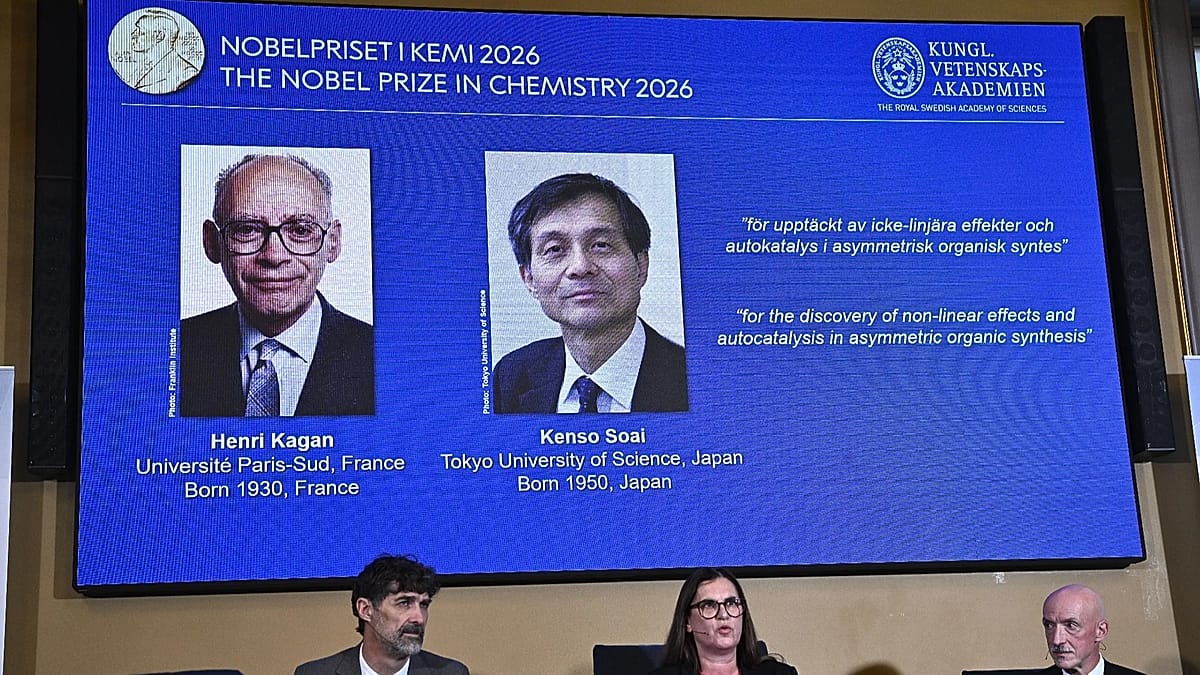
The 2026 Nobel Prize in Chemistry has been awarded to Henri B. Kagan of France and Kenso Soai of Japan for their pioneering research into the mirror-image forms of molecules, work that the Royal Swedish Academy of Sciences said is "decisive for chemists who design reactions for the manufacture of pharmaceuticals."
Announced in Stockholm on Wednesday, the prize recognises the two scientists for their discovery of non-linear effects and autocatalysis in asymmetric organic synthesis. Many molecules, including amino acids, exist in two mirror-image versions, yet living organisms typically use only one of these forms—a phenomenon known as chemical asymmetry.
This asymmetry poses a major challenge in drug development. Many pharmaceutical molecules come in two variants that are non-identical mirror images: one has the desired therapeutic effect, while the other can cause unnecessary and sometimes harmful side effects, the Nobel Committee explained.
"Henri Kagan and Kenso Soai have provided a solution to a chemical mystery that is over a century old: how homochirality can emerge spontaneously," said Heiner Linke, chair of the Nobel Committee for Chemistry, in a press release. "The chemical reactions they have developed are spectacular."
Kagan is affiliated with Université Paris-Sud in Orsay, France, while Soai works at the Tokyo University of Science. Speaking after the announcement, Soai said: "I'm very excited to receive the very nice news about the Nobel Prize. This is one of the most exciting days in my life. I'm really glad to share the prize with Professor Henri Kagan, such a famous organic chemist."
Implications for drug manufacturing
The laureates' work could have far-reaching consequences for the pharmaceutical industry across Europe and beyond. By understanding and controlling how mirror-image molecules form, chemists can design more efficient and safer production processes for medicines, potentially reducing side effects and improving drug efficacy.
Their discoveries also shed light on a fundamental question in chemistry: how did life on Earth come to favour one mirror-image form over the other? This research not only has practical applications but also deepens our understanding of the origins of biological homochirality.
The prize, worth 12 million Swedish kronor (about €1.09 million), will be shared equally between the two laureates. It is one of the most prestigious awards in science, and this year's recognition highlights the importance of fundamental chemistry in addressing real-world challenges.
Earlier this week, the Nobel Prizes in Medicine and Physics were announced, and the remaining prizes—in literature, peace, and economics—will be revealed in the coming days. The economics prize is scheduled for 12 October, and the award ceremony will take place on 10 December, the anniversary of Alfred Nobel's death in 1896.
Since 1901, 117 Nobel Prizes in Chemistry have been awarded, with 198 laureates in total. Eight of those have been women, including Marie Curie in 1911. Last year's chemistry prize went to Susumu Kitagawa of Kyoto University, Richard Robson of the University of Melbourne, and Omar M. Yaghi of the University of California, Berkeley, for creating a molecular structure used to extract carbon dioxide from air and separate pollutants from water.
The recognition of Kagan and Soai underscores the global nature of scientific collaboration, with European and Japanese researchers working together to push the boundaries of knowledge. As Europe continues to invest in research and innovation, such achievements highlight the continent's role in shaping the future of science and medicine.