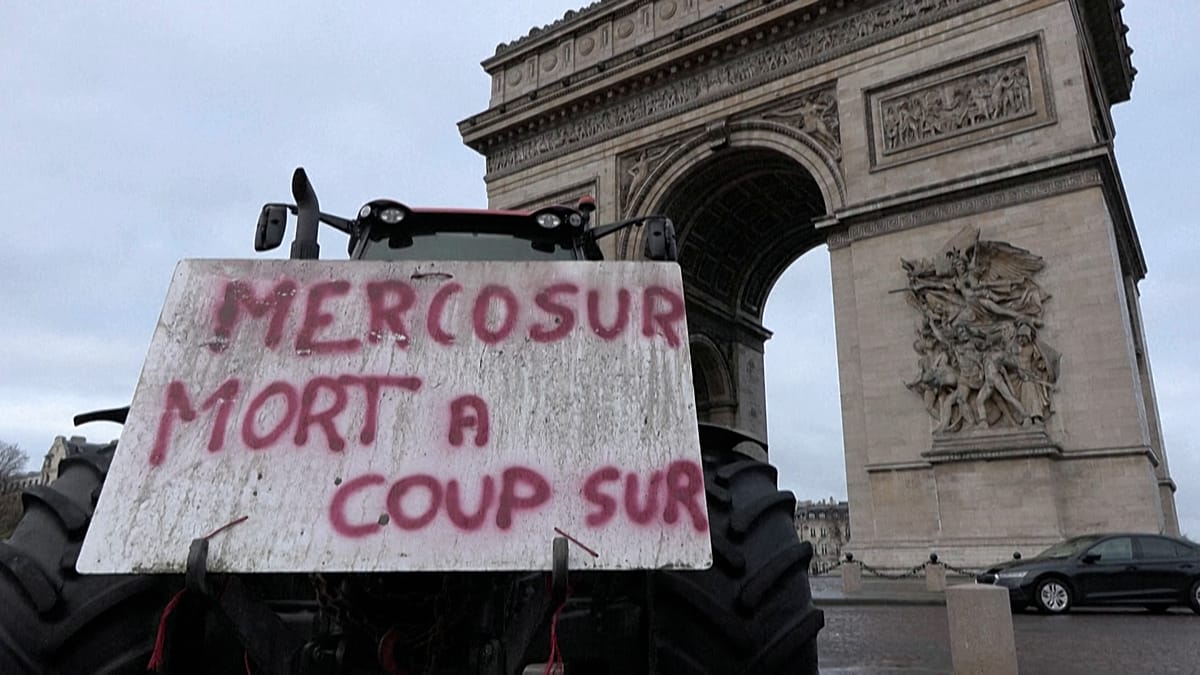
Hundreds of farmers steered tractors through the streets of Paris on Monday, mounting a fresh challenge to the European Union's proposed trade agreement with Mercosur countries. The convoy, organised by France's main agricultural unions, converged on the capital to demand that Paris and Brussels abandon or substantially rework the deal, which they say would expose French producers to unfair competition from South America.
The protest is the latest in a series of demonstrations that have unsettled the French government over the past year. Farmers argue that the EU-Mercosur pact, which has been under negotiation for more than two decades, would allow tariff-free access to the European market for beef, poultry, sugar and ethanol produced under environmental and labour rules far looser than those binding European farms.
An uneven playing field
At the heart of the dispute is the principle of reciprocity. French farmers contend that while they must meet stringent EU standards on pesticides, animal welfare and carbon emissions, their South American counterparts face no equivalent obligations. The result, they say, is a structural advantage for imported goods that can be produced more cheaply and sold at lower prices in European supermarkets.
"We are not against trade," one union representative told reporters at the scene. "We are against being asked to compete with products that do not respect the same rules we do." The sentiment was echoed across the convoy, where banners called for mirror clauses — provisions that would require imported goods to meet the same production standards as those made within the EU.
The demonstration follows months of mounting frustration in rural France, where farm incomes have been squeezed by rising input costs, volatile energy prices and what producers describe as an uneven regulatory burden. Similar grievances have fuelled protests elsewhere in Europe, including in Germany, the Netherlands and Poland, where farmers have blockaded roads and ports.
Pressure on Brussels and the Élysée
The timing is awkward for both the European Commission and the French government. Ursula von der Leyen, the Commission president, has pursued the Mercosur deal as part of a broader strategy to diversify trade partners and secure access to critical raw materials. But the agreement requires ratification by member states, and France has repeatedly signalled that it will not support the text in its current form.
President Emmanuel Macron's administration has sought to position itself as a defender of European agriculture, calling for stronger safeguards and a formal review of the deal's environmental impact. Yet the government has also faced criticism from farmers who say that warm words have not translated into concrete protections. The Élysée has not indicated whether it would formally block the agreement, a move that would require assembling a blocking minority among member states.
The protest in Paris also intersects with a broader wave of social unrest in France. Recent weeks have seen student demonstrations over school conditions and rallies linked to the left-wing opposition, adding to the sense of a government under pressure from multiple directions. Police reported isolated scuffles but no major injuries as the tractors wound through the city.
A continental dilemma
The Mercosur question exposes a deeper tension within the EU. For member states with large agricultural sectors — France, Ireland, Poland, Austria — the deal represents an unacceptable risk to rural livelihoods. For others, particularly Germany and Spain, it offers export opportunities for cars, machinery and services. The European Parliament has also voiced concerns, with a majority of MEPs signalling that they would reject the agreement without binding environmental and social guarantees.
Brussels has attempted to address some of these worries by proposing curbs on Ukrainian farm imports and subsidies, a move designed to show that the Commission is responsive to agricultural discontent. But the Mercosur file is more complex, involving four South American economies and a web of geopolitical considerations, including the EU's desire to reduce its dependence on China and Russia.
For now, the tractors have returned to the fields, but the underlying dispute remains unresolved. French farmers have promised further action if their concerns are ignored, and the coming months will test whether Brussels can reconcile its trade ambitions with the demands of a constituency that has become increasingly vocal — and increasingly willing to take to the streets.