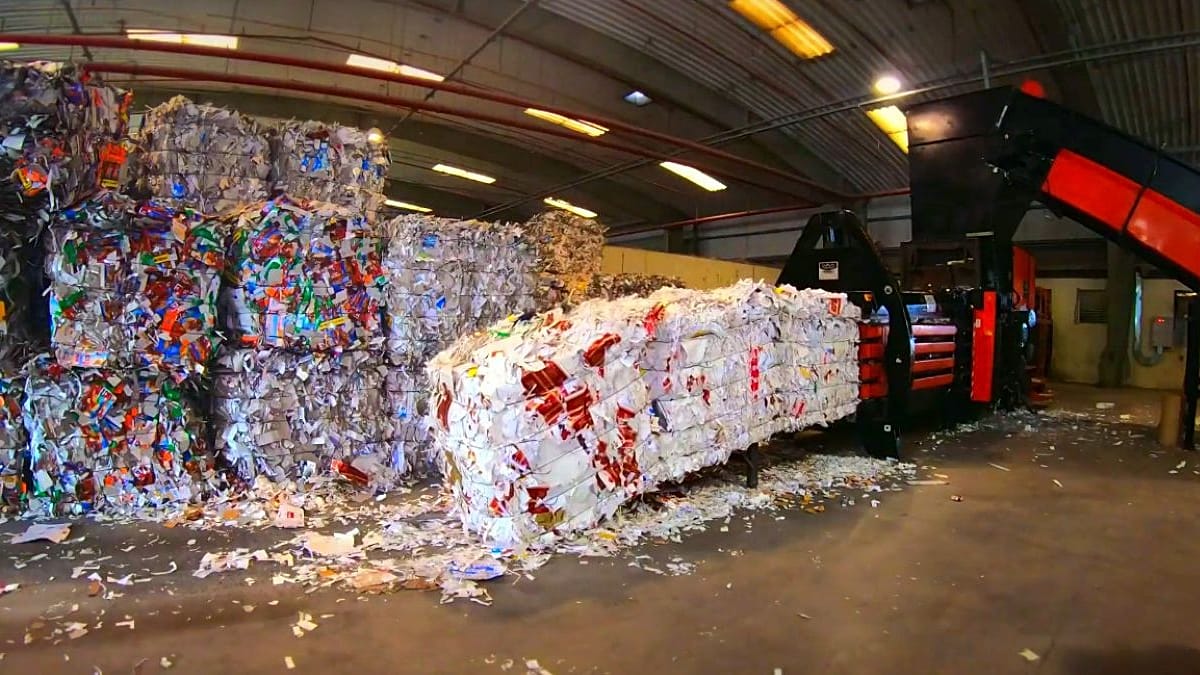
Every year the world generates more than two billion tonnes of municipal waste, most of it vanishing from sight the moment it hits a bin. But disposal is only the start of a longer process. A plastic bottle can be reprocessed into new packaging; food scraps can become compost or biogas; material that resists recycling may be burned for electricity; and whatever cannot be recovered ends up buried. The more material is captured along the way, the less reaches the final destination.
That logic underpins the circular economy: keep resources in use as long as possible, first by consuming less, then by reusing and recycling rather than discarding. The principle is easy to state and hard to deliver, as two very different contexts illustrate.
Sorting what still has value
At the BEEAH waste complex in Sharjah, municipal rubbish travels along a sorting line where machines separate plastics, metals, paper and cardboard. What arrived mixed together leaves as distinct streams that can re-enter manufacturing. Plastics become new packaging and consumer goods; paper and cardboard return to the production cycle.
Not everything can be recovered. Some residual waste is sent to a waste-to-energy plant, where it is burned to generate electricity instead of being landfilled directly.
“Recycling preserves material. Waste-to-energy addresses what remains, ensuring residual waste still creates value,” says Alya Al Obeidli, lead engineer at Emirates Waste to Energy.
The sequencing matters: recycling keeps materials in circulation, while waste-to-energy handles what cannot be recycled. Whatever remains unrecoverable exits the circle and is buried. It is this entire chain that Uzbekistan is now trying to rebuild.
Uzbekistan rethinks its waste
Uzbekistan produces roughly 15 million tonnes of household waste annually. Government figures suggest only about 5% to 6% is recycled or processed by specialist companies. For most of the rest, landfill is the endpoint.
A new 24-hectare landfill outside Tashkent receives between 1,500 and 2,500 tonnes a day, depending on the season, according to Shahzod Safarov, chief specialist at the Agency for Waste Management. For decades the capital's rubbish went to an older site nearby. At the newer facility, waste is compacted and covered with soil, while protective layers underneath are designed to stop contaminated liquid from seeping into groundwater.
Buried waste nonetheless keeps affecting the environment. As organic material decomposes without oxygen, it releases methane, a potent greenhouse gas.
“There was a very large build-up of methane gas at the old landfill site,” says Rafael Bekmullin, director of the Waste Recycling and Disposal Branch. “Now, there's actually a project underway there to extract that gas and generate electricity from it.”
Officials say 47 landfills have been closed and rehabilitated in recent years, and Uzbekistan aims to halve the number of landfills by 2030. But closing a landfill does not make waste disappear. If less is buried, it must go somewhere else.
Turning residual waste into electricity
Part of the answer is taking shape outside Samarkand. A new waste-to-energy plant is under construction to process around 1,500 tonnes of household waste a day and is expected to generate roughly 240 million kilowatt-hours of electricity annually once operational.
Aziza Nazarova, head of the investment department at the Agency for Waste Management, says the longer-term goal is to separate waste into distinct streams: recyclables returning to production, organics heading to compost or biogas, and residuals to waste-to-energy plants. The order is crucial. Incineration can reduce landfill volumes, but extracting recyclables first keeps more material in circulation.
That brings the journey back to where it began: the bin. In Angren, east of Tashkent, the private company Zero Waste distributed 10,000 bags to residents in a pilot encouraging households to separate their rubbish. According to Sobir Mashrabov, the company's regional representative, only about 1% came back with the waste sorted.
“Without sorting the waste, nothing is achievable,” Mashrabov says.
For him, infrastructure alone cannot solve the problem. Separating waste has to become a daily habit, taught from kindergarten through school and university. The experiment brings the waste journey full circle: once plastic, paper, food and everything else are thrown together, recovering useful material becomes harder. Sorting earlier creates more opportunities for recyclables to return to production rather than move towards incineration or landfill.
Sharjah and Uzbekistan are addressing different stages of the same journey, from sorting and recycling to landfill management and energy recovery. Europe is pursuing its own version of this transition, with EU repair rules designed to keep appliances in use longer and waste heat recovery gaining attention as a way to cut gas reliance. The Greek island of Tilos has shown how far a community can go, having eliminated its landfill almost entirely.
Yet all this infrastructure deals with what society has already decided to throw away. The harder task is reducing what reaches the bin in the first place.