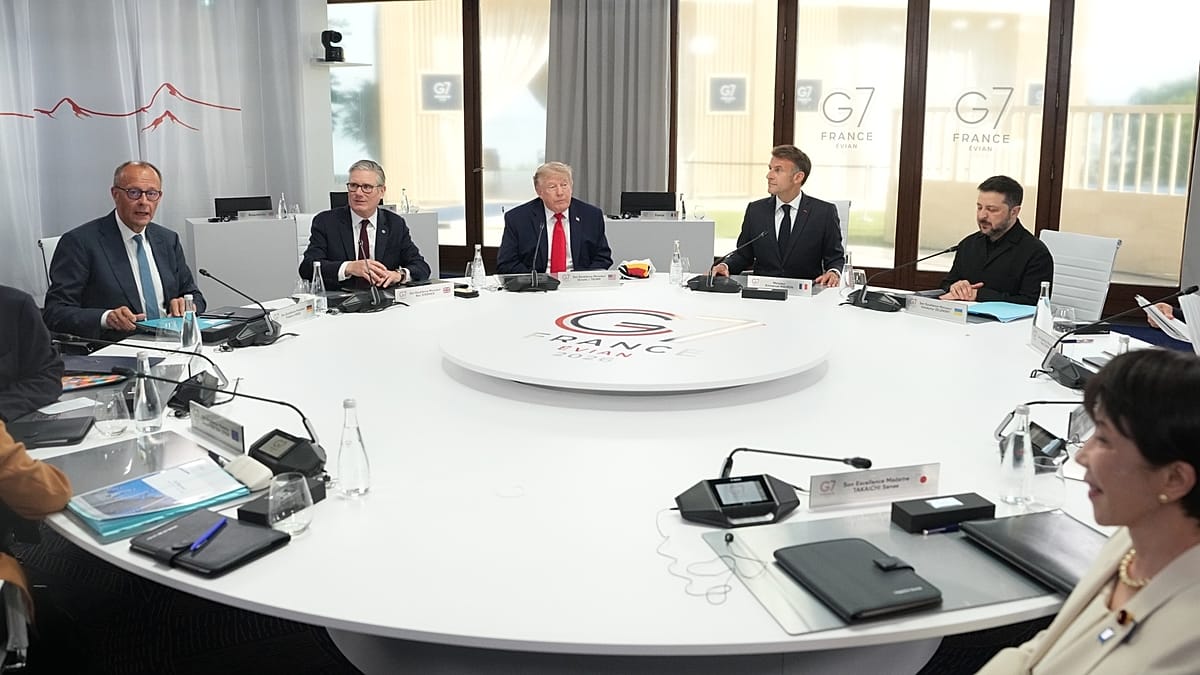
The final day of the G7 summit on the shores of Lake Geneva in Évian saw leaders coalesce around a rare joint stance on the war in Ukraine, while also grappling with the implications of American export controls on artificial intelligence. The gathering, hosted by France, brought together the heads of the United States, Canada, Japan, the United Kingdom, Germany, France, and Italy, along with European Union representatives.
Unity on Ukraine and Sanctions
In a statement published shortly after midnight, the leaders declared they “stand united in our unwavering support for Ukraine in defending its freedom, sovereignty, and territorial integrity.” The document was signed by US President Donald Trump, marking a significant moment of transatlantic alignment. Crucially, all leaders committed to increasing “pressure on the Russian war economy” and to “strengthen our sanctions, including those on the oil and gas sectors.”
European officials view the statement as a major diplomatic win, particularly after both Washington and London had faced accusations of softening sanctions on Russian energy commodities to mitigate the economic fallout from the war in Iran. The unified stance reinforces the message that the continent’s eastern flank remains a priority, even as the US weighs a partial drawdown of its military presence in Europe.
For more on Ukraine's strategic position, see Ukraine's Former PM Sees US Support as Key Leverage Against Russia.
US-Iran Memorandum Expected Friday
Trump also vowed to publicly disclose the 14-point Memorandum of Understanding with Iran, due to be signed Friday at Switzerland’s mountainside Bürgenstock resort, according to reports. The signature is expected to trigger 60 days of negotiations, according to a draft MoU seen by Euronews, focusing on sanctions relief and the future of Tehran’s nuclear programme. The memorandum includes a US commitment to a $300 billion fund designed to kick-start investment in Iran and finance reconstruction.
The G7 summit in Évian has been dominated by geopolitics, trade, and energy security, as detailed in G7 Summit in Évian: Geopolitics, Trade, and AI Dominate as Ukraine Talks Advance.
AI Governance and the American Kill Switch
On the technology front, leaders were joined by executives from Anthropic, OpenAI, Google, and Mistral AI for a discussion on ensuring “a safe, rapid and effective deployment of artificial intelligence.” As AI becomes a strategic asset, fears of a potential American “kill switch” have rarely felt more real. On Friday, Washington imposed export control measures blocking all access to Anthropic AI’s Fable 5 and Mythos 5 by any foreign national. Anthropic consequently had to “abruptly disable” access to both models to comply.
The restrictions, and the speed with which the company applied them, confirmed one of Europe's worst-kept fears: that the Americans could shut down access to their most powerful technology at a moment's notice. Washington cited national security as its justification, noting that Fable 5 and Mythos 5 have unprecedented capabilities to identify and exploit cyber vulnerabilities, making them formidable hacking tools. But being abruptly cut off from the world's most advanced AI models left European and other Western allies flat-footed, delivering the ultimate reality check: access to American technology in the Trump era is no longer a given.
Germany and Poland Deepen Defence Ties
Separately, Germany and Poland were set to sign a new defence agreement Wednesday, putting aside their complicated past to strengthen European military cooperation at a time of heightened tension with Russia and growing uncertainty over US engagement in Europe. Relations between the two neighbours have become more pragmatic since Russia’s full-scale war on Ukraine in 2022 and the coming to power of a liberal government in Poland in 2023.
As the US weighs a partial drawdown of its military presence in Europe, Poland is keen to ensure that major European allies take a greater role in defending the continent’s eastern flank. German Chancellor Friedrich Merz is seeking partners in his bid to revitalise his country’s military, the Bundeswehr, after decades of neglect, with ambitions to build the strongest conventional army on NATO’s European side — an effort that will make it a central pillar of European defence in the years ahead. Poland’s importance as a logistics hub for Ukraine, alongside its growing economy and heavy defence investment, has made it a compelling partner for Germany and other core European countries.
For context on Ukraine's defence ambitions, see Ukraine Seeks License to Manufacture Patriot Systems for Europe.
Other Developments
Activists have denounced Israeli miner ICL in Spain and its links to white phosphorus. An activist camp and the documentary ‘Salt in the Wound’ highlight environmental damage by ICL in a Catalan mining basin and its ties to white phosphorus used in warfare in Lebanon. Meanwhile, Belarus leader Aliaksandr Lukashenka apologised to Ukrainian President Volodymyr Zelenskyy, calling him “young and inexperienced,” and said his country poses no military threat to Ukraine, claiming his earlier statements were only in response to threats from Kyiv to Minsk.