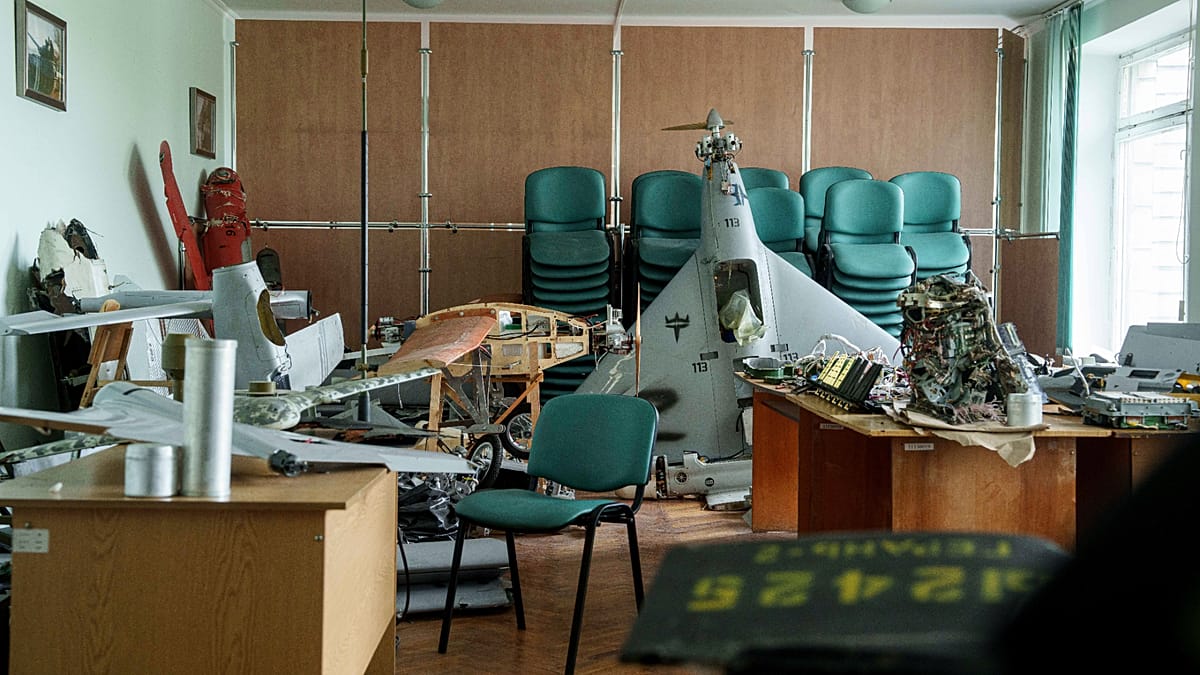
Despite successive rounds of European Union sanctions, German-made components continue to appear in Russian drones and military hardware used against Ukraine. Ukraine's military intelligence service, the HUR, has published a detailed list of components without which Russian drones would not function, tracing many of them back to manufacturers in Germany.
The War and Sanctions portal, which tracks foreign components in Russian weaponry, lists 137 components from Germany. Of these, 59 are installed in drones, while the remainder are found in missiles, radar systems, military vehicles, and helicopters.
Transistors and Pumps in Iranian-Designed Drones
Transistors are the most commonly identified German component. The HUR published a list of such transistors, including their manufacturers. One name appears repeatedly: Infineon Technologies, based in Neubiberg near Munich. Infineon told Euronews: "Infineon Technologies condemns Russia's war of aggression against Ukraine. We are deeply concerned when our products are misused for purposes for which they are not intended."
Ukrainian intelligence found German transistors in the Geran-5 drone, an upgraded, jet-powered variant of the Geran series. According to the International Institute of Strategic Studies, the Geran-5 more closely resembles a cruise missile, with speeds up to 600 km/h, a range of around 950 kilometres, and a payload of about 90 kilograms.
Fuel pumps from Bosch, the Stuttgart-based engineering giant, have also been found in Russian drones, including the Geran-3 and Shahed-136. Bosch stated: "Bosch no longer has any operational business relations with Russia. Nor does the company supply any products or components to Russia. All our units and staff worldwide have been instructed not to conduct any business with Russia or Belarus."
Russia launched 6,462 Shahed-type drones at Ukraine in March 2026, averaging 208 per day — a new record, according to the Institute for Science and International Security. This surpassed the previous record of 203 per day in July 2025. Between 6 pm on 23 March and 6 pm on 24 March, Russia launched 948 Shahed-type drones and 35 missiles, the highest daily drone deployment since the war began.
The Shahed-136, a kamikaze drone developed in Iran, is used by Russia under the designation Geran-2. It flies slowly at low altitude, guided by satellite navigation, and carries a warhead of 30 to 50 kilograms. Its simple, inexpensive design makes it suitable for saturation attacks.
Components in Armoured Vehicles
Beyond drones, German components have been found in Russian military vehicles. The Kamaz-63968, a heavily armoured personnel carrier, contains inductors, generators, capacitors, transformers, and batteries from German manufacturers. The vehicle has a V-shaped hull to protect against mines and can carry up to 16 soldiers.
Bosch components have also been identified in the ZSA-T Linza, an armoured medical evacuation vehicle designed for combat zones. Other German manufacturers implicated include TDK Electronics, Würth Elektronik, and Pierburg, a subsidiary of Rheinmetall.
How Components Reach Russia
Producing Shahed drones in Russia is relatively inexpensive, enabling mass production, according to The Kyiv Independent. One European intelligence source told the outlet that the Geran-2 drone poses a potential threat to the European Union because of its range of around 2,000 kilometres. During large-scale Russian air raids, Shahed drones have violated the airspace of neighbouring Poland, Romania, and Moldova.
In 2025, Ukrainian military intelligence recovered an unexploded Geran-2 drone manufactured at the Russian Kupol plant in Izhevsk. Among the wreckage, investigators found an encoder produced by the Austrian company ams-OSRAM. The sensor was dated to 2024, two years after the Kremlin launched its full-scale invasion and after EU export restrictions were in place. According to ams-OSRAM, the sensor was shipped in July 2024 to a company in Hong Kong, then forwarded to a firm in China, which the manufacturer regarded as the end user.
The findings underscore the difficulty of enforcing sanctions when components travel through multiple intermediaries and third countries. As the EU debates further restrictions, including a maritime ban delayed by opposition from Greece and Malta, the presence of German parts in Russian weaponry highlights the need for more robust enforcement mechanisms.