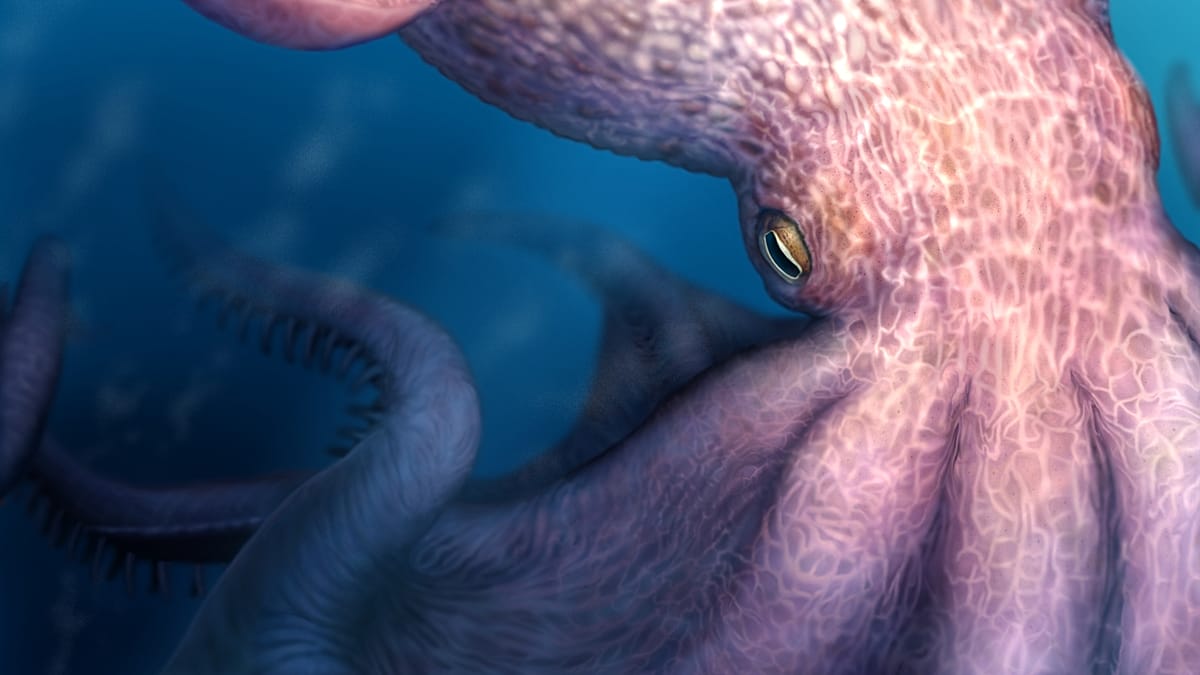
During the late Cretaceous period, around 100 million years ago, the oceans were home to a predator that could rival the largest marine reptiles: giant octopuses. New research published in the journal Science on 23 April reveals that these cephalopods, with bodies extending up to 19 metres, were formidable hunters in their own right.
Palaeontologists from Hokkaido University and collaborating institutions studied 15 fossilised octopus jaws previously discovered in Japan and on Vancouver Island, Canada. Using a technique they call digital fossil mining—scanning rock cross-sections to detect hidden remains—they identified 12 additional jaws from Japan. By comparing these ancient beaks to those of modern octopuses, the team estimated the creatures' lengths ranged from 7 to 19 metres.
“The largest jaw was substantially bigger than that of any modern octopus,” said co-author Yasuhiro Iba, a palaeontologist at Hokkaido University, in an email. The findings challenge the perception that soft-bodied invertebrates were not top predators during the age of dinosaurs.
Wear and Tear on Ancient Beaks
The researchers observed significant wear on the largest jaws, including scratches, chips, and rounded edges. “The animals repeatedly crushed hard prey such as shells and bones,” Iba explained. Octopus beaks are made of stiffened chitin, a material tough enough to break through the shells of crustaceans and the bones of small vertebrates.
Adiel Klompmaker, a palaeontologist at the University of Alabama who was not involved in the study, described these ancient octopuses as “a fearsome sight to behold.” He noted that while sharks, mosasaurs, and plesiosaurs are well-known Cretaceous predators, octopuses have been largely overlooked due to their poor fossilisation potential.
Without stomach contents, it remains uncertain what these giant octopuses ate. They may have preyed on fish, snails, or other marine life, using their flexible arms to capture and their beaks to dismember. Neil Landman, a palaeontologist at the American Museum of Natural History in New York, said that searching for octopus fossils in other regions could clarify their role in ancient food webs. “It's a big old planet,” he remarked. “So we have lots to look at to piece together the marine ecosystem through time.”
The findings add a new dimension to our understanding of prehistoric marine ecosystems, suggesting that invertebrates were more dominant than previously assumed. For European readers, this research underscores the global nature of palaeontology—fossils from Japan and Canada contribute to a picture that spans continents, much like the collaborative efforts seen in European scientific projects such as OpenAI's GPT-Rosalind model for biotech.
As scientists continue to explore fossil sites worldwide, the story of these giant octopuses reminds us that the past holds surprises that reshape our view of evolution and ecology.