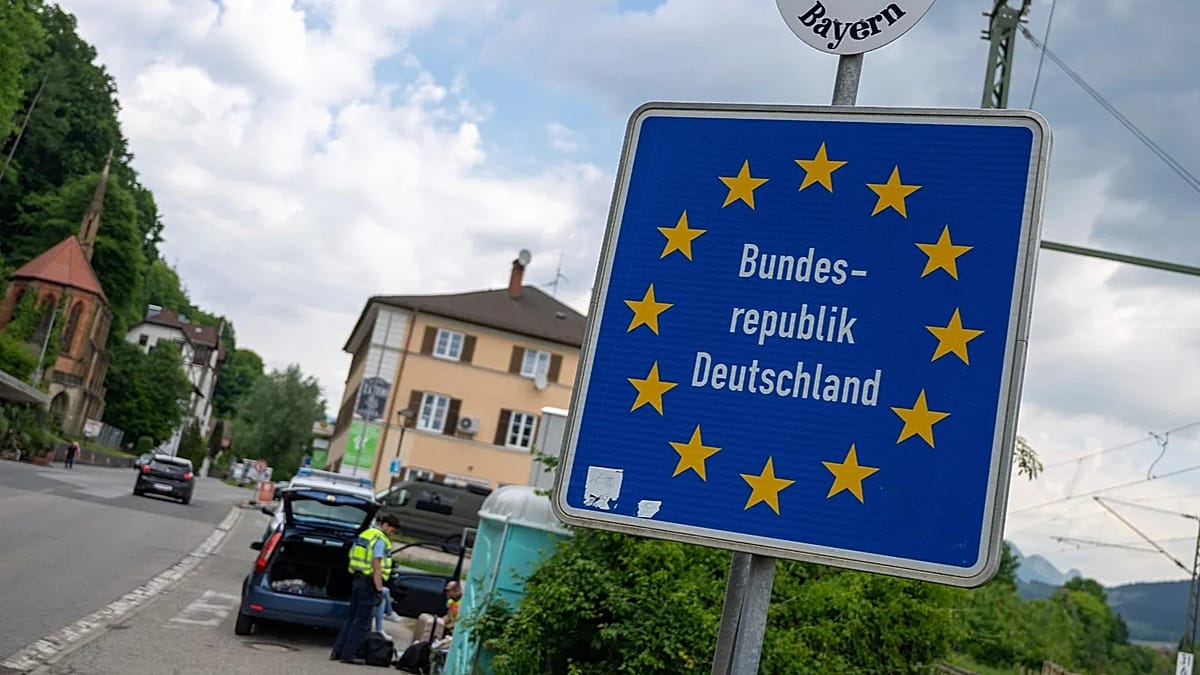
BERLIN — Germany's Interior Minister Alexander Dobrindt, approaching his first year in office, has declared a “migration turnaround” as he pushes to keep internal EU border controls in place. The centre-right CSU politician, who took office in April 2025, has made tighter borders a cornerstone of his policy, but the approach is facing mounting legal and academic pushback.
Dobrindt’s first day in office saw the announcement of stricter controls at Germany’s borders with other Schengen states, fulfilling a key campaign pledge of the CDU/CSU coalition. Federal police have since turned back asylum seekers at the border, with around 1,340 people rejected between his appointment and April 2026, according to Tagesschau. Monthly rejection figures have remained steady at between 2,000 and 3,000, roughly unchanged from before he took office.
Asylum applications have fallen more sharply — from 350,000 in 2023 to 170,000 last year — and Dobrindt has cited this as evidence that his policy is working. “We have now been able to execute 8,000 arrest warrants at the border,” he told Die Welt.
Doubts from academia and judiciary
Migration researcher Victoria Rietig dismissed the minister’s reasoning. “When the figures go up, people say we are lightening the dark field. If the numbers go down, they say people are deterred and if the numbers stay the same, they say we are stabilising the situation,” she told Tagesschau. “Scientifically, of course, that's complete rubbish, but politically it's brilliant.”
Several courts have ruled against the controls. The Koblenz Administrative Court recently found that internal border controls at the Luxembourg-German border between March and September 2025 were unlawful, ruling that the federal government had not adequately justified their necessity. Dobrindt has said he intends to maintain the controls regardless. SPD politician Uli Grötsch said it was “urgent” to find ways to organise border controls in accordance with the law.
Dobrindt has described the controls as a temporary measure, saying Germany can “move away from border controls again” once the European migration system is functioning. He did not specify when that might be.
Taliban negotiations
His decision to organise deportations to Afghanistan through direct contact with the Taliban has drawn the sharpest criticism. Greens MP Marcel Emmerich called it a “massive border shift” and accused Dobrindt of acting as a “door opener for the Taliban.” Research by ZDF’s Magazin Royale found Taliban representatives had been involved in German official processes to facilitate the deportations.
“The fact that this regime stands for terror, systematically violates human rights and massively oppresses women is simply being ignored,” Emmerich said. SPD Minister President of Saarland Anke Rehlinger warned against making the controls permanent.
The debate comes as European NATO members, including Germany, have boosted defence spending by 14% in 2025, with Berlin leading the increase. Meanwhile, the EU’s broader migration policy remains under strain, with countries like Spain pursuing alternative approaches — such as mass regularisation — as a model for the bloc.