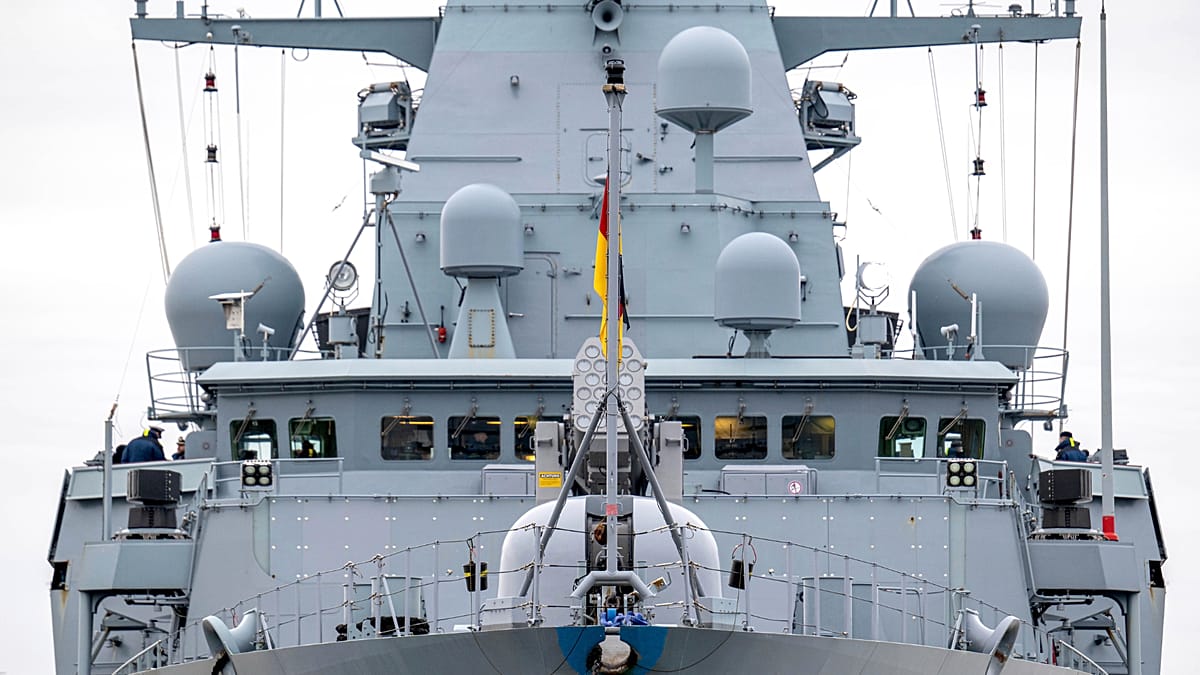
The German Navy’s minehunter Fulda departed from the port of Kiel on Monday, heading for the Mediterranean as the government in Berlin weighs a possible deployment to the Strait of Hormuz. The move comes amid heightened tensions in the Persian Gulf, where Iran has repeatedly threatened commercial shipping and European military assets.
The vessel, a Frankenthal-class minehunter, is expected to join NATO’s Standing Naval Maritime Group 2 in the Mediterranean. Its ultimate destination, however, could be the Strait of Hormuz, a chokepoint for global oil shipments. Germany has not yet made a final decision on a Hormuz mission, but the dispatch of the Fulda signals that Berlin is preparing for such a scenario.
Strategic Context
The Strait of Hormuz, connecting the Persian Gulf to the Gulf of Oman, is a critical waterway for European energy security. Roughly 20 percent of the world’s oil passes through it. Recent incidents, including Iranian seizures of tankers and threats to block the strait, have alarmed European capitals. The Iran Threatens European Military Bases as Hormuz Crisis Deepens report highlights the broader risks to European installations in the region.
Germany’s potential involvement would be part of a European-led maritime security initiative, distinct from the US-led Operation Sentinel. The European Union has been exploring a separate naval mission to ensure freedom of navigation, with France, Italy, and the Netherlands also contributing assets. The Fulda’s deployment is a concrete step in that direction.
“The situation in the Strait of Hormuz remains volatile,” said a spokesperson for the German Defence Ministry. “We are preparing for all contingencies to protect international shipping and our economic interests.” The ministry declined to confirm a timeline for a final decision on the Hormuz mission.
Domestic and International Reactions
The deployment has sparked debate within Germany’s coalition government. The Social Democrats (SPD) and Greens have expressed caution about a military mission in the Gulf, while the Free Democrats (FDP) have pushed for a robust European response. The Bundestag must approve any combat deployment, though mine-clearing operations are considered less controversial.
Internationally, the move has been welcomed by Gulf states and the United States. However, it also risks escalating tensions with Iran, which has warned European nations against participating in any naval coalition. The Iran Claims to Block US Navy in Strait of Hormuz as Tensions Escalate article details Tehran’s recent aggressive posturing.
Germany’s decision to send the Fulda also reflects a broader shift in its defence policy. Under Chancellor Olaf Scholz, Berlin has increased military spending and taken a more active role in international security, partly in response to Russia’s invasion of Ukraine. The Hormuz mission would be another test of Germany’s willingness to project power beyond Europe.
The Fulda is equipped with advanced sonar and remotely operated vehicles to detect and neutralise naval mines. Its deployment to the Mediterranean will allow it to train with allied navies before any potential transit to the Gulf. The vessel is expected to remain in the region for several months.
For European readers, the story underscores the continent’s dependence on stable sea lanes and the growing need for autonomous defence capabilities. As the United States reduces its military footprint in Europe, as seen in the Trump Vows Deeper US Troop Cuts in Germany, Escalating Transatlantic Rift report, European nations are being forced to take greater responsibility for their security.