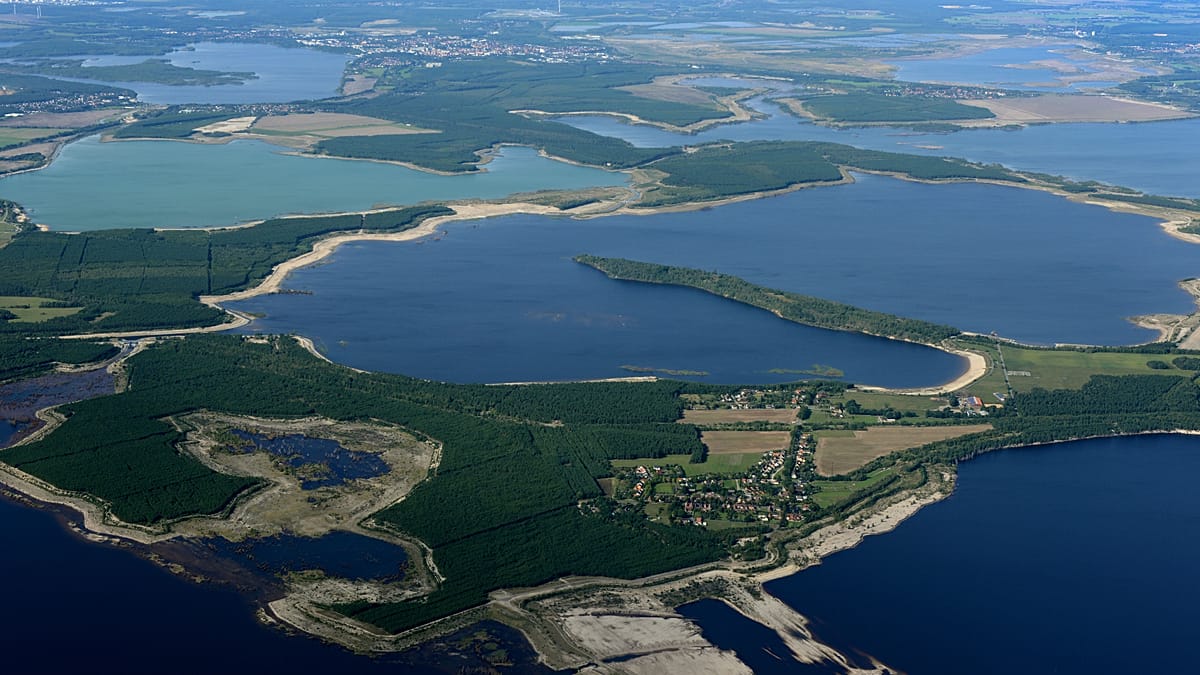
For decades, the landscape of Lusatia, straddling Brandenburg and Saxony between Berlin and Dresden, was defined by gaping craters left by lignite mining. Now, a monumental engineering project is turning those scars into Europe's largest artificial lake district. This April, Lake Sedlitz—the final major component of the Lusatian Lakeland—will open for swimming and boating, marking a new chapter in one of the continent's most ambitious environmental transformations.
The Lusatian Lakeland spans 14,000 hectares of water surface, comprising 23 human-made lakes. When fully developed, it will cover 144 square kilometres, nearly matching Italy's Lake Como (146 square kilometres). But unlike Como, this landscape is not a natural wonder; it is the result of decades of targeted engineering and billions of euros in investment.
From Brown Coal to Blue Water
During the German Democratic Republic (GDR), miners extracted over two billion tonnes of lignite from depths exceeding 60 metres. The first artificial lake, Senftenberger See, was created in 1967, but the systematic transformation began after reunification. The Lausitz and Central-German Mining Administration Company (LMBV), a federal entity, took over 19 open-cast mining areas in the early 1990s and has been coordinating reclamation ever since.
Dr Uwe Steinhuber of the LMBV told European Pulse that the process will span two generations. "This is a process that will take two generations," he said. The company is developing around 50 large post-mining lakes, 24 of them in Lusatia alone. The total cost for the Lusatian reorganisation has reached approximately €7 billion, with the overall LMBV budget, including central German districts, at €13.8 billion. An additional €4.8 billion will likely be needed over the next 25 years.
Each lake presents unique challenges: embankments must be geotechnically secured, mineral-laden groundwater managed, and complex inlet and outlet channels built. The rapid introduction of neutral river water prevents acidic water from entering the lakes. A flooding centre in Senftenberg coordinates water extraction from the Neisse, Spree, and Schwarze Elster rivers. Without active flooding, it would take 80 to 100 years for a mine to fill naturally.
A Tourist Destination and Water Reservoir
The lakes are not just for recreation; they increasingly serve as water reservoirs for the Spree and Schwarze Elster rivers, especially during droughts. Ten of the 23 lakes will eventually be connected by canals for leisure boating, creating a continuously navigable water area of 7,000 hectares. Four of the 13 planned canals are already complete, with six more under construction.
Lake Sedlitz, formerly the Ilse-Ost open-cast mine (operational from 1938 to 1980), is the last major piece. Around 200 hectares of dead wood remain submerged and must be removed. The lake reached its target water level in 2025 and will now welcome visitors. The project is financed 75% by the federal government and 25% by the respective federal states; no EU funds are used for mining restoration.
The transformation has already reshaped the region. Communities like Neu-Seeland have emerged around the water landscape. The name Lusatia itself derives from the West Slavic term 'luzica', meaning marshland—a fitting irony for a region that now boasts Europe's largest artificial lake district.
As Germany grapples with its identity as an industrial powerhouse and a leader in environmental policy, the Lusatian Lakeland stands as a tangible example of post-industrial renewal. It is a reminder that even the most degraded landscapes can be reclaimed, though the cost—both financial and generational—is immense.