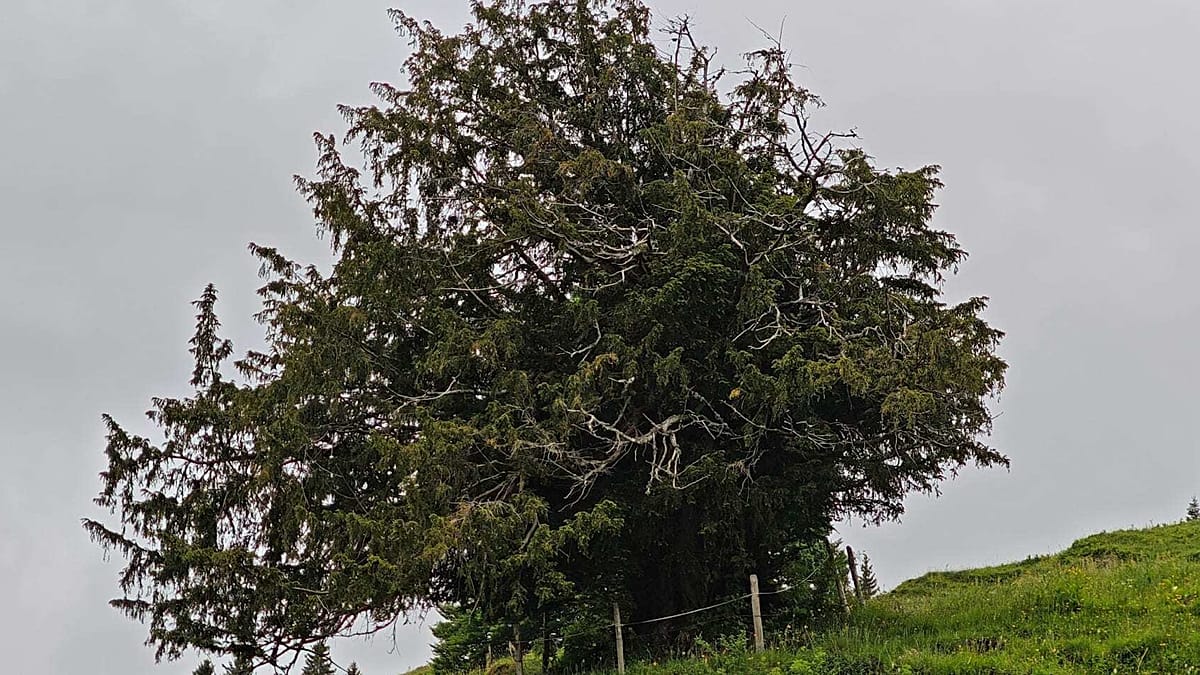
On a remote, grazed meadow in the Upper Allgäu, between the villages of Steibis and Balderschwang, stands a living piece of history: a yew tree that experts believe has been growing for more than 1,100 years. If confirmed, it would make this gnarled giant Germany's oldest known tree, a title previously held by a summer lime in Lower Saxony.
The tree, located at an altitude of 1,100 metres on a north-west facing slope, is close to the upper limit of the yew's natural range in the Alps, which is around 1,300 metres. According to the German Dendrological Society, an association of tree scientists, the tree's location is particularly harsh: "During the winter half of the year it hardly gets any sun there, and it is noticeably colder than on south-facing slopes at this altitude," the experts note. "That is why it is a miracle that it has survived all these centuries and is obviously thriving – it may even be 'pleased' about the current warming."
Andreas Roloff, senior professor of tree biology at Dresden University of Technology, describes the tree with admiration: "Its trunk is a dreamlike monument with fissures, bulges, bumps, ribs, cracks and holes, made up of several very different sections." The trunk measures 5.1 metres in circumference, a testament to its age and resilience.
A silent witness to centuries
How the yew came to this remote spot remains a mystery. It is almost certain that it was not planted; a bird likely dropped the seed. Yew wood has held significance in the region for millennia – Ötzi, the famous "Iceman" discovered in the Ötztal Alps, carried a hunting bow made of yew wood around 5,000 years ago.
The Allgäu yew now displaces the village lime tree of Upstedt in Lower Saxony, which was previously thought to be about 1,000 years old. Not far behind is the Erle Feme oak in Raesfeld, in western Münsterland, estimated at around 900 years old. That oak, with a trunk circumference of more than twelve metres, is probably Germany's thickest of its species. From 1363 until the end of the 16th century, secret tribunals known as Femegerichte held sessions beneath its crown, making it Europe's oldest known court tree. The "Feme" was feared in the Middle Ages for its secretive proceedings and the possibility of death sentences.
The European yew, the species to which the 1,100-year-old specimen belongs, has been present on the continent for around 150 million years, making it Europe's oldest native tree species.
Globally, the oldest tree by above-ground parts is a bristlecone pine in California's White Mountains, estimated at over 5,000 years old. In Sweden's Fulufjället National Park, a Norway spruce known as "Old Tjikko" has a root system estimated to be around 9,550 years old. Even older is the clonal colony "Pando" in Utah, a network of quaking aspen roots dated to about 80,000 years.
The discovery of the Allgäu yew adds a remarkable chapter to Germany's natural heritage, offering a tangible link to the early Middle Ages. For those interested in exploring Germany's quieter natural wonders, the country's lesser-known islands offer a similar sense of timelessness. As climate change alters growing conditions, this ancient tree may continue to thrive, a silent witness to the changing landscape.