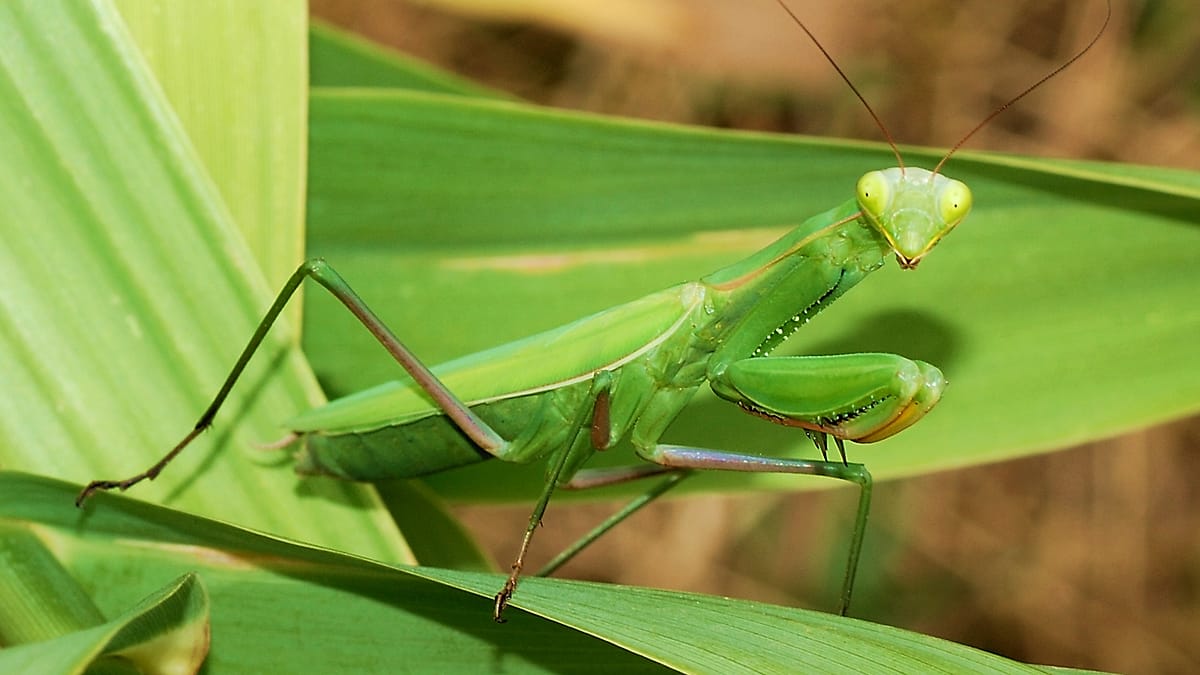
This summer's relentless heatwaves across Europe have created ideal conditions for an insect that many Germans are now spotting in their gardens for the first time: the praying mantis. The species, known scientifically as Mantis religiosa, thrives in warm, dry habitats, and 2026 has delivered exactly that.
According to the German Nature and Biodiversity Conservation Union (NABU), the number of praying mantis sightings reported this year has reached unprecedented levels. From the beginning of July to mid-August alone, the citizen science platform NABU-naturgucker.de recorded more than 15,000 reports—more than in the whole of 2025. The organization says the data, which includes photographs, is remarkably reliable, with an error rate of just one in a thousand.
A warmth-loving species on the move
The praying mantis is among the largest native insects in Germany. Males can grow up to six centimetres long, while females reach eight centimetres. Its distinctive triangular head, which can rotate on a long neck, sets it apart from grasshoppers, whose heads are attached directly to their thoraxes. The insect's colour ranges from green to brown, and it is roughly twice the size of a bush-cricket.
Originally from Africa, the praying mantis has been established in the Mediterranean region for millennia. NABU notes that its migration into Europe dates back around 10,000 years. In the late 19th century, it was introduced to the United States, where it has since spread widely. In Germany, the species has traditionally been confined to the warmer south-west and east, but rising temperatures are allowing it to push further north.
This year, after a warm spring, particularly large numbers were recorded in the state of Baden-Württemberg. Researchers are now asking the public to help them map the species' expanding range. They are especially interested in whether the separate populations in south-western and eastern Germany are beginning to merge, a question with implications for the species' long-term viability in a warming climate.
NABU is encouraging anyone who spots a praying mantis to report it on the Naturgucker platform, ideally with a photograph. The data will help scientists understand how climate change is reshaping insect distributions across the continent.
Despite their fearsome appearance, praying mantises pose no danger to humans. They have no venom and cannot sting. Both larvae and adults feed exclusively on other insects and spiders, lying in wait motionless before striking with lightning speed. Their prey is held fast and eaten alive.
The species is perhaps best known for its sexual cannibalism: most males die after mating, often being consumed by the female, who uses the protein to produce eggs. Only the eggs survive the winter, hatching in the spring.
The surge in sightings is part of a broader pattern of climate-driven changes in European wildlife. As temperatures rise, species from the south are expanding their ranges northward, while some native species struggle to adapt. The praying mantis is just one example of how the continent's ecosystems are being reshaped.
For those who encounter a praying mantis, NABU advises simply observing and photographing it, then submitting the sighting online. The insect is a fascinating addition to Germany's biodiversity, and its presence is a clear signal of the changing climate.