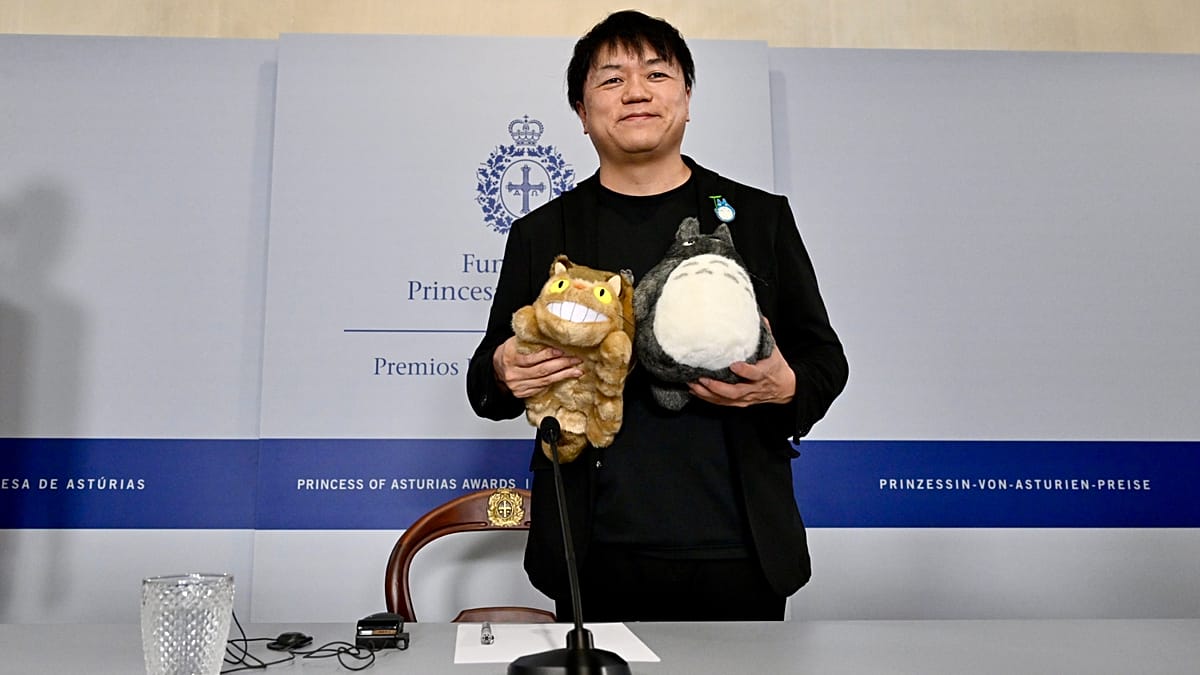
Kenichi Yoda never imagined he would one day lead the animation studio he once covered as a culture journalist for the Yomiuri Shimbun. On 22 June, he became president of Studio Ghibli, succeeding Hiroyuki Fukuda. Two days later, he accepted the 2026 Princess of Asturias Award for Communication and Humanities on behalf of the studio, in Oviedo, Spain.
Ghibli, founded by the late Isao Takahata and Hayao Miyazaki, has long been a gateway to Japanese culture for millions worldwide. In Spain, series like Marco and Heidi—produced before Ghibli existed—introduced an entire generation to Japanese animation during the transition from Francoism to democracy. Yoda laughs at the idea that Ghibli is a tool of soft power. "Each work exists only because its directors and animators devoted themselves to it with care," he says. "We are happy that people watch it, but we are not doing it for diplomacy."
War and the beauty of machines
War is a recurring theme in Ghibli's films, from Grave of the Fireflies to The Wind Rises. Takahata was a pacifist and defender of Article 9 of Japan's constitution; Miyazaki grew up with the war, his family's company making parts for military aircraft. Yoda acknowledges the complexity: "How to address war is a very important topic for Studio Ghibli. Of course, it is better if there are no wars. But Miyazaki has been fascinated by the weapons used in war, by fighter planes, by their beauty as objects. He has not the slightest sympathy for war, but there is a feeling he cannot resist: the attraction of those things as objects. That is, in a way, something very human."
Asked about the famous line from Porco Rosso—"I'd rather be a pig than a fascist"—Yoda deflects, noting that the film is a favourite of French President Emmanuel Macron. He does not say whether such a line would be written today.
Artificial intelligence and the human touch
Artificial intelligence is an inevitable topic. In 2016, a viral clip showed Miyazaki rejecting a proto-AI, calling it "an insult to life itself." Yoda says he is asked about AI in every interview. "It is very difficult to predict how it will evolve," he says. "But imagine two restaurants: one where the food is made by an AI and another where it is made by people. I would undoubtedly choose the second."
Yoda's team signals the interview is over, but he adds a final thought: "Listening to your questions, I have realised that Ghibli is very closely bound up with its time. We debate every day what the studio can do in this era and what kind of era we are living in. In that sense, we are creating something with restraint."
He emphasises the studio's commitment to artistic creation over business plans. "It is not a business plan: it is about thinking seriously about what response the studio gives to its time. That is now the studio's day-to-day reality. And it has probably always been that way."
As Miyazaki, now 85, prepares for a generational handover, the question remains whether Ghibli can maintain its creative independence and ideals. Yoda's leadership will be tested in the coming decade, as the studio navigates a changing world while staying true to its roots.
For Europeans, Ghibli's films have been a cultural touchstone, from the early anime broadcasts in Spain to the studio's global influence. The Princess of Asturias Award, one of Spain's highest honours, underscores that connection. As Yoda accepts the award, he carries with him the legacy of two visionary filmmakers and the hopes of a studio that has captivated audiences far beyond Japan.