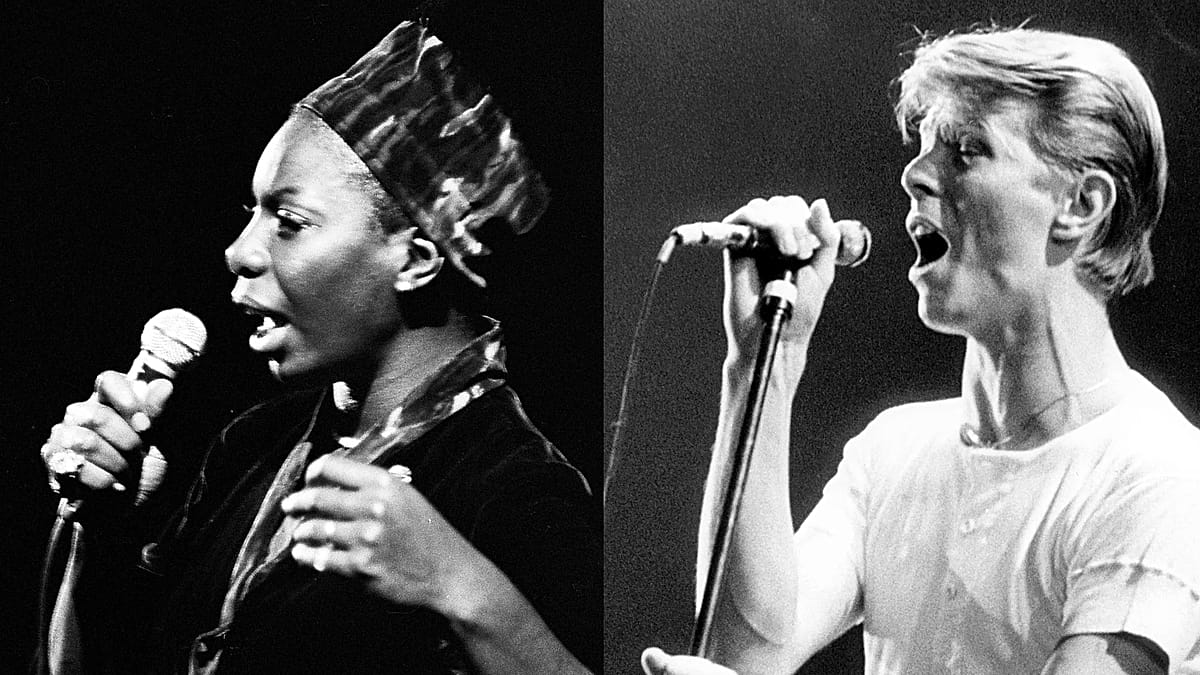
Walking into the darkened gallery at the Guggenheim Bilbao, visitors are met not by images but by sound. In one corner, Nina Simone's voice rises a cappella; from another, David Bowie responds with the same lyrics, the same song. This is the heart of Steve McQueen's exhibition 66–76–26, a sound sculpture that transforms a museum hall into a space of intimate encounter.
The British artist and Oscar-winning filmmaker first heard Wild is the Wind three decades ago. Written by Dmitri Tiomkin and Ned Washington for the 1957 film of the same name, the song was reimagined by Nina Simone in 1966 and later by David Bowie in 1976, who paid homage to Simone's version. McQueen was struck by the raw yearning in both performances—the want, the need, the must.
An experiential installation
Curator Lekha Hileman emphasizes that the exhibition is not about prior knowledge. “This is an exhibition that’s very experiential. It's about feeling, it's about being present,” she told Euronews Culture. “It's about slowing down and just receiving something. So in that way, it's very universal.” McQueen himself has said that the viewer becomes the other voice in the work.
The installation draws on a little-known anecdote: in 1975, Nina Simone's daughter dragged her mother to a David Bowie concert, and the two met backstage. McQueen sees Bowie's version as a tribute, noting “a certain kind of imitation of her voice, but then it goes somewhere.” By placing the two recordings together, he creates a duet that never happened—yet feels inevitable.
“She took that song and took it to another stratosphere,” McQueen said of Simone. “By putting these two versions together, it's complimentary. They're both singing A major. And it's one of those things where I just felt that by putting those two things together, these two stones, it makes fire. And I know for sure they would be extraordinary, happy with this collaboration, with this duet.”
Love in turbulent times
The title 66–76–26 references the recording years and the current exhibition year. Both versions emerged during periods of political upheaval—the civil rights movement, Vietnam, Watergate—and McQueen sees a resonance with today's uncertainties. “Particularly now things seem very turbulent. And I think when things are very turbulent, the things that you hold on to are the things which are precious to you, which is love,” he explained. “I know it sounds sort of corny, but it's important because that's the basis of us all in one way, shape, form or the other. That's what we crave and that's what we need.”
The exhibition opened on 9 October, McQueen's 57th birthday, after six years of planning. While he is best known for films like 12 Years a Slave—which earned him an Oscar, a Golden Globe, and a BAFTA—McQueen first gained recognition as a contemporary artist, representing Great Britain at the Venice Biennale and exhibiting at London's Tate museums.
In parallel, the Guggenheim Bilbao is screening a film programme dedicated to McQueen's cinematic work, inviting audiences to consider the interplay between his moving images and gallery installations. 66–76–26 continues his long-standing exploration of perception, embodiment, memory, and duration—the capacity of art to create spaces for reflection and encounter.
For those who cannot visit Bilbao, the exhibition offers a reminder of how art can bridge generations and geographies. As McQueen put it, the duet is a meeting of two voices that, though separated by time, speak to a shared human longing. The installation is a testament to the enduring power of a song to carry emotion across decades—and to the ability of a museum to become a place of quiet, profound connection.