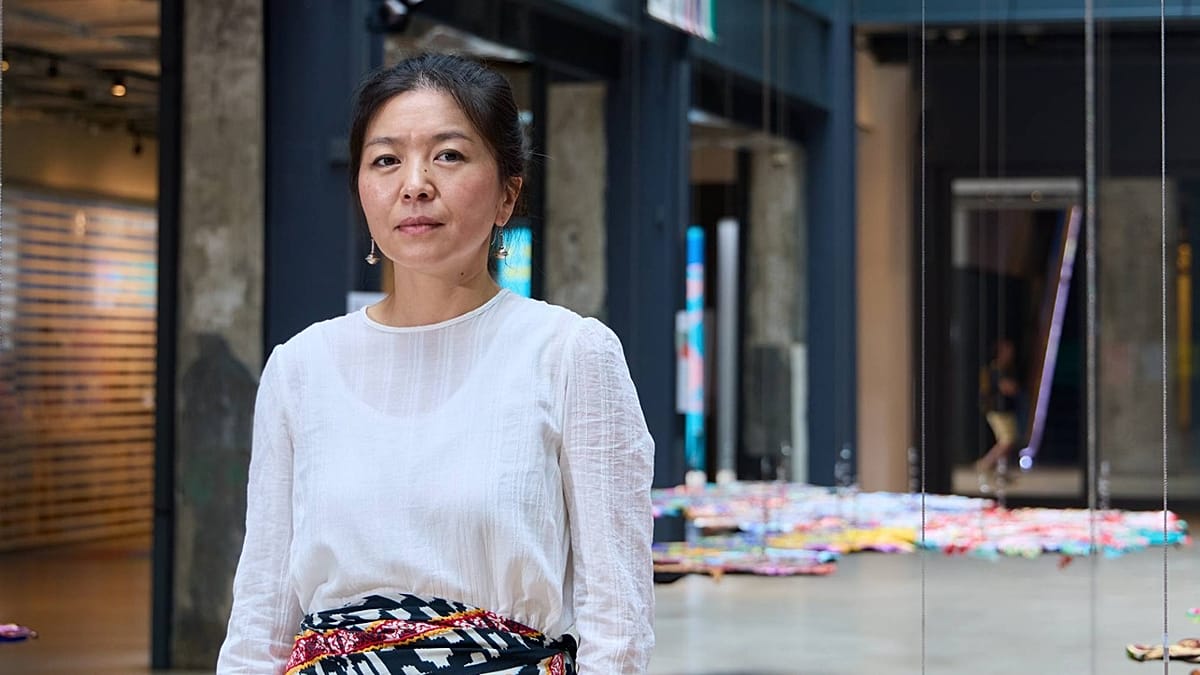
At this year's Frieze London, one of the most anticipated events on the contemporary art calendar, Kazakh-born, Berlin-based artist Gulnur Mukazhanova turned a simple material into a meditation on identity and displacement. Her ongoing Bosağa series, begun in 2021, took centre stage in a presentation supported by Turkish Airlines, offering visitors a tactile encounter with centuries of nomadic culture.
The title Bosağa comes from a word shared by Kazakh and other Turkic languages, meaning “threshold” – that liminal point between one place and another, between home and the open road, between past and future. For Mukazhanova, the threshold is not just a physical doorway but a conceptual space where cultures meet and identities are renegotiated.
Felt as a living archive
At the heart of the triptych on display is felt, a material that has sheltered generations of Central Asian nomads. Traditionally used to construct yurts, felt was both practical and symbolic – a portable home that could be dismantled and reassembled across vast steppes. Mukazhanova honours this heritage by combining handmade felt with fragments of vibrant fabric collected during her travels across Asia. Rather than sewing or gluing these pieces together, she pins them into place, creating a sense of fragility and impermanence that echoes the nomadic ethos: nothing need be permanent.
The works also draw on the tuskiiz, a traditional Kazakh embroidered wall hanging rich in symbolism and often associated with protection. Mukazhanova's research into 14th-century Italian art, particularly the richly decorated carpets that travelled from Asia to Europe along the Silk Road, further informs the series. These historical textiles were not merely decorative; they were carriers of stories, beliefs, and technical knowledge that crossed continents long before globalisation.
In an era when borders are both more porous and more contested, Mukazhanova's work resonates beyond the art world. Her exploration of movement and belonging speaks to broader questions about migration, cultural exchange, and the ways we carry our heritage with us. As Europe debates its own identity, artists like Mukazhanova remind us that culture is never static – it is a living, evolving conversation.
The Frieze presentation also highlights a growing interest in Central Asian art within European institutions. Earlier this year, Kazakhstan's rock-hewn Sufi mosques gained UNESCO World Heritage status, underscoring the region's rich cultural legacy. Mukazhanova's work, with its fusion of traditional techniques and contemporary concerns, fits squarely within this renewed attention.
For those unable to attend Frieze, the Bosağa series offers a reminder that art can be both deeply personal and universally resonant. As Mukazhanova herself has said, “Fabric holds memory. When I pin these pieces together, I am not just creating an image – I am creating a conversation between places and times.”
The collaboration with Turkish Airlines, a carrier that connects Europe and Asia, is fitting. It underscores the idea that travel – whether physical or imaginative – is central to how we understand ourselves and others. In a world increasingly defined by both connection and division, Mukazhanova's thresholds invite us to pause and consider what we carry with us, and what we leave behind.
As the art world looks to new voices from the Eurasian heartland, Mukazhanova stands out for her ability to weave together the personal and the historical. Her work is a testament to the enduring power of textiles to tell stories that words alone cannot capture.