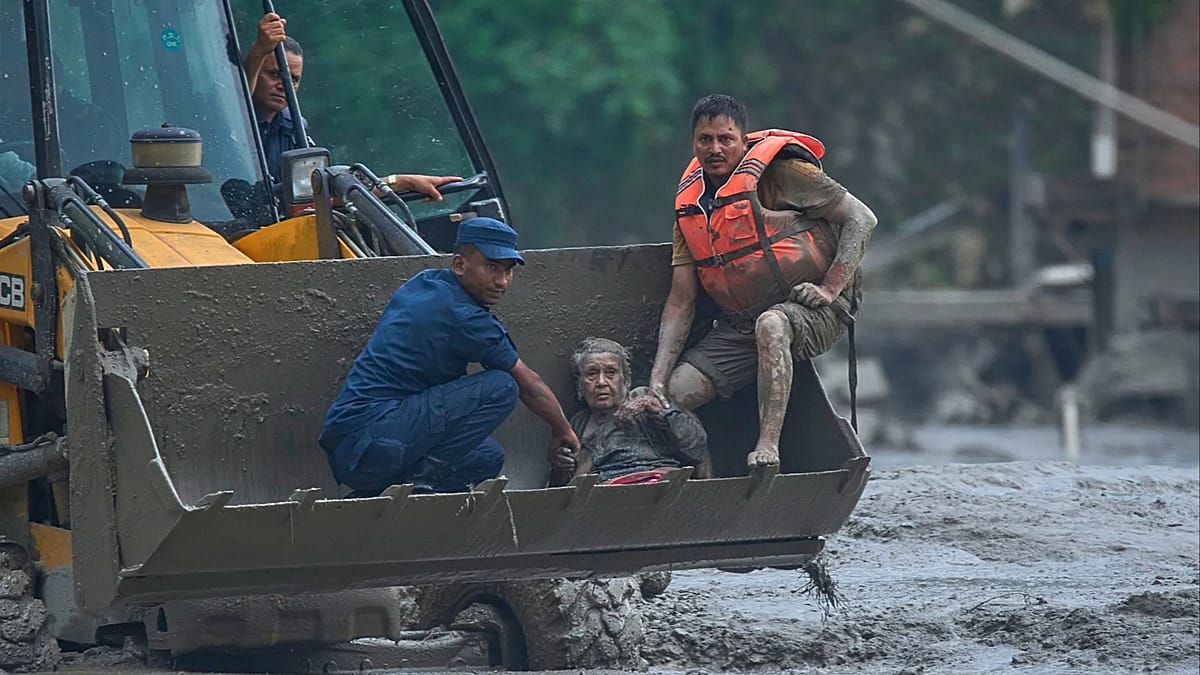
At least 165 people have died and around 1,000 remain missing after a glacial collapse triggered massive flash floods in the border region between Nepal and Tibet on Wednesday. The disaster swept through communities with little warning, destroying roads, burying buildings, and leaving a trail of devastation that authorities are still struggling to assess.
China's state media reported that mudslides in Tibet killed three people and left 558 missing, including roughly 260 foreign nationals. In Nepal, officials confirmed at least 162 deaths, with hundreds more unaccounted for. Drone footage from the Nepalese side showed torrents of water the colour of wet cement tearing through valleys, snapping bridges and engulfing entire market areas.
Rescue efforts hampered by damaged infrastructure
Rescue teams are using earthmovers to reach submerged houses in Nepal's Nuwatkot district, where the Trishuli River burst its banks. The scale of the destruction has made access difficult, and many remote villages remain cut off. In Tibet, two villagers were rescued, but the search for survivors continues under challenging conditions.
Shoyam Rajbhandari, a Tibetan resident, described the suddenness of the disaster: "When I reached Dhunge bazaar, in half an hour, the flood came and damaged all the market. People were preparing to go to the office then. How many people are missing or dead, we don't know."
Foreign nationals among the missing
The disaster has drawn international attention as foreign nationals are among the missing. Australia's Foreign Minister Penny Wong confirmed that at least 34 Australians on separate pilgrimage and hiking tours are unaccounted for. "We understand these Australians were part of separate pilgrimage and tour groups," Wong told reporters in Adelaide, adding that Australia is coordinating with Nepal, the United Nations, and the Red Cross on a humanitarian response.
Malaysia's Foreign Ministry reported that 55 Malaysians in Kathmandu are unreachable due to severe infrastructural delays. The ministry is working with local authorities to determine their safety, though no formal confirmation of their presence has been made.
Seismic event was a glacial collapse, not an earthquake
The US Geological Survey initially recorded a magnitude 4.4 earthquake near the Nepal-Tibet border, but later revised its analysis, concluding that the event was a magnitude 5.2 glacial collapse. The collapse sent debris flowing downstream with catastrophic impact. The USGS based its determination on seismic data, long-period wave analysis, and satellite imagery, ruling out an earthquake.
Climate experts at the Kathmandu-based International Centre for Integrated Mountain Development (ICIMOD) said an avalanche from a glacier likely caused the flash flood. "Hydrological observations indicate the exceptional speed and magnitude of the flood wave," they noted, with water levels on the Trishuli River rising by as much as 9 metres in just 30 minutes. The Lhende Khola River, a tributary of the Bhotekoshi, experienced maximum flooding.
Saswata Sanyal, a disaster risk reduction specialist at ICIMOD, explained: "The Lhende Khola has flooded twice in 14 months, this time triggered by an ice rock avalanche from a glacier on the Nepal side that blocked the river and released a sudden surge downstream."
Climate change heightens Himalayan risks
This catastrophe is not an isolated event. The Lhende Khola river system has now flooded twice in just over a year, and the increasingly unstable Himalayan glacier system poses a growing threat to one of the most densely populated mountain regions in the world. The steep valleys are vital economic lifelines and travel corridors, but they are highly vulnerable when disaster strikes.
Last August, a similar flash flood occurred when a glacial lake in Tibet overflowed due to high temperatures. Scientists warn that rising global temperatures are accelerating glacial melt, increasing the frequency and intensity of such events. The Himalayas, often called the 'Third Pole', are losing ice at an alarming rate, putting millions of people downstream at risk.
As rescue operations continue, the full scale of the human toll remains unclear. The international community is mobilising support, but the immediate priority is reaching those still trapped and accounting for the missing. This disaster serves as a stark reminder of the urgent need for climate adaptation and disaster preparedness in vulnerable mountain regions worldwide.