Oil prices extended their gains on Wednesday, while global equity markets presented a mixed picture as investors turned their attention to the latest US inflation figures. The data, due later in the day, could shape the Federal Reserve's monetary policy and, by extension, financial conditions worldwide.
Brent crude, the international benchmark, rose 0.9% to $89.67 a barrel in early trading, while US benchmark West Texas Intermediate gained 0.9% to $83.98. Gold also advanced, climbing 0.8% to $4,400.44 an ounce, with silver up 1% to $65.30.
The upward pressure on oil prices stems largely from the ongoing conflict in the Middle East. The United States and Israel launched strikes on Iran in late February, leading to the closure of the Strait of Hormuz, a critical chokepoint for global oil shipments. That disruption has kept a significant portion of the world's crude supply locked in the region, with Brent prices swinging between $72 and $102 a barrel last month alone.
Adding to the uncertainty, an attack by Iran-backed Houthi rebels on a vessel in the Bab el-Mandeb strait off Yemen has raised fears of a renewed civil war and further threats to regional shipping routes. These developments have kept energy markets on edge, and higher oil prices feed directly into inflation, complicating the task of central banks.
In the United States, the average price of a gallon of regular petrol has climbed to $4.01, according to AAA, up from less than $3.14 a year ago. That increase is one reason why Wednesday's inflation report is being watched so closely. Economists expect the data to show inflation eased to 3.4% in July from 3.5% in June, but any surprise could trigger volatility across asset classes.
Wall Street has already pulled back from the record highs set last Friday. The S&P 500 fell 0.3% on Tuesday, the Dow Jones Industrial Average dipped 184 points (0.3%), and the Nasdaq Composite dropped 0.6%. Treasury yields have also risen since the war with Iran began, pushing long-term US mortgage rates to their highest level in a year.
Cooler inflation would reduce pressure on the Federal Reserve to raise interest rates, which could support equity valuations. However, if inflation proves sticky, the Fed may need to tighten further, making borrowing more expensive for households and businesses and potentially dampening economic growth.
Asian markets show resilience
Across Asia, trading was mostly positive. Tokyo's Nikkei 225 gained 0.6% to 67,334.94, while Taiwan's Taiex advanced 0.8%. The Shanghai Composite added 0.3% to 3,946.51, though Hong Kong's Hang Seng slipped 1.2% to 25,352.13.
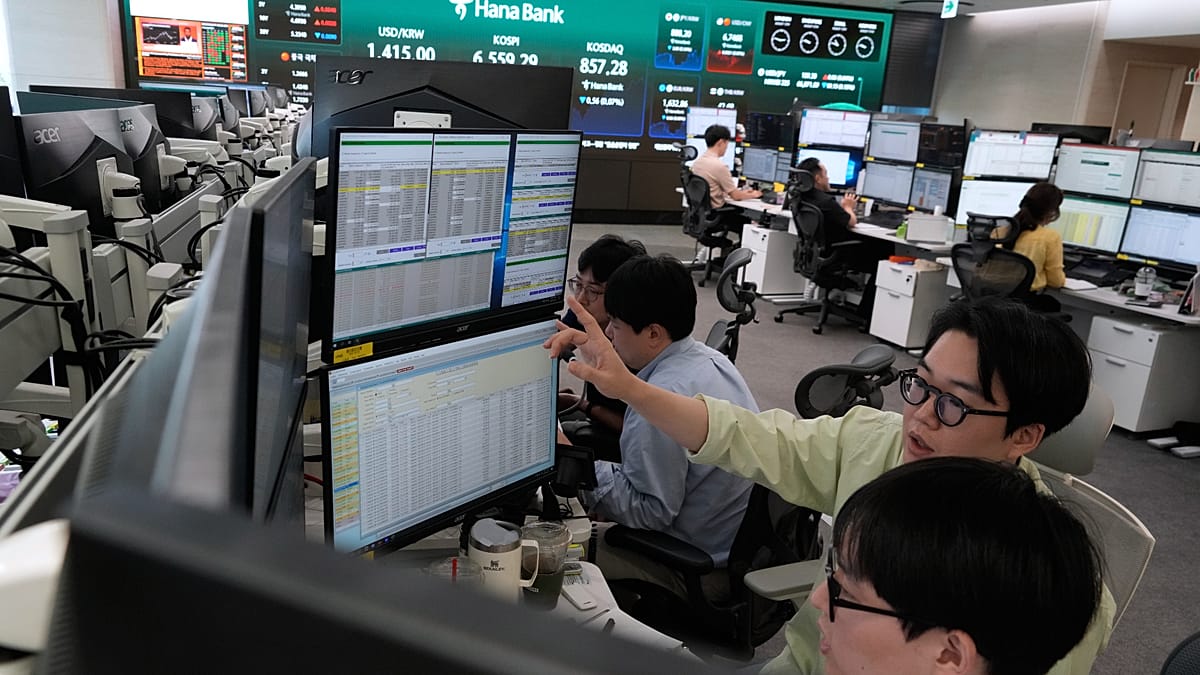
South Korea's Kospi was the standout performer, jumping more than 4% to 6,597.90 on renewed buying of computer chipmakers. Samsung Electronics surged 7.7%, and memory chipmaker SK Hynix rose 7.1%. This rally reflects continued strong demand for semiconductors, a sector that has been buoyed by the global AI boom. As AI chip demand keeps prices high, investors are betting on sustained growth for major producers.
In Australia, the S&P/ASX 200 lost 0.6% to 9,197.00, while currency markets saw the dollar edge up to 159.41 yen from 159.30 yen. The euro slipped slightly to $1.1535 from $1.1544.
For European investors, the US inflation reading carries particular significance. A stronger-than-expected figure could prompt the Fed to keep rates higher for longer, which would likely strengthen the dollar and put pressure on the euro and other currencies. It could also influence the European Central Bank's own policy decisions, as the bloc grapples with its own inflation dynamics.
Meanwhile, the energy crisis continues to reverberate across the continent. Portugal is set to see fuel prices drop sharply from Monday, offering some relief to consumers, but the overall outlook remains uncertain. The conflict in the Middle East shows no signs of abating, and Iran has rejected a comment by US President Donald Trump suggesting that Washington would demand compensation in any talks, further dimming hopes for a diplomatic breakthrough.
As the world waits for the inflation data, the interconnectedness of global markets is once again on display. From Seoul to Frankfurt, investors are bracing for the next move in a complex economic landscape shaped by war, energy prices, and monetary policy.