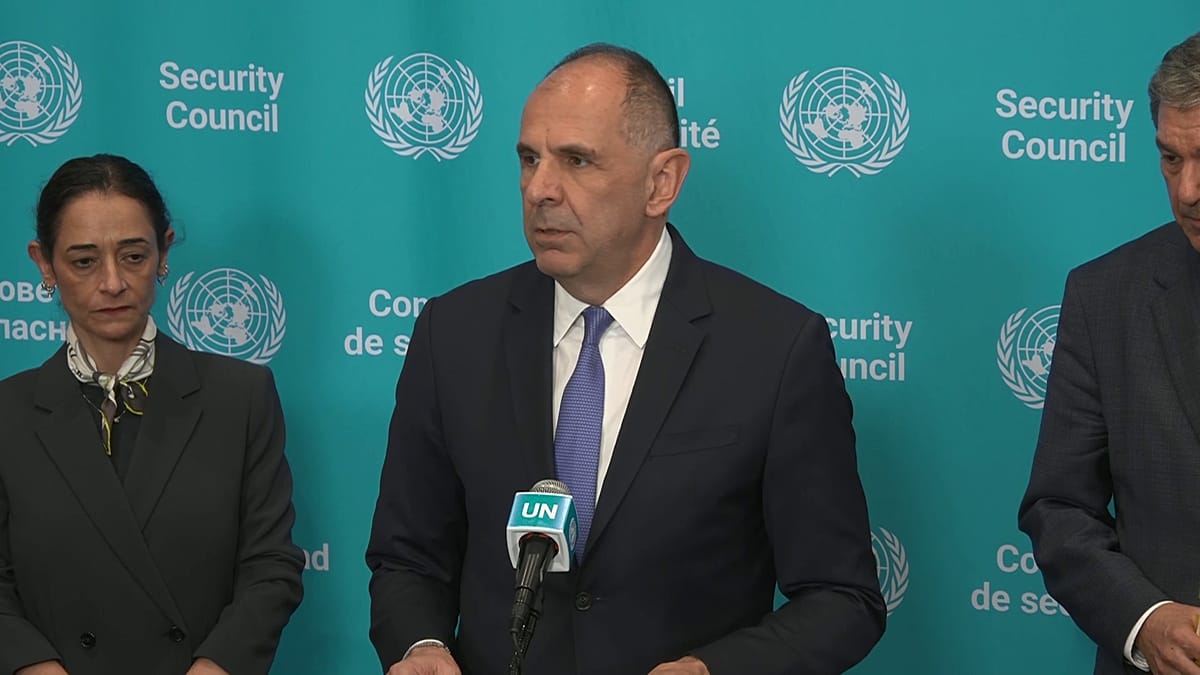
ATHENS — Greece's foreign minister, Giorgos Gerapetritis, on Monday declared that the 2019 maritime boundaries agreement between Turkey and Libya "remains null and void," delivering a joint statement on behalf of Greece, Egypt, Cyprus, Bahrain, the United Arab Emirates, and the European Union.
The statement directly addressed the recent ratification of the 2019 memorandum by Libya's House of Representatives, a move that the signatories said "raises serious concerns for regional security and stability." Gerapetritis stressed that the memorandum "runs counter to international law and cannot serve as a lawful basis for the delimitation of maritime zones, nor can it produce legal consequences for third states."
A challenge to the international legal order
The joint statement framed the issue as part of a broader challenge: the need to ensure that arbitrary bilateral agreements do not undermine established rules of international law or prejudice the rights of third states. Gerapetritis emphasized that the United Nations Convention on the Law of the Sea (UNCLOS) and customary international law provide the only legitimate framework for maritime delimitation.
These rules, he said, are "of fundamental importance for safeguarding predictability, legal certainty and peaceful relations among states." He warned that accepting bilateral agreements that disregard these principles "would create a dangerous precedent, undermining the international legal order and the principles on which the peaceful settlement of disputes is based."
The memorandum, according to the statement, violates these principles because it "ignores the geographical reality and the rights of all the coastal states involved over maritime zones, including the rights of islands in accordance with the United Nations Convention on the Law of the Sea." The signatories added that "the subsequent decision of Libya's House of Representatives does not alter this legal reality."
The dispute has long been a flashpoint in the eastern Mediterranean, where competing claims over energy resources and maritime jurisdiction have strained relations between Ankara and Athens. The 2019 deal, signed between Turkey and Libya's internationally recognized government at the time, was widely seen as an attempt to assert Turkish claims over waters that Greece considers its own, particularly around Crete and the Dodecanese islands.
Greece has consistently rejected the agreement, and the latest joint statement reinforces that position with the backing of key regional and international partners. The inclusion of the European Union underscores the bloc's interest in upholding a rules-based order in the Mediterranean, a region where energy exploration and migration routes remain sensitive issues.
The signatories also reaffirmed their commitment "to the reunification of Libya's institutions and to the prospect of a united and prosperous Libya," stressing that a stable Libya, engaging actively in regional cooperation, was essential for peace and security in the Mediterranean.
Analysts note that the ratification by Libya's House of Representatives, based in the eastern city of Benghazi, may not carry full legal weight given the country's divided political landscape. The Tripoli-based Government of National Unity, which signed the original memorandum, has not endorsed the ratification, further complicating the legal status of the deal.
The joint statement comes amid broader tensions in the region, including ongoing disputes over energy exploration and naval boundaries. Greece has also been bolstering its own maritime claims through diplomatic channels, and the country's tourism sector has continued to grow, with foreign visitors leading a 2.6% rise in August.
Meanwhile, the EU has been grappling with energy security concerns, and the bloc's ministers recently weighed energy demand cuts as the Hormuz crisis persists. The Mediterranean's strategic importance is thus not only geopolitical but also economic, as European states seek to diversify energy sources and secure stable supply routes.
For now, Greece and its allies have drawn a clear line: the 2019 memorandum has no legal standing, and any attempt to enforce it will be met with unified opposition. As Gerapetritis put it, the rules of international law are not optional, and the peaceful settlement of disputes must remain the cornerstone of regional relations.