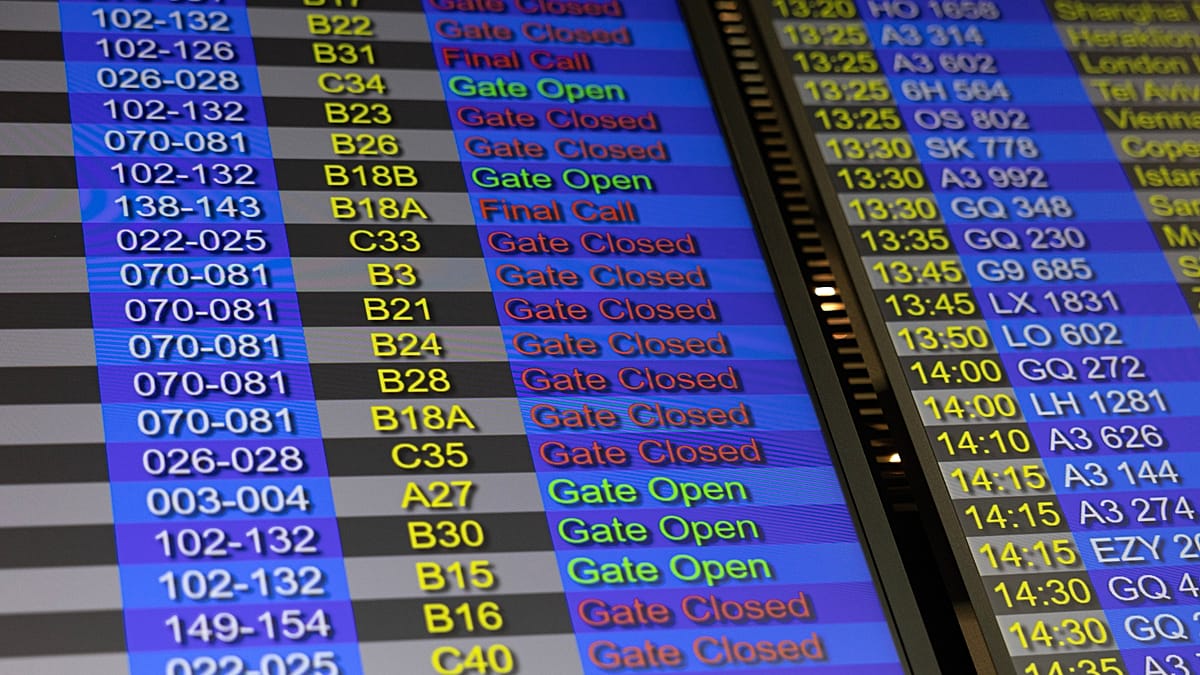
Greece’s Hellenic Civil Aviation Authority (HCAA) has released operational data for June 2026 showing a decline in flight delays at Athens International Airport, countering earlier reports based on Eurocontrol figures that suggested a sharp increase. The discrepancy highlights the complexity of measuring air traffic performance across Europe’s fragmented airspace.
According to the HCAA, the average delay per flight due to air traffic at Athens airport stood at 4.43 minutes in June, down from 6.50 minutes during the same period in 2025—a reduction of more than two minutes. Total delays at the airport fell by 31.77% year-on-year. At the Athens–Macedonia Area Control Centre (KEPATHM), the average delay was 2.26 minutes per flight, compared with 1.62 minutes in June 2025. Excluding weather and external factors, the figure was 0.97 minutes, up slightly from 0.85 minutes a year earlier.
The statement comes after reports citing Eurocontrol data indicated that delays across Greek airports had risen 63% compared with the same period last year. In the last week of June, Greece accounted for 13% of all delays recorded across the European air transport network. The HCAA cautioned against equating network-level air traffic flow management (ATFM) delays with the passenger experience at individual airports. “These indicators are important for the operational monitoring of airspace,” the authority said. “However, they should not be equated with the overall passenger experience at airports, nor interpreted as the average delay time faced by each flight.”
Network Pressures and Geopolitical Factors
The HCAA attributed the increase in ATFM delays to seasonal demand and geopolitical developments that have altered flight patterns in the wider region. The authority noted that on 4 July 2026, traffic reached 4,925 flights, exceeding the 2025 peak of 4,916 flights recorded on 10 August. “In this context, efforts to ensure the smooth handling of flights are constant and ongoing,” the HCAA added.
Greece’s airspace has faced mounting pressure this summer, partly due to rerouted flights avoiding conflict zones. The ongoing war in Ukraine and instability in the Middle East have forced carriers to adjust routes, adding strain to southern European hubs. Meanwhile, the aviation industry has urged the EU to suspend its digital border system amid concerns over summer chaos, a move that could further affect traffic flows.
The HCAA’s data suggests that despite these pressures, the operational impact on Greek airports remains more limited than the impression created by isolating a single indicator. The authority emphasized that its figures reflect actual delays experienced by flights, not just network-level metrics.
Greece’s tourism sector has seen a 37% rise in revenue and a 27% increase in arrivals in early 2026, according to recent reports. The country’s ability to manage air traffic efficiently is critical to sustaining this growth, especially as wildfires rage across southern Europe, with Greece warning of toxic smoke from blazes that have disrupted travel in some regions.
The HCAA’s clarification comes as European air traffic management faces broader challenges. Eurocontrol has reported that delays across the continent have risen due to capacity constraints and staffing shortages. In Greece, the authority’s operational data for June shows that average delays at KEPATHM remain below two minutes when external factors are excluded, suggesting that core air traffic control performance has held steady.
For travelers, the HCAA’s figures offer some reassurance. The reduction in delays at Athens International Airport, a key gateway for tourists, contrasts with the narrative of worsening congestion. However, the authority’s statement also underscores the need for continued investment in air traffic management infrastructure to cope with rising demand and geopolitical disruptions.