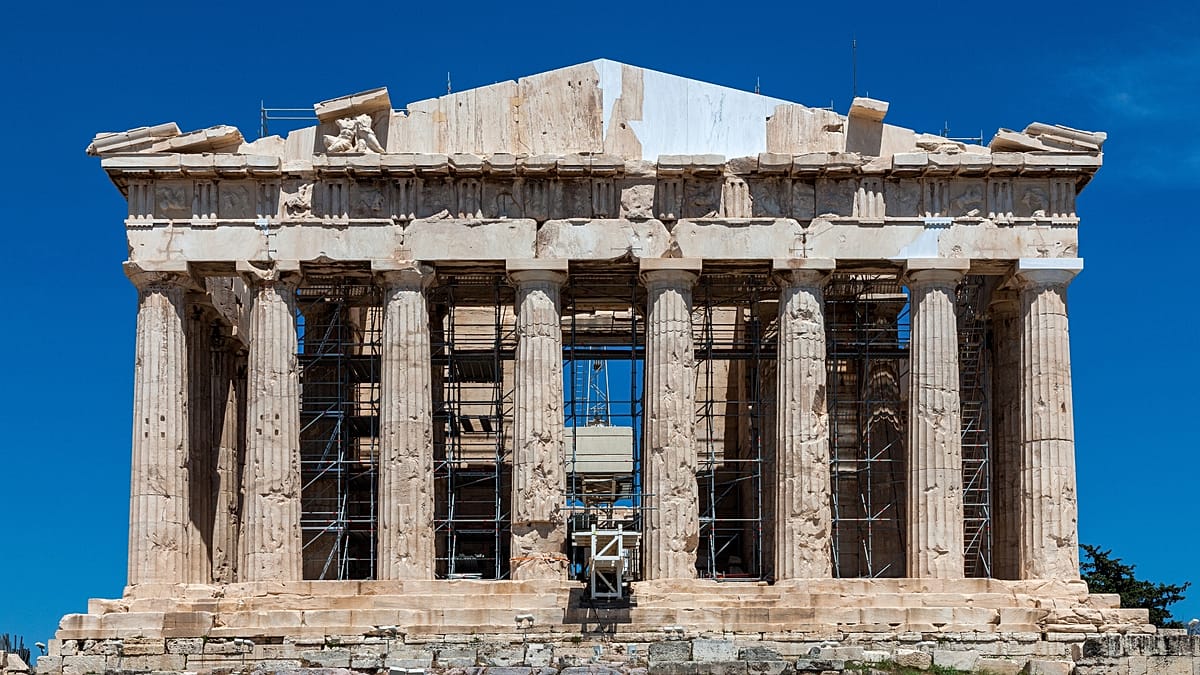
For the first time in over two centuries, the west façade of the Parthenon in Athens stands fully exposed, as Greece's Acropolis Monuments Restoration Service (YSMA) has permanently removed the external scaffolding that had obscured its classical lines. The completion of this phase marks a historic moment for the monument, the Acropolis, and global cultural heritage.
A Complex Restoration
The restoration focused on the western pediment's orthostates—the upright stone blocks that form the tympanum's base. According to Greece's Ministry of Culture, the intervention was one of the most demanding in recent years, requiring highly specialised technical solutions and absolute precision at every stage. Workers bonded surviving ancient fragments with new marble to restore one large orthostate to its original geometry, while a second was crafted entirely from new marble. A new functional scaffolding system, designed to meet modern safety standards while blending aesthetically with the monument, was used for the final placement.
Culture Minister Lina Mendoni described the achievement as "a moment of historic significance for the monument, for the Acropolis and for world culture." She noted that the pediment, which generations of Greeks and international visitors had grown accustomed to seeing incomplete, is now regaining its architectural unity. "The two new orthostates do not simply make good a morphological gap," she said. "They allow the unique proportions and geometric perfection of the Parthenon’s western façade to be highlighted once again."
The sight, Mendoni added, is "truly breathtaking," filling the nation with pride and a sense of responsibility to continue protecting what she called "the foremost symbol of Western civilisation."
This restoration milestone comes as Greece continues to invest in cultural heritage and tourism infrastructure. The country has also launched initiatives like the PosoKanei app, which lets shoppers compare supermarket prices in real time, and Hellenic Seaplanes is expanding routes to Albania and beyond, eyeing a Mediterranean network. Meanwhile, southern European destinations including Greece, Spain, and Italy are expected to lead a travel surge in summer 2026, as the region gains popularity among global tourists.
The Parthenon, built in the 5th century BCE as a temple to Athena, has endured centuries of war, looting, and environmental degradation. Its west façade had been partially hidden by scaffolding since the early 19th century, when restoration efforts began in earnest. The current project, part of a broader conservation program, aims to stabilise the structure and restore its original appearance using authentic materials and techniques.
Experts say the removal of scaffolding not only enhances the visual impact of the monument but also improves its structural integrity. The new orthostates are designed to withstand seismic activity and weathering, ensuring the Parthenon remains a symbol of ancient Greek achievement for future generations.
For visitors to Athens, the unveiled west pediment offers a rare opportunity to see the Parthenon as it was meant to be seen—a testament to the precision and artistry of classical architecture. The Acropolis, a UNESCO World Heritage site, attracts millions of tourists annually, and this restoration is expected to further boost interest in the country's cultural treasures.
As Mendoni emphasised, the work is not just about aesthetics but about preserving a legacy. "Today we are looking at the west pediment of the Parthenon as it has not been seen for two centuries," she said. "It is a moment that fills us with pride, but also with a sense of responsibility to continue, with the same consistency, the great work of protecting and showcasing the foremost symbol of Western civilisation."