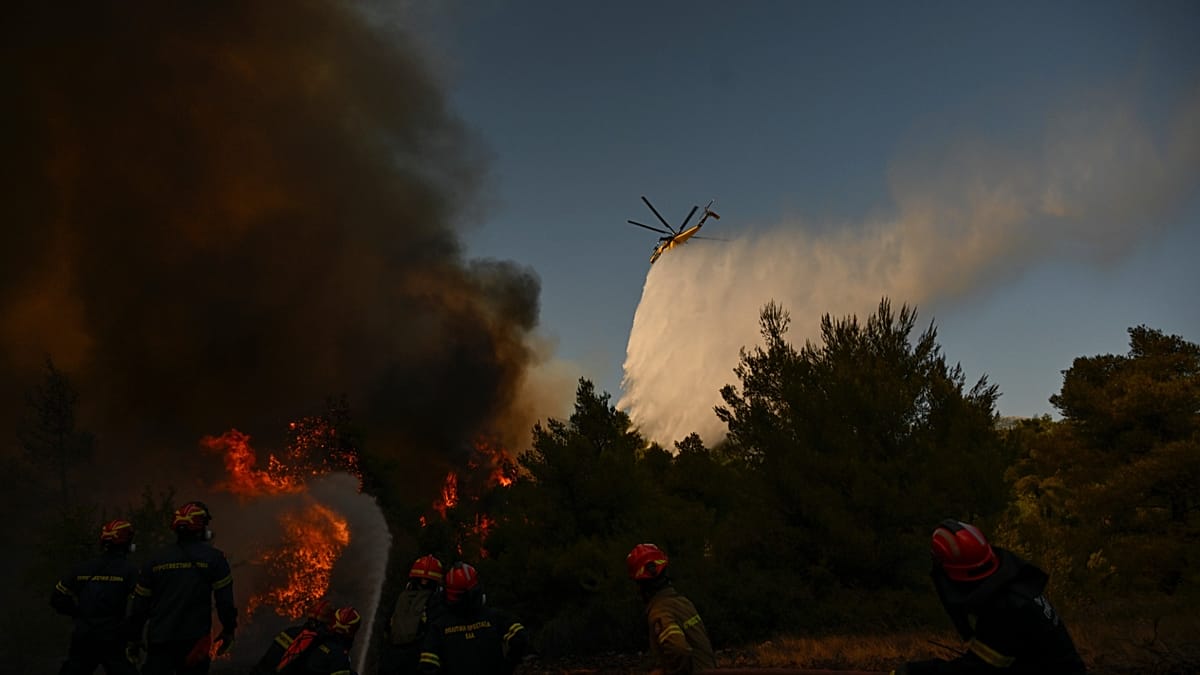
Five water-dropping planes and five helicopters took off at dawn on Monday to reinforce hundreds of firefighters battling a major wildfire west of Athens, a day after a mid-air collision between two firefighting helicopters killed two crew members. The incident underscored the dangers faced by those on the front lines of Europe's escalating wildfire crisis.
The two victims—a Greek coordinator and a Danish pilot—died when their helicopter collided with another near the coastal area of Psatha while both were engaged in water-dropping operations. The second helicopter's crew, a Greek and a British national, were taken to hospital with what were described as light injuries. International firefighting crews are routinely deployed to Greece during its hot, dry summers to assist with the country's frequent blazes.
Greek Prime Minister Kyriakos Mitsotakis expressed his condolences, saying, "The loss of the Greek coordinator and the Danish pilot as they were fighting the major blaze at Porto Germeno fills us all with grief. My sincere condolences to their families."
Flames push toward Athens, but winds ease
The fire, which started on Friday morning, has raged through pine forests and scrubland, driven by gale-force winds that at times grounded aircraft. By Monday, the flames had advanced deeper into the Attica region, prompting fresh evacuation orders for three more areas in the early hours. More than 1,000 people have been evacuated, including over 250 rescued by boat from beaches.
However, winds were beginning to subside, raising hopes that the nearly 500 firefighters on the ground could halt the blaze's advance. Crews were also working to create firebreaks in a forest to protect communities. Authorities warned that the broader Athens region remained at high risk due to a forecast rise in temperatures.
The fire's cause is under investigation. Greece's firefighting department said on Sunday that it likely originated from sparks from a faulty power line connecting a private wind generator facility to the national grid. Two people—an electrical engineer and a contractor involved in the project—have been arrested on felony arson charges, and an arrest warrant has been issued for the owner of the wind generator company.
Greece experiences devastating wildfires every summer, with hot, dry conditions and strong winds turning small sparks into major conflagrations. Many fires are caused by negligence, such as ignored bans on barbecues and outdoor welding. But some are deliberately set; on Sunday, authorities arrested a man on the island of Kefalonia suspected of starting a fire that forced the evacuation of nearby villages.
The situation in Greece is part of a broader pattern of extreme fire activity across southern Europe. In France, the largest wildfire of the season remained contained within its perimeter on Sunday night, after forcing 224,000 people to flee—possibly the country's largest civilian evacuation outside wartime. Hotspots still smoldered within a 420-square-kilometre scar, and nearly 3,000 firefighters were deployed against the Gironde megafire and a separate blaze in Provence. Together, the fires in France and Spain have displaced roughly a third of a million people, straining emergency services across the continent.
As Europe faces another summer of intense wildfires, the need for coordinated response and long-term prevention has never been more urgent. The EU crisis chief has called wildfires a wake-up call, and experts warn that rising wildfire risk will continue to challenge the region.