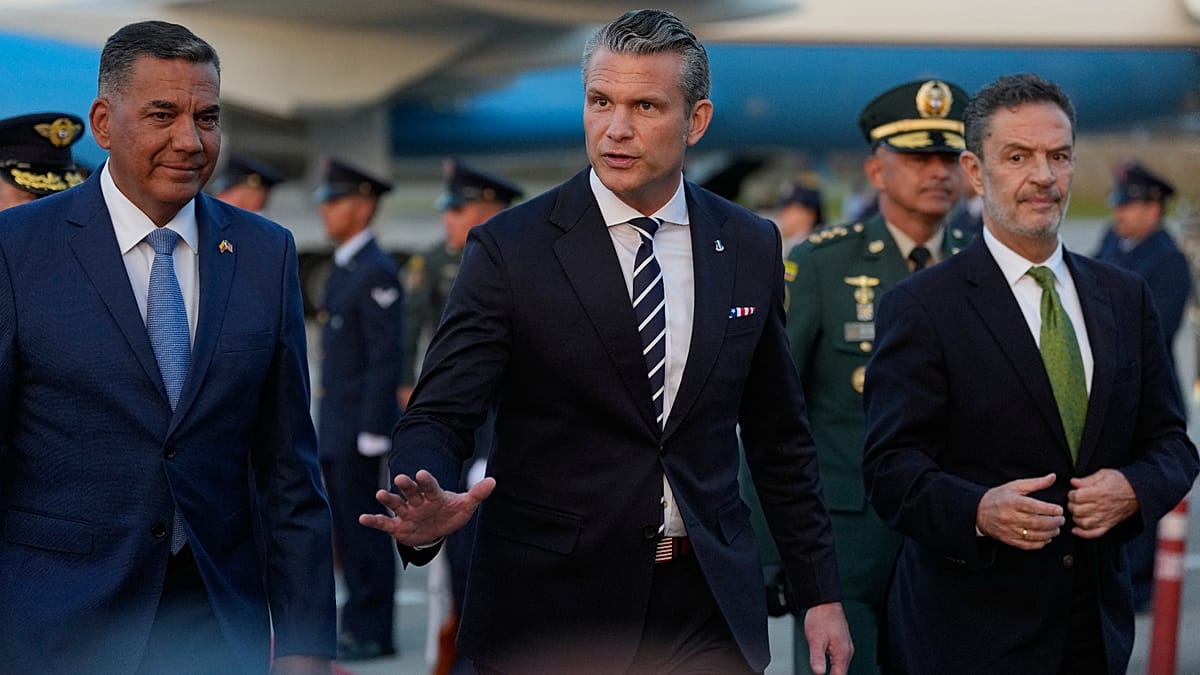
US Defense Secretary Pete Hegseth landed at a military airbase in Bogotá on Wednesday for talks on security cooperation, days after an unannounced stopover in Venezuela that signaled a shift in regional policy. He was received by Colombian Defense Minister Jorge Eduardo Mora, who had told Congress the previous day that the Pentagon chief would hand over a C-130 Hercules transport aircraft during the visit.
Standing alongside Colombian ministers, Hegseth struck a combative tone: “In each country, according to each country's laws, but in working together, we are going to find, we are going to hunt, we are going to kill and defeat narcoterrorists.” He added that “each country wants to deny safe haven to those cartels while respecting the sovereignty, the laws and the constitution and the congress of each individual country, but bonding and working together to take a fight to a common enemy in way that has never happened before.”
After a closed-door meeting, Colombian Foreign Minister Omar Bula said the government would ask Congress to approve joint military operations with the United States. Washington has long supported counter-narcotics strikes inside Colombia, and the new right-wing administration of President Abelardo de la Espriella has intensified that cooperation since taking office in August. Bula noted that the president “has been very clear about his country's sovereign position, and it is also very clear to the secretary of war after the conversation we had.”
An alliance under strain
Hegseth's visit comes at a delicate moment for his own position. He is facing an impeachment attempt in the US Congress, led by Republican lawmaker Thomas Massie, who accuses him of mismanaging the war with Iran, overstepping his authority in personnel decisions, and carrying out extrajudicial killings through strikes on boats suspected of smuggling drugs in the Caribbean and Pacific. Hegseth has survived the push for now, but the political turbulence in Washington adds an unpredictable element to his diplomatic engagements.
Colombia has traditionally been one of the United States' closest allies in the region, and the two countries have long cooperated against drug trafficking—linking the world's largest cocaine market with one of its biggest producers. The new Colombian president, who vowed to confront the country's many trafficking groups, has stepped up military cooperation with Washington and intensified the crackdown.
Hegseth's trip follows a series of high-level exchanges. Vice President JD Vance cancelled a planned visit to Colombia this month, while Secretary of State Marco Rubio visited in September and pledged to “restore” ties with Bogotá after four years of leftist government. Most recently, General Dan Caine, a top US military officer, visited Colombia last week to coordinate joint efforts against drug trafficking.
The two countries are currently carrying out a major offensive against criminal gangs that Washington classifies as terrorist organisations. More than 300 US soldiers recently trained with 400 Colombian troops in anti-trafficking exercises, which US Southern Command (SOUTHCOM) said highlight “the deep and enduring security partnership between the United States and Colombia.”
While the focus of Hegseth's visit is bilateral, the broader context is regional. The surprise stopover in Venezuela—where the US and Venezuela announced military cooperation—has raised eyebrows across Latin America and in European capitals that have watched Washington's shifting approach to the region. For European observers, the deepening US-Colombia security ties are a reminder of the complex dynamics in the Americas, where drug trafficking remains a transnational challenge with global implications.
As the US and Colombia move closer, questions remain about the legal and political framework for joint operations. Colombia's Congress will have the final say, and the debate is likely to be contentious. For now, Hegseth's visit underscores the Trump administration's determination to confront narcotrafficking head-on, even as its own political battles rage at home.