Hong Kong's Chief Executive John Lee has concluded a visit to Kazakhstan with the largest delegation he has led on any foreign trip — 75 officials and entrepreneurs representing logistics, green energy, mining, technology, and education. The trip comes as China's trade with Central Asia grew 12% year on year, reflecting a broader surge in Chinese economic engagement across the region.
Kazakhstan's President Kassym-Jomart Tokayev, who met with Lee, expressed confidence that the visit would open new opportunities to strengthen mutually beneficial cooperation, expand business contacts, and launch promising joint projects, including in investment, finance, digitalisation, AI, and transport and logistics.
"This event will undoubtedly give further impetus to the development of cooperation between Kazakhstan and Hong Kong, and more broadly, between Kazakhstan and China, with which we enjoy a long-standing comprehensive strategic partnership," Tokayev said. "Our countries maintain a high level of political dialogue and are actively developing trade, economic, and investment cooperation. The same can be said about our relations with Hong Kong."
Hong Kong as a Bridge for Chinese Enterprises
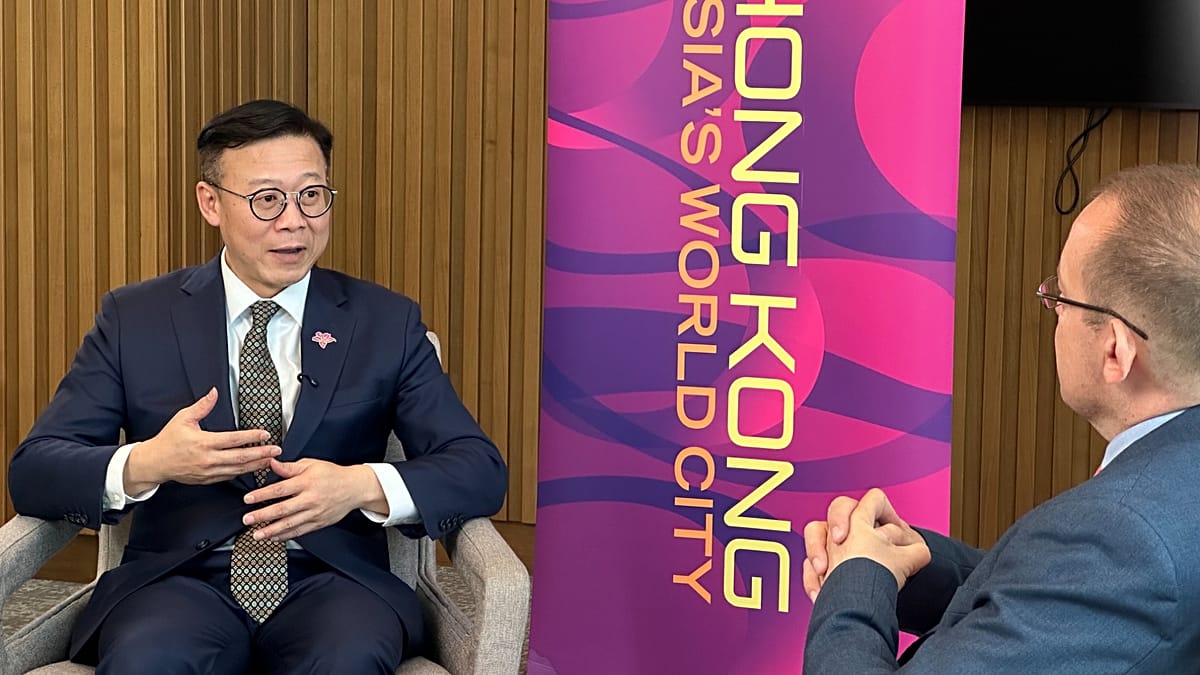
Hong Kong's Deputy Secretary for Justice Dr Cheung Kwok-kwan told Euronews the delegation was designed to position Hong Kong as a bridge between Chinese mainland companies seeking to expand internationally and Central Asian markets. "Certainly, Central Asia is a promising, emerging new market for the Chinese mainland enterprises," he said.
"So, you can see, in this delegation we have enterprises from Hong Kong, and they are very good, especially in the financial sector as well as the innovation and technology sector. We also have Chinese mainland enterprises, and you can see on the list that they are some of the big enterprises of mainland China."
The online platform Dr Cheung oversees is a prime example of the kind of cooperation Hong Kong seeks. Its purpose is to provide a database of professional service providers for companies from Hong Kong and mainland China that wish to enter foreign markets. "In the past, Chinese companies that wanted to go to the international markets without the professional services of Hong Kong faced many challenges and many failure cases because they were not familiar with the commercial culture or the regulatory regime of the overseas market," Dr Cheung explained.
"For the Hong Kong professional service providers, Central Asia is not a new market and I bring many success stories with this delegation. For example, Central Asian airline companies lease planes from Chinese airlines and we can help this transaction."
Shared Legal Foundation
The delegation's visit included a stop at the Astana International Financial Centre, which operates under English common law, the same legal framework that governs Hong Kong. Cheung said the shared legal foundation created direct opportunities for Hong Kong lawyers and financial professionals to act as intermediaries for Chinese mainland businesses operating in Kazakhstan and across Central Asia.
"The companies from mainland China can come here under the guidance of legal practitioners from Hong Kong," he said. "And not only from the Chinese mainland but also businessmen from the Middle East and all around the world."
The visit coincides with a broader surge in Chinese economic engagement across Central Asia. Trade between China and the five Central Asian states reached $106.3 billion (€91.3bn) in the first 10 months of 2025, according to China's Ministry of Commerce — outpacing the previous year's growth rate by six percentage points.
For European readers, this development is noteworthy as it underscores the growing economic ties between China and Central Asia, a region that has traditionally been a sphere of influence for Russia and, increasingly, the European Union. The EU has been deepening its own engagement with Central Asia through initiatives like the EU-Central Asia connectivity strategy, which aims to develop sustainable transport and energy links. As China's presence expands, European policymakers may need to recalibrate their approach to ensure a balanced and competitive environment in the region.