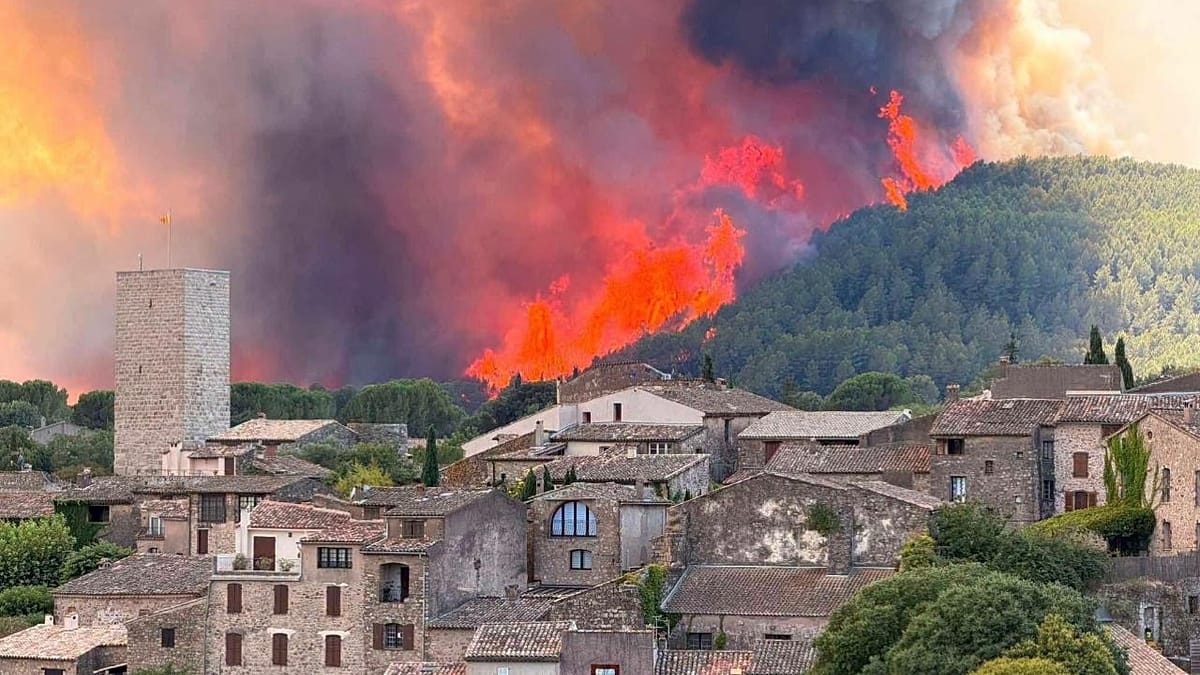
Ash still coated the narrow streets of Cotignac on Wednesday morning after a wildfire that erupted on Tuesday afternoon swept through the medieval cliffside village in the heart of Provence. The blaze destroyed nearly 60 homes and scorched thousands of hectares across five communes overnight, leaving a community shaken but resilient.
The fire began in a field near the village of Pontevès and, driven by fierce winds and drought conditions, raced northward before reaching Cotignac after dark. By dawn, more than 900 firefighters—including reinforcements from across southern France and Marseille's naval pompiers—had been deployed to contain the flames.
Four people were injured: two firefighters and two civilians. Around 500 residents were evacuated across the affected communes by Wednesday afternoon. Thousands of homes lost electricity, the majority in Cotignac itself, a village that regularly wins recognition as one of France's most beautiful and whose summer population swells from roughly 2,500 to nearly 10,000.
Historic Sites Spared by Meters
The Sanctuaire Notre-Dame de Grâces, a 16th-century pilgrimage site built on the spot where the Virgin Mary is said to have appeared in 1519, and the nearby Monastery of Saint-Joseph du Bessillon were evacuated and came within meters of the flames but survived. The narrow escape underscored the fragility of the region's cultural heritage amid increasingly severe wildfire seasons.
For residents who lived through the night, survival depended on quick decisions and often on the kindness of strangers. Lolita Philippon described how an elderly relative had come close to being caught in the flames in the Caillades area. “My ex-mother-in-law got stuck in the flames. She went back home to save her cats and put them in safety. She got stuck by the flames while getting out,” Philippon told Euronews. “Her sister got her back in the car. They wanted to leave together, but in the end they got stuck. She panicked and got out of the car.” The woman then took refuge in a neighbor's pool, Philippon said, before her son contacted firefighters and rescued her.
With official information slow to reach residents, the village's informal networks carried much of the weight of communication through the night. “We all went to the centre of the village and watched the smoke roll over the hills from a huge fire that seemed to be right behind the village, and there wasn't a lot of information going around officially,” another resident, John Michael Peck, told Euronews. “We all found ourselves gathering in places known to us all where everyone would be and just exchanging information, because everyone wanted to know what to do, how close the fire was.”
Peck noted that many residents had relatives or friends among the pompiers, providing a stream of firsthand updates. That community network translated into practical help. “A lot of people ended up opening their doors to strangers. Anyone who was in a location that was affected or ordered to evacuate came to the village and got filtered through the network of friends and relations and taken care of really well,” he explained. “The priests and the nuns came down from Notre-Dame, which had flames literally licking the stones behind it in the woods, and were able to easily find accommodation with strangers.”
Peck said Lou Calen, an eco-resort with a Michelin Green-starred restaurant, opened its doors on Wednesday morning and gave breakfast to anyone who had been at the sanctuary. He himself left for the home of a friend of a friend in Salernes. “I showed up with my cat and my best friend and his baby. They took us on like family. That's Cotignac,” Peck concluded.
The destruction has left some families with nothing. “When I went to work this morning, my colleague told me that his parents completely lost their house because of the fire last night in Cotignac,” a second resident, Manon Roubard, told Euronews. “So they had to leave. And thanks to all the community, Carcès opened free places that people who had to leave could go.” She added, “They went to Carcès. And one of their friends called them to tell them to come over and sleep for the night. So I could feel relief at least a little bit, but it was really painful for them. They are completely lost. It is really complicated for people like them—older people—who can lose everything.”
The town of Carcès activated its emergency community plan and opened three reception facilities, including a gymnasium and the Château hall, to support evacuees from the affected area. The wildfire in Cotignac is part of a broader pattern of intense blazes across southern Europe this summer, with France already seeing record burned areas. For more on the regional context, see our coverage of France's record wildfire season and similar fires in Spain.