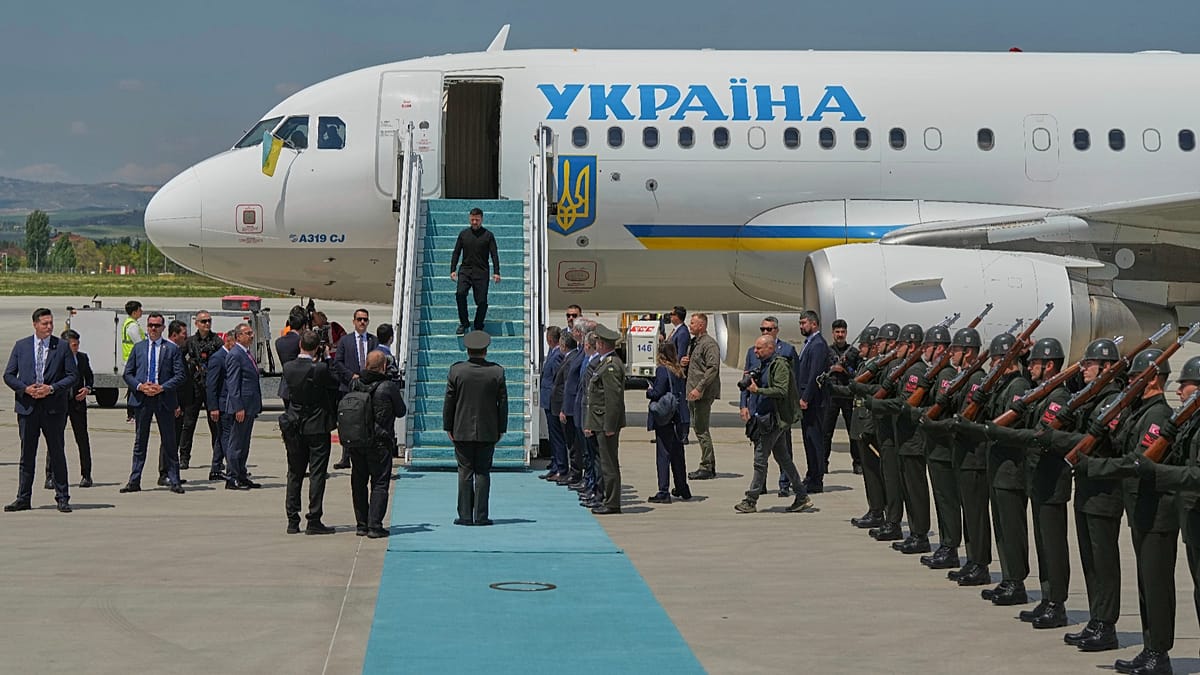
On Tuesday afternoon, Ukrainian President Volodymyr Zelenskyy's aircraft was preparing to leave Chișinău for Oslo when Moldovan military radar picked up an unidentified unmanned aerial vehicle in the country's airspace. What initially seemed like yet another Russian drone intrusion took on far greater significance the next day, when Norwegian Prime Minister Jonas Gahr Støre revealed that the presidential plane had come within moments of being struck.
“His flight was almost hit by a drone when it was taking off from Moldova. That is the reality he lives in,” Støre told Norwegian public broadcaster NRK.
The incident unfolded over roughly 90 minutes, according to official statements and open-source monitoring channels. Here is how the sequence played out.
Timeline of the incursion
At 4:20 pm CEST, Moldova's military detected an unidentified UAV in its airspace. Seventeen minutes later, at 4:37 pm, Romania's Defence Ministry confirmed that the drone had crossed into Romanian territory — and therefore into NATO airspace. Two minutes after that, two Spanish F-18 fighter jets, deployed as part of NATO's enhanced Air Policing mission, were scrambled to track the object.
The jets did not intercept the drone. Romanian radar continued to follow it until 5:02 pm, when contact was lost. Five minutes later, at 5:07 pm, the drone was detected again over Moldova, where it eventually crashed roughly 25 kilometres east of the Romanian border. According to flight-monitoring channels, Zelenskyy's plane took off from Chișinău around 5:57 pm — about 50 minutes after the drone had last been tracked.
For most of Russia's full-scale war in Ukraine, which began in early 2022, Zelenskyy has travelled abroad primarily through Poland, with Rzeszów serving as his usual departure point. In recent months, however, his presidential aircraft has increasingly used Chișinău for foreign trips, a shift that adds a new layer of risk to an already perilous routine.
What kind of drone was it?
The exact model has not been officially confirmed, but Ukrainian open-source monitoring channels identified it as a Geran-4, one of Russia's newer jet-powered attack drones. The Geran-4 and its sibling, the Geran-5, are the latest additions to Moscow's expanding Geran family, though they differ markedly in design and capability.
The Geran-4 has a wingspan of about three metres and a length of roughly 3.5 metres, with a maximum take-off weight of around 450 kilograms. According to Ukrainian military intelligence, it can reach speeds of up to 500 km/h and carry a warhead weighing between 50 and 90 kilograms.
Russia has recently stepped up its use of jet-powered drones, often launching them in complex barrages alongside ballistic and cruise missiles designed to overwhelm Ukrainian air defences. Their higher speed makes them far harder to intercept than conventional Shahed-type drones, particularly for the mobile fire groups and other relatively inexpensive systems Ukraine has relied on to counter slower-moving UAVs.
As a result, Ukraine is forced to use scarce and considerably more expensive air-defence missiles against these faster threats, putting additional pressure on already limited interceptor stocks. The incident near Chișinău has sharpened the debate across Europe about how to respond to such provocations, with defence officials weighing new measures to protect allied airspace and leaders.
The episode also underscores the broader security concerns in the region, particularly for the Baltic states and other frontline nations that have faced repeated Russian drone and missile incursions. Baltic officials have long warned that such violations are not accidental but part of a deliberate pattern of hybrid pressure.
Moldova, which has accelerated its EU accession process amid the war, finds itself increasingly exposed. Brussels has moved to fast-track Moldova's membership talks, but the country's airspace remains vulnerable to Russian drones that often cross into Romanian and NATO territory before crashing or being shot down.
For Zelenskyy, the close call in Chișinău is a stark reminder of the dangers that accompany his wartime leadership. As he continues to travel abroad to rally support for Ukraine, the threat from Russian drones is no longer confined to the battlefield — it now follows him into the skies of Europe.