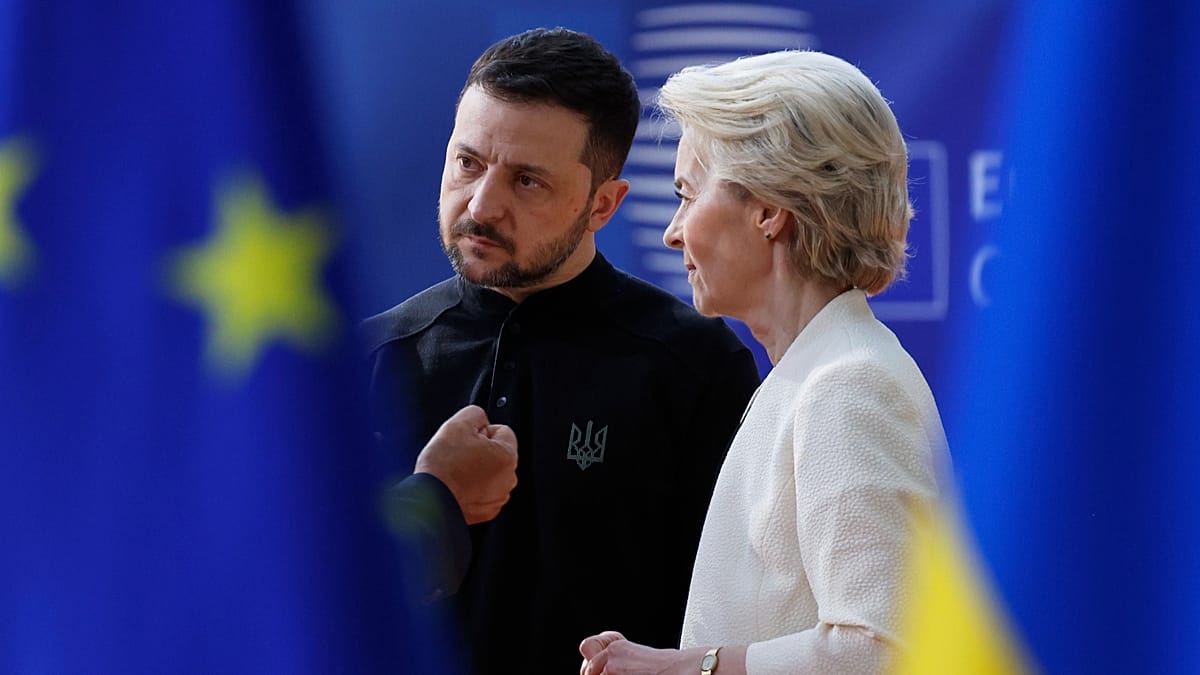
As Ukrainian President Volodymyr Zelenskyy's aircraft narrowly avoided a drone collision over the Baltic Sea late Wednesday, the incident served as a stark reminder of the security challenges facing Europe. Norwegian Prime Minister Jonas Gahr Støre confirmed the near-miss, which occurred as Zelenskyy was flying from Moldova to Oslo. The episode underscores the persistent threat from unmanned aerial vehicles, a tactic increasingly employed by Russian forces in Ukraine.
For the Baltic states, this is not a distant concern but a daily reality. Latvia, which shares a border with Russia, has been preparing for a worst-case scenario for decades. Walking past the Russian embassy in Riga, one sees the street renamed Ukrainas neatkarības iela (Ukrainian Independence Street) in 2022, surrounded by buildings displaying unflattering illustrations of President Vladimir Putin. Latvian Prime Minister Andris Kulbergs reiterated on Wednesday that frontline countries need billions in additional EU funds to bolster their defences.
Political interference and the far-right
The threat is not only physical but also political. Finnish Foreign Minister Elina Valtonen told Europe Today that Moscow is likely pleased with the recent electoral success of the far-right Alternative for Germany (AfD) in a regional election, highlighting the Kremlin's growing influence in European politics. This development adds another layer to the continent's security dilemma, as populist and pro-Russian parties gain ground in several member states.
Meanwhile, the EU is grappling with internal challenges. The housing crisis has reached "emergency" levels, according to EU housing and energy commissioner Dan Jørgensen. New measures unveiled on Wednesday aim to give local authorities more power to regulate short-term rentals like Airbnb in areas designated as under "housing stress." Jørgensen acknowledged that the crisis is a "European problem" that the bloc takes "very seriously," even though housing policy remains largely a national competence.
In an interview with Euronews' Mared Gwyn, Jørgensen admitted that in many cities, ordinary workers—police officers, nurses, teachers—are being priced out of the housing market. "We see normal people with normal jobs not being able to find a place to live," he said, calling the situation "totally unacceptable."
Chemical weapons evidence in Sudan
In a separate investigation, former officials from the Organisation for the Prohibition of Chemical Weapons (OPCW) have reportedly found credible evidence that Sudanese government forces may have used toxic chemicals during the country's civil war. The experts gathered consistent witness testimony and digital evidence suggesting victims were exposed to chemical agents following a military operation. This report, obtained by Euronews, raises serious concerns about the use of banned weapons in conflict zones.
State of the Union preview
As the EU prepares for next week's State of the Union address, Commission President Ursula von der Leyen gave a preview of her priorities during a meeting with European Parliament leaders on Wednesday. According to sources in the room, she outlined plans to address online child protection, competition and the single market, climate, migration, innovation, energy costs, and the EU's partnership with Canada. One political representative summarized the agenda as "very green, not very social," suggesting a focus on environmental issues over social policies.
Political groups have their own wish lists: Socialists want more attention on housing and the European social pillar; Liberals push for a genuine single market by removing non-tariff barriers; conservatives and far-right parties demand stronger border controls. The speech, scheduled for 16 September, will be closely watched for concrete proposals.
Canada seeks closer EU ties
Amid its trade war with the United States, Canada is looking to strengthen its relationship with Brussels. The EU-Canada summit is set for 29-30 October, and Canadian Prime Minister Mark Carney has signalled a desire for deeper cooperation. His presence at the State of the Union address in Strasbourg next week will be an early signal of this new chapter. EU diplomats describe Canada as "one of the EU's most like-minded partners," with potential for expanded trade and security agreements, including a digital trade deal.
As Europe faces these multifaceted challenges—from drone threats to housing crises and political interference—the need for a cohesive and proactive strategy has never been more urgent. The near-miss involving Zelenskyy's plane is a reminder that the security environment remains volatile, and the EU must act decisively to protect its citizens and values.