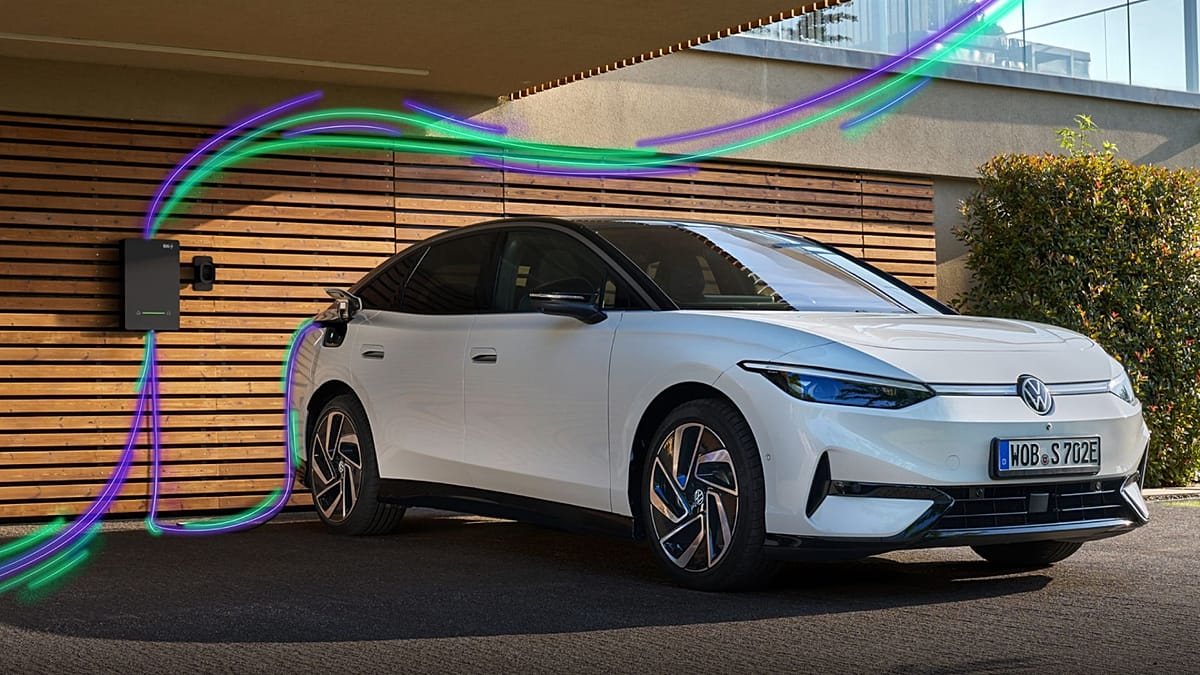
As climate change intensifies extreme weather across Europe, power outages are becoming a more regular feature of life. Heatwaves drive up demand for cooling, storms and wildfires damage infrastructure, and high temperatures reduce grid efficiency. Households from Berlin to Barcelona are now looking for ways to secure backup power — and for the growing number of electric vehicle owners, the answer may already be parked outside.
A new generation of EVs can be plugged directly into a home's electricity meter, keeping fridges, medical devices, and lighting running during an outage. But the technology goes further: some models can also feed electricity back into the grid, turning the car into a mobile power station that earns its owner money while parked overnight.
Vehicle-to-grid could save Europe billions
Vehicle-to-grid (V2G) technology allows surplus renewable energy to be stored in EV batteries and discharged when the grid needs it most. According to research from the Fraunhofer Society, commissioned by Transport & Environment, a properly deployed V2G system across Europe could save up to €22 billion a year in energy system costs by 2040, and as much as €175 billion cumulatively between 2030 and 2040. It would also reduce the need for curtailment — when renewable generators are paid to switch off because supply outstrips demand.
Germany alone curtailed around 9,374 GWh of renewable electricity in 2024, enough to power roughly three million EVs for a year. A V2G system could store that energy instead of wasting it. This is particularly relevant as Europe struggles with grid bottlenecks that strand wind and solar power.
Earning while sleeping
For individual car owners, the financial incentives are becoming tangible. Volkswagen, through its energy brand Elli, is preparing a fully integrated V2G offer for private customers in Germany, with a market launch planned for the fourth quarter of 2026. The system bundles the EV, a smart meter, a bidirectional charger, and an energy tariff into one package. Under favourable conditions, Volkswagen says owners could earn between €700 and €900 a year simply by letting their car's battery flex with the energy market while it's parked overnight.
"Electric mobility can only realise its full potential if it also makes economic sense for our customers," says Martin Sander, a Volkswagen board member responsible for sales and marketing. "With Vehicle-to-Grid, we are delivering exactly that."
Nissan has announced plans to roll out affordable bidirectional charging in 2026, starting in the UK before expanding to other European markets. Kia and Hyundai have launched a V2G service in the Netherlands for select models, and Mercedes-Benz has announced bidirectional charging for its electric GLC through a partnership with The Mobility House. In the UK, BYD has paired one of its models with an Octopus Energy tariff to let drivers export power back to the grid. Some of the hardware behind these launches is European-made: the bidirectional chargers used in several pilots come from Wallbox, an EV-charging company founded in Barcelona.
Backup power without a generator
Beyond earning potential, V2G-enabled EVs offer resilience. A charged EV battery can typically keep key home systems running for several days during an outage, depending on what's drawing power. Ford, for example, has built a system letting owners of certain hybrid and electric pickups in the US plug directly into their home's electric meter via an adapter and a transfer switch, at an installation cost starting around €1,000 — far cheaper than a conventional standby generator.
"The way we think about it, especially for customers who already have a compatible vehicle is, you already own the power source, it's in your driveway," says Amanda Roraff, Ford's grid and energy services business acceleration lead. American automakers are leaning into this technology partly because EV sales have cooled there — down nearly a quarter year-on-year in the first half of 2026, according to Cox Automotive. In Europe, where EV interest remains stronger, the same technology is becoming a core reason to buy, alongside lower running costs and emissions.
Not quite plug-and-play yet
The technology comes with real caveats. Only a limited number of EV models currently support true bidirectional charging, and the hardware — a bidirectional charger plus installation — can cost several thousand euros more than a standard home charge point. Utilities must approve the setup before it can be connected, a process that can take time, and some manufacturers have raised questions about battery warranty and degradation from the extra charge cycles involved.
Even so, researchers say the direction of travel is clear. "We already know [the impact of] providing electricity to the home during an outage," says Scott Samuelsen, engineering professor emeritus at the University of California, Irvine. "This is going to become very, very popular."
For European households increasingly exposed to severe storms that leave tens of thousands without power, the ability to turn an EV into a home battery — and earn money while doing so — may soon shift from a niche feature to a standard expectation.