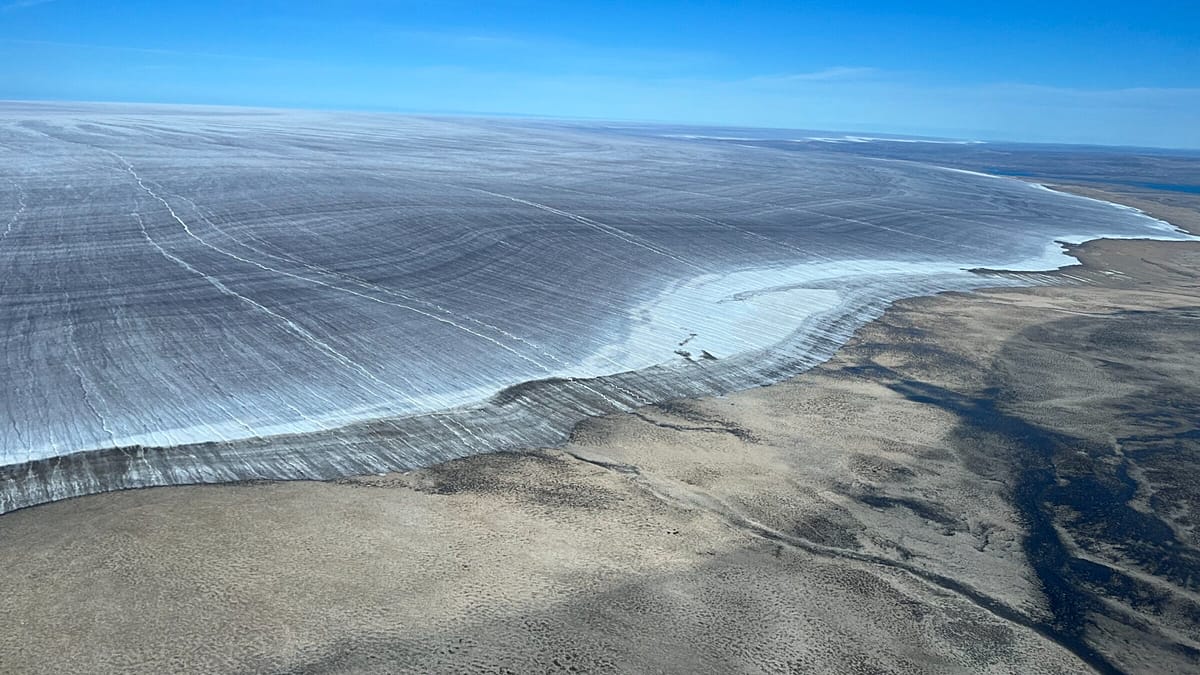
For decades, the Barnes Ice Cap in northeastern Canada has been shrinking, a stark symbol of human-induced climate change. But new research suggests that this vast glacier—covering roughly 6,000 square kilometres on Baffin Island—was not always in retreat. In fact, it was growing until about 1960, and its expansion may have marked the beginning of a new ice age that human activity inadvertently halted.
A glacier that almost started an ice age
Nicolás Young, a geochemist at Columbia University's Lamont-Doherty Earth Observatory, and his colleagues have been studying the Laurentide Ice Sheet, which once blanketed much of Canada and the northern United States between 95,000 and 20,000 years ago. Today, the Barnes Ice Cap is its last remnant. The team's findings, published in the journal Nature Communications, indicate that the ice sheet reached its minimum size about 3,000 years ago and then began to expand again around 2,000 years ago.
By analysing carbon-14 in vegetation samples collected along the glacier's edge, the researchers reconstructed a timeline of the ice front's advance. "If you do this often enough, you can build up a timeline showing how the ice margin systematically spread across the plants," Young explained. The evidence points to a period of cooling that allowed fresh ice to accumulate—conditions that, if left unchecked, could have led to a full glacial period.
Joerg Schaefer, a climate geochemist and co-author, noted that while indirect measurements had long suggested such growth, "capturing the start of the process through direct observations is new." The team's work offers a rare glimpse into how renewed glaciation begins, challenging the conventional view that the next ice age would not start for tens of thousands of years.
The 1960s turning point
The summer of 1961 was one of the hottest on record in the 20th century, comparable to the extreme heat of 2021. Since then, Canadian summers have warmed significantly—by about 2.1°C on average compared with the baseline period, with the Arctic warming roughly three times faster than the global average. This warming reversed the Barnes Ice Cap's expansion, causing it to lose more ice in summer than it gains in winter.
Young described this as "a very striking example of how humanity has knocked the system out of balance." The glacier's retreat is not just a local phenomenon; it has global implications. As the last remnant of the Laurentide Ice Sheet disappears, it could alter the dynamics of future glaciations and ice ages. Some researchers even speculate that a new ice age could begin in Europe, though the current trajectory of warming makes that unlikely in the near term.
The findings also resonate with broader debates about climate policy. As Europeans express support for climate action while questioning the effectiveness of EU green policies, this study underscores the profound impact of human activity on the planet's long-term climate cycles.
While the Barnes Ice Cap's growth 2,000 years ago may have been the start of a new glacial period, the rapid warming of the past six decades has cut it short. Young and his team argue that this should be seen as the beginning of an ice age that never came to fruition—a reminder of the power of human influence over the Earth's climate system.
As the glacier continues to melt, it serves as a tangible marker of how quickly natural processes can be disrupted. The implications extend far beyond Canada, affecting sea levels, weather patterns, and the future of ice sheets worldwide. For Europe, which has its own climate data gaps and faces the challenge of adapting to a warming world, the story of the Barnes Ice Cap is a cautionary tale about the unintended consequences of our actions.