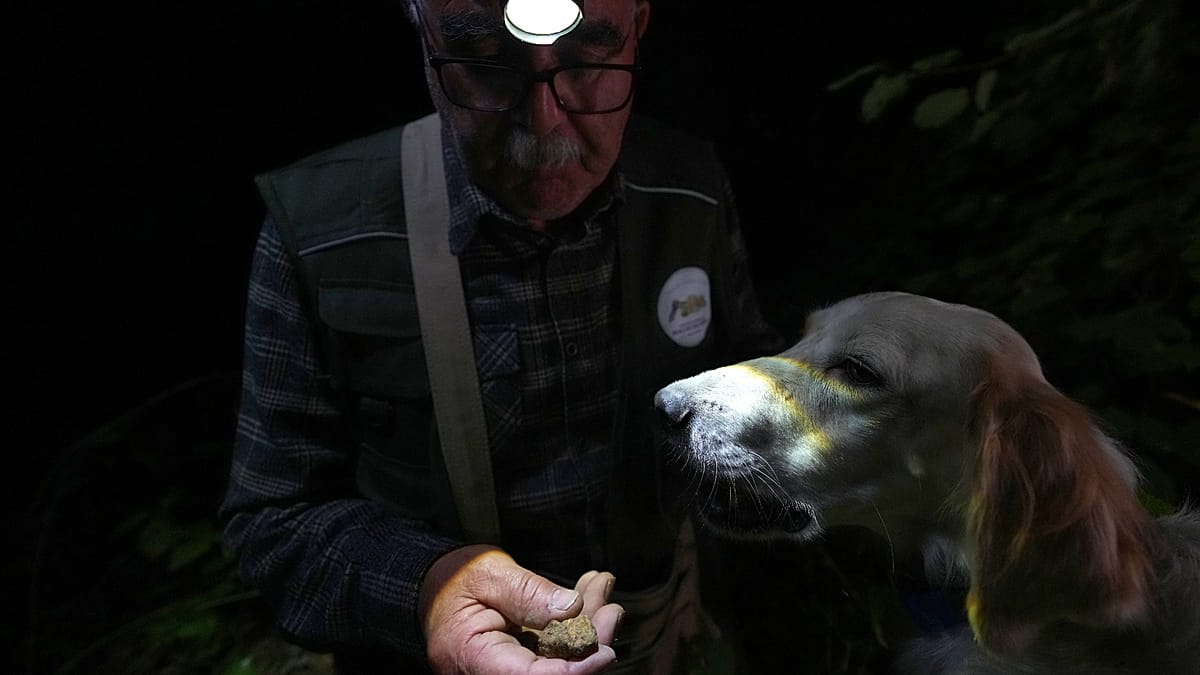
In the hills around Alba, home to the world's most celebrated white truffles, the traditional hunting season begins on 1 October. But for the 'trifolau' — the truffle hunters who have worked these woodlands for generations — the start of the season is no longer a simple matter of heading out with a dog and a digging stick. Months of heat and drought have made the hunt increasingly unpredictable, and the prized fungus that depends on cool, moist soils and a delicate symbiosis with tree roots is showing the strain.
“The entire month of October was affected by the lack of rain in July and August and the high temperatures, so it was characterised by poor production and poor truffle shelf life,” says Antonio Degiacomi, president of Italy’s National Centre for Truffle Studies. Dry, compacted soils have also produced smaller truffles this season, he adds.
The difficult harvest comes as Alba and the surrounding Langhe hills welcome visitors for the International White Truffle Fair, one of Italy’s best-known food events, which opened on 10 October and runs until 6 December. The fair is a major draw for gastronomes, but this year the spotlight is as much on the challenges facing the region's signature product as on the delicacies themselves.
A changing climate, a changing truffle harvest
Axel Iberti, president of the fair, says the season began slowly, with smaller truffles emerging after a hot, dry summer. More recent rains have improved conditions, helping larger specimens appear. Despite tighter supplies, demand remains strong. Prices at Alba’s truffle market are running about 20 to 30 per cent higher than last year, Iberti says, while hotels and other accommodations have largely sold out during the fair period.
The concerns extend beyond this year’s crop. “This year certainly stands out from a trend we all know has been going on for five or six years now,” Degiacomi says, citing hotter summers and increasingly erratic rainfall patterns. Truffle hunter Tino Marolo says uncertainty has always been part of the hunt. “You certainly come home empty-handed more often than you do with a truffle,” he says. “It’s really the thrill of saying: I don’t know what I’m going to find.”
From Italy to Croatia, truffle-producing regions see the same warning signs
Similar concerns are emerging elsewhere in Europe’s truffle-producing regions, suggesting a challenge extending beyond any single forest or region. Across the Adriatic Sea in Croatia, truffle hunters and scientists describe many of the same problems, from shrinking harvests to declining habitat suitability. In oak forests outside Zagreb, truffle hunter Petar Alebic says years of drought have made the prized fungi harder to find. “Each year for the past seven or eight years has been worse than the last,” Alebic says. “Due to the drought, unfortunately, truffles are becoming smaller and scarcer.” Alebic estimates this year’s harvest is about 30 per cent below normal and increasingly supplements his income with truffle-hunting tours for tourists.
Scientists studying truffles in Croatia report similar findings. Croatia is home to about a dozen truffle species, according to mycologist Armin Mesic of the Rudjer Boskovic Institute. The most prized, the white truffle, can fetch as much as €4,000 per kilogram. “Drought, a lack of rainfall and high temperatures have a significant impact on both the quantity and quality of truffles,” Mesic says. “Quantities are declining, as is the geographical area where white truffles grow,” he adds.
Forests are part of the solution to failing truffle harvests
Yet experts in Italy’s Piedmont region, where Alba is located, reject the idea that the white truffle is doomed. “I don’t think we’re facing extinction; we’re facing a challenge,” Degiacomi says. Researchers are studying ways to help truffle habitats adapt, including improved forest management and experimental irrigation during prolonged droughts. “We’re trying to do what nature does, and do it artificially,” Degiacomi says.
In Alba, the response increasingly centres on restoring and protecting forests. Iberti has expanded the fair’s focus beyond tourism to include environmental education and conservation efforts. “The truffle is the sum, but it’s also the vector,” Iberti says. “People come to Alba and the Langhe to discover everything the territory has to offer.” Working with municipalities, truffle hunters and landowners, communities have begun creating new public truffle grounds and planting trees that could eventually support truffle growth. “The forest is an act of love and faith for the next two or three generations,” Iberti says.
Advocates say reforestation can help lower soil temperatures, retain moisture and reduce erosion, although it can take more than a decade before newly planted trees become suitable hosts for truffles. Researchers are also investigating the role of soil microorganisms and looking for tree varieties better suited to hotter and drier conditions. The approach mirrors broader efforts across Europe to use nature-based solutions to climate challenges, such as Milan's urban forest plan, which has become a UN restoration model.
Attempts to cultivate the prized white truffle continue, but reliable commercial production remains elusive. Unlike black truffles, which can be cultivated, white truffles have largely resisted large-scale production. As autumn progresses, the size of this year’s harvest will become clearer, along with its effect on prices and supplies reaching restaurants and markets. For now, the hunters of Alba and beyond are adapting, as they always have, to the rhythms of a forest that is changing under their feet.