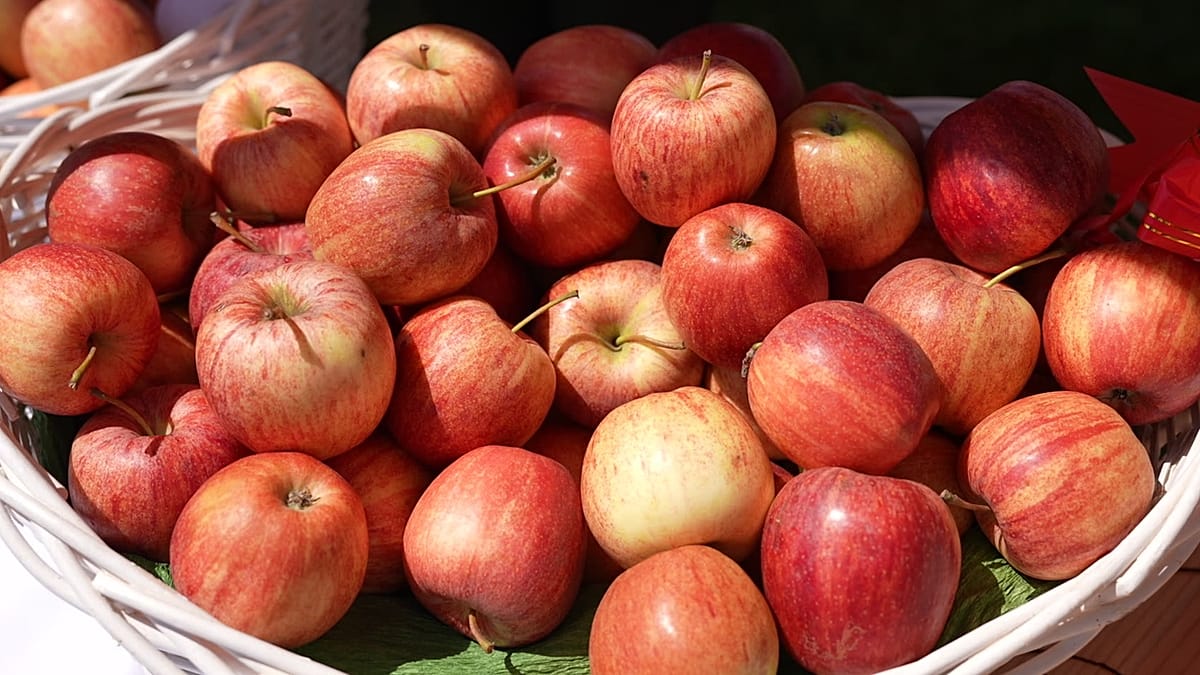
Few fruits are as ubiquitous as the apple, yet its origins have long been a puzzle. Recent genetic research has settled the debate: the ancestor of every apple we eat today grows wild in the mountains of Central Asia, specifically in the Tian Shan range that straddles south-eastern Kazakhstan and Kyrgyzstan.
That ancestor is Malus sieversii, the Sievers apple, named after the German botanist Johann August Carl Sievers, who documented the region's wild apple forests in the 18th century. In the 1930s, Soviet scientist Nikolai Vavilov studied these forests and concluded that Kazakhstan was the apple's original home.
Modern science has confirmed Vavilov's insight. Gulnara Sitbayeva, a Doctor of Biological Sciences, explains: "In one study, scientists analysed more than 10,000 cultivated apple varieties. The fact that 46% of the samples contained genetic material from the Sievers apple provided evidence that it is a progenitor of modern cultivated apples."
The European wild apple, Malus sylvestris, also contributed to the apple's genetic mix, but the Central Asian species played the dominant role. This means that when you bite into a crisp Gala or a tart Granny Smith, you are tasting the legacy of a fruit that evolved in the foothills of the Tian Shan.
From mountain slopes to global orchards
How did this wild apple travel from its isolated homeland to orchards across Europe and beyond? The journey began with animals. Birds and mammals fed on the apples and dispersed the seeds across the mountain slopes, allowing the species to spread naturally. Later, humans took over.
As trade routes developed, the apple hitched a ride along the Silk Road, the ancient network of caravan trails that connected China, Central Asia, the Middle East and Europe. Merchants and travellers carried apples as provisions, and the fruit gradually made its way westward, adapting to new climates and soils. By the time it reached Europe, it had already been cultivated and selected for desirable traits for centuries.
Today, the Sievers apple still thrives in its native habitat, and its spring blossom has become a cultural spectacle. In the Zhetisu region of Kazakhstan, an annual festival celebrates the blooming of the wild apple trees, drawing visitors who camp in traditional yurts, watch folk sports and sample local crafts. The event is often compared to Japan's famous sakura season, a testament to the apple's deep roots in the region's identity.
Almaty: the city named after apples
Kazakhstan's largest city, Almaty, owes its name to the fruit. In Kazakh, alma means apple, and the city's name is traditionally linked to its apple-rich surroundings. The city lies at the foot of the mountains where wild apple trees have grown for centuries, and apple motifs appear throughout its urban design, from sculptures to metro mosaics.
One of the most famous apple varieties to emerge from this region is the Aport, developed through selective breeding and known for its large size and distinctive aroma. Ivan Sergeev, who has been growing Aport apples for nearly two decades, describes their appeal: "The aroma of Aport apples is like French perfume. These apples also have very delicate skin, so we harvest the entire crop by hand."
Sergeev also grows Sievers apple trees on his orchard. "The main difference between Sievers and Aport is that Sievers is a wild apple, and the tree can live for 250 to 300 years. Aport trees live for around 40 to 70 years," he notes.
Beyond the orchards, Almaty hosts an annual harvest festival called Alma Fest, where farmers bring apples from across the region. Visitors can taste fresh juice, dried slices, jams and other apple products. This year, more than 200 tonnes of apples were brought to the festival, a testament to the fruit's enduring importance.
For travellers interested in exploring the apple's homeland, the Tian Shan mountains offer trekking routes that pass through ancient Silk Road ruins and wild apple forests, as this guide to southern Kazakhstan shows. The region's natural beauty and cultural heritage make it a compelling destination for those curious about the origins of one of the world's most beloved fruits.