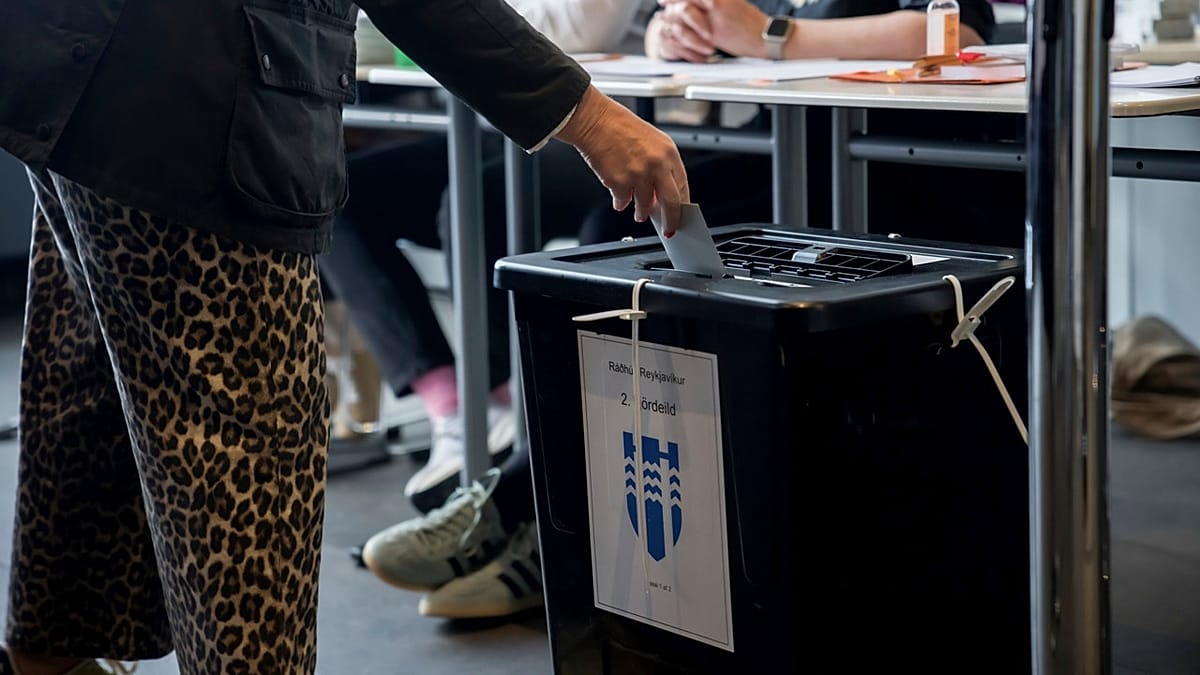
Reykjavík saw a surge in early voting on Saturday as Icelanders headed to the polls in a referendum that could reopen European Union membership talks. By midday, turnout in the capital's two constituencies had already surpassed the levels recorded during the 2024 parliamentary election, according to preliminary figures reported by local media.
In Reykjavík North, 13.7% of registered voters had cast ballots by noon, compared with just over 10% at the same point in the 2024 election. Reykjavík South recorded 14.1%, up from 11.1%. The national broadcaster RÚV also reported that more than one in five voters had taken advantage of early voting before election day.
The referendum, which asks whether the government should resume negotiations with Brussels on full EU membership, is expected to be extremely tight. A final opinion poll released on Friday put the yes vote at 50.4% and the no vote at 49.6%, within the margin of error.
A nation divided over sovereignty and stability
Supporters of EU membership argue that closer alignment with the continent is essential to tackle cross-border challenges such as climate change. They also point to the euro as a more stable alternative to Iceland's volatile króna, which has often complicated trade and investment.
Opponents counter that Iceland already enjoys the benefits of European integration—through the European Economic Area and the Schengen area—without the sovereignty costs of full membership. They highlight trade agreements, such as the one with China, that would be jeopardised by EU common commercial policy.
“I think we should be part of a bigger unity. I think it's worth looking into it,” said Unnur Jokulsdottir, a 71-year-old retiree, after voting at Reykjavík's City Hall.
Olafur Thorsson, a 53-year-old fish trader, expressed scepticism. “I used to like the European Union back when it was a good thing. But today it's become a sort of big economic prison,” he said.
Iceland, a nation of just under 400,000 people, first applied for EU membership in 2009 after the collapse of its banking sector devastated the economy. Talks were suspended in 2013 when a eurosceptic government took office, and successive administrations have avoided reopening the issue until now.
A yes vote would trigger renewed negotiations with the European Commission across 35 policy areas, from agriculture to justice. The most sensitive issue is fisheries, a cornerstone of Iceland's economy that Reykjavík insists on controlling exclusively. Brussels, for its part, has signalled a willingness to be flexible this time around.
The geopolitical backdrop has also shifted. Russia's full-scale invasion of Ukraine has upended European security assumptions, while former U.S. President Donald Trump's unpredictability—and his repeated threats to take over neighbouring Greenland, which he has occasionally confused with Iceland—has heightened concerns in Reykjavík. Iceland has no standing army and relies on NATO and a 1951 bilateral defence agreement with the United States.
The outcome will be closely watched in Brussels, which has not welcomed a wealthy, net-contributing member since 1995. A yes vote would also have implications for other non-EU European states, as Norway's relationship with the bloc could be reshaped. For a deeper look at what the vote means for both sides, see our analysis of the referendum's stakes.
Polls close at 22:00 local time, with results expected shortly after. The narrow margin means the final count could hinge on a few thousand votes.