The Ig Nobel Prizes, the satirical counterpart to the Nobels, were handed out this week in Zurich, Switzerland, marking the first time the ceremony has been held outside the United States. Organizers cited the hostile climate for science in the US and travelers' reluctance to visit as reasons for the move. "During the past year, it has become unsafe for our guests to visit the country," said Marc Abrahams, master of ceremonies and editor of The Annals of Improbable Research, told the Associated Press. "We cannot in good conscience ask the new winners, or the international journalists who cover the event, to travel to the US this year."
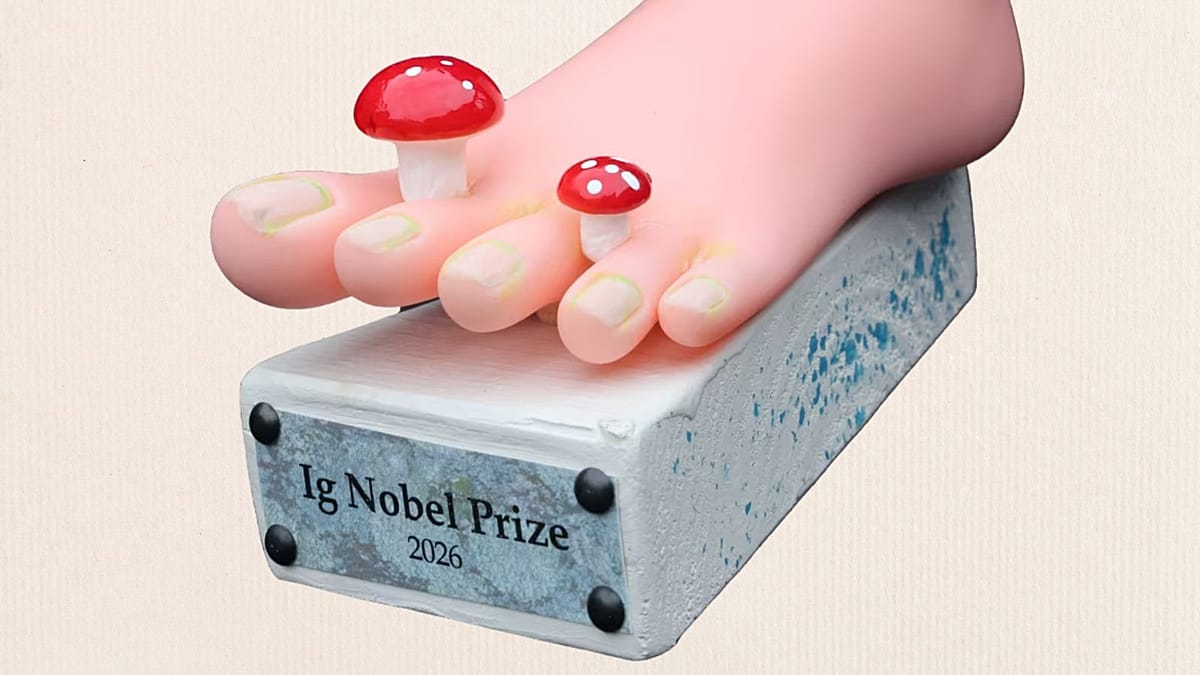
The 36th edition, themed around fungi, saw winners receive a statuette of a blue cheese slab trampled by a foot sprouting toadstools, along with the traditional 10 trillion Zimbabwean dollars—a currency that collapsed years ago, making the prize essentially worthless. But as Abrahams noted, last year's winners got a moist towelette, so it's all relative.
Established in 1991, the Ig Nobels honor achievements that "first make people laugh, and then make them think." This year's crop of research certainly delivers on both counts.
Biomechanics: A New Definition of Kissing
Matilda Brindle and colleagues from the UK and US won for devising a more precise definition of kissing: "non-agonistic interactions involving directed, intraspecific, oral-oral contact with some movement of the lips/mouthparts and no food transfer." Their comparative study found that kissing occurs in most large apes and likely in Neanderthals, suggesting early humans and Neanderthals may have kissed. "Next time you kiss someone, you can think, 'This is a 21.5-million-year-old tradition that I'm honoring here,'" said Dr. Brindle. "It's not just a modern human behaviour. It's really ancestral."
Economics: The Rich Are Different (and Not in a Good Way)
Paul Piff and an international team from the US, Mexico, and Canada amassed evidence that upper-class individuals are more likely to snatch candy from children, lie in dice games, cut off other drivers, and view greed positively. "The general pattern seems to be that with wealth and rising power, you become less engaged with the needs of others," Piff said. "Taking candy from children might be the least of our worries but it's emblematic of the tendency to prioritise one's own needs." Dorothy Parker's quip comes to mind: "If you want to know what God thinks of money, just look at the people he gave it to."
Chemistry: Cockroach Milk, Anyone?
A multinational team from India, France, Japan, and the US discovered that milk proteins from viviparous cockroaches contain three times the energy of cow milk. They extracted crystals from the guts of Diploptera punctata embryos to determine the protein structure. The finding could have implications for sustainable nutrition, though the thought of cockroach milk may be hard to swallow.
Physics: The Splash-Free Urinal
Researchers from Canada, the US, China, and Saudi Arabia, including students at the University of Waterloo, designed a urinal that minimizes splashback, a breakthrough for public hygiene and sustainability. The team's theoretical and experimental work could lead to cleaner restrooms worldwide.
Other winners included studies on the evolution of kissing in ants and polar bears, and the discovery that cockroaches may inherit the Earth in more ways than one. The ceremony, held in Zurich, was a celebration of the weird and wonderful, reminding us that science can be both fun and thought-provoking. As Abrahams put it, the Ig Nobels are about "celebrating the unusual, honoring the imaginative—and spurring people's interest in science, medicine, and technology."
For those inspired by this year's winners, the Ig Nobels also serve as a reminder that even the most absurd research can have real-world applications. Whether it's redefining a universal human behavior or designing better public facilities, these studies push the boundaries of knowledge in unexpected ways.