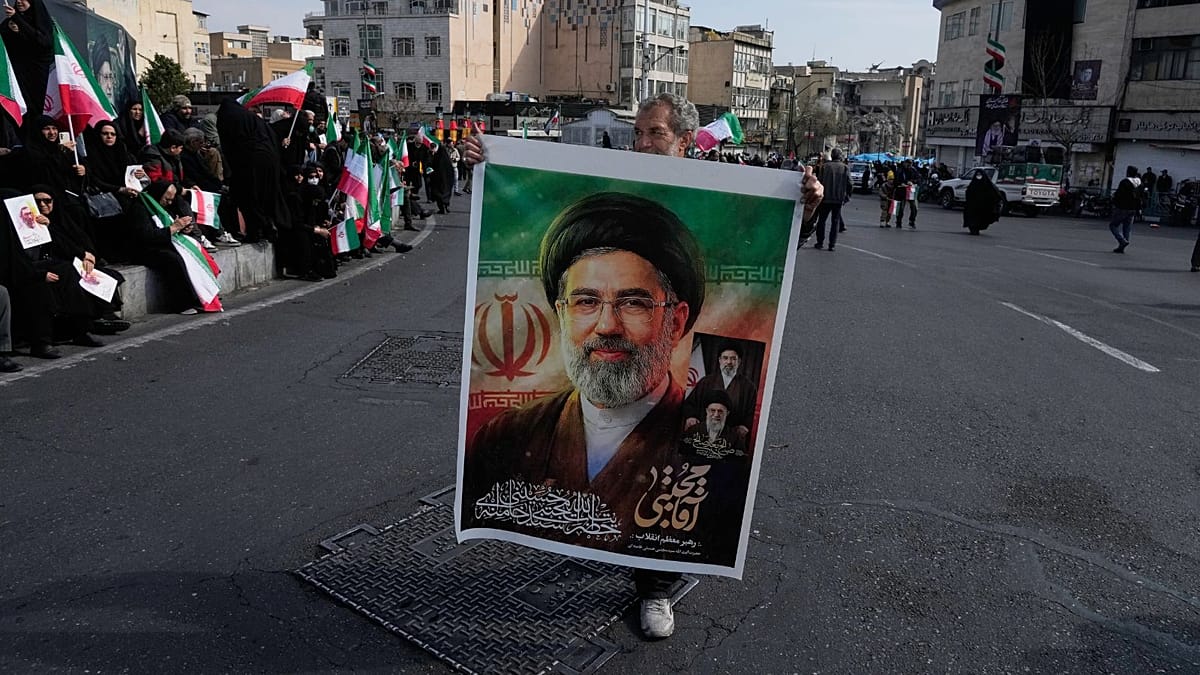
Six months after succeeding his father as Iran's supreme leader, Mojtaba Khamenei has yet to give a public interview or appear in a new photograph. Now, his late wife's family is offering a rare glimpse into the man behind the veil, painting a portrait of a cleric with a taste for Hollywood cinema and a curiosity about technology.
In interviews republished by state-aligned Iranian media, Farideddin Haddad Adel, brother of Zahra Haddad-Adel—who was killed alongside Ayatollah Ali Khamenei in the 28 February US-Israeli strike on the supreme leader's compound—described his brother-in-law as someone with broad interests spanning technology, start-ups, psychology, cognitive sciences, and film. He said Mojtaba Khamenei is familiar with the work of British director Christopher Nolan, known for intricate narratives in films like Inception and Oppenheimer.
"Unlike His Eminence (Ali Khamenei), he is not into literature, but he watches a lot of films," Haddad Adel said, according to the interviews.
Tayyebeh Mahrouzadeh, Zahra's mother, added in comments republished in June that before asking for her daughter's hand, Mojtaba Khamenei had obtained a TOEFL English-language certificate and was diligent in learning foreign languages. The details, while not independently verifiable, offer a striking contrast to the austere image of his father, who was known for his poetry and religious scholarship.
A life in the shadows
Haddad Adel also revealed that Mojtaba Khamenei spent some 25 years working in security, military, and political roles alongside his father. He dates this involvement back to May 1997, when reformist candidate Mohammad Khatami won the presidential election against the candidate backed by the ayatollah's office—a period that became known in Iran as the start of the reform era.
Ali Khamenei and institutions under his control subsequently worked to obstruct the reformist government's legislative agenda. Khatami later said his administration faced a crisis every nine days, a testament to the deep political divisions that have shaped modern Iran.
The family also describes Mojtaba Khamenei as living simply, dressing plainly, and sleeping little. This portrayal echoes the pro-regime media coverage of Ali Khamenei throughout his decades in power, which often highlighted his modest lifestyle to distance the leadership from corruption allegations and signal loyalty to the values of the 1979 revolution.
Now, Mojtaba Khamenei is being intentionally presented as a cleric rooted in religious and security structures while staying in touch with modern culture—someone familiar with English, Hollywood cinema, and technology, yet not at odds with the Islamic Republic's political order. This carefully crafted image may be an attempt to appeal to a younger, more tech-savvy generation in Iran, even as the regime faces international isolation.
Mojtaba Khamenei, 56, was appointed ayatollah by the Assembly of Experts on 8 March, nine days after surviving the strike that killed his father and wife. He had married Zahra Haddad-Adel in 1999. The strike, which also reportedly left him severely injured, has been a point of contention; former US President Donald Trump claimed Mojtaba Khamenei was alive but seriously hurt, a statement that has not been independently confirmed.
As Iran navigates a volatile geopolitical landscape, with Qatar pushing daily diplomacy to restart US-Iran talks, the new supreme leader's personal interests may seem peripheral. Yet they offer a rare window into the leadership style of a man who has remained largely invisible since taking office.
For European observers, the portrayal of a tech-friendly ayatollah could signal a subtle shift in Iran's approach to the outside world. Whether this translates into policy changes remains to be seen, but the narrative is a far cry from the revolutionary austerity of his father's era.