Tehran has escalated its pressure on the Strait of Hormuz, with Iran's army commander-in-chief ordering the navy to tighten the closure of the crucial waterway until Washington meets a list of Iranian conditions. Major General Amir Hatami told senior commanders on Monday that the strait would be closed “further day by day” and that stronger control would be exercised over it, warning that any new US military action would draw blows that are “more severe, more crushing and without geographical limitation.”
Hatami cited orders from Ayatollah Mojtaba Khamenei, adding that if the United States “commits a new folly and starts another war, in the new phase the blows will be more severe, more crushing and without geographical limitation.” The remarks come amid a sharp rise in tensions that have already seen Iran launch attacks on US bases in Bahrain and Kuwait, and almost daily reports from Tehran of tankers hitting naval mines.
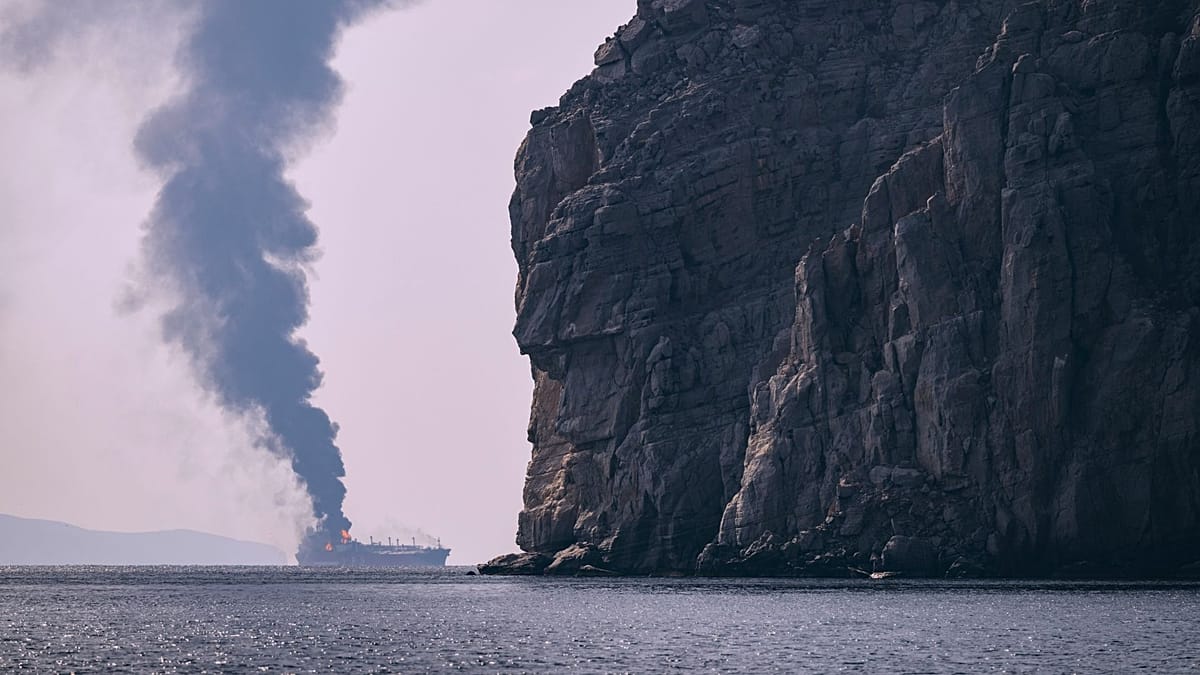
The Islamic Revolutionary Guard Corps (IRGC) claimed on Monday that three oil tankers in the Strait of Hormuz suffered “powerful explosions and massive fires” after striking naval mines. According to an IRGC statement, one tanker was hit off the southern shores and two more in the east of the strait, all while under “extensive air escort by the US army.” The IRGC said it would publish images of the explosions and warned shipowners that “military escort by the US army is no substitute for compliance with maritime regulations.”
However, the Joint Maritime Information Centre (JMIC), which monitors shipping in the region, said in a report covering 19 to 21 November that it recorded 114 passages through the strait “with the assistance of the United States” and that claims of tankers hitting naval mines were unconfirmed. The discrepancy highlights the difficulty of verifying events in a waterway that carries about a fifth of global oil supply.
Iran’s conditions and threats
Iranian Parliament Speaker Mohammad Bagher Ghalibaf, who is leading the Iranian delegation in talks in Islamabad, said there would be no further negotiations or action before Washington moves. “Before the implementation of Iran's seven conditions there will be no action and no negotiation, and in response to the enemy's moves we are also ready to give a decisive answer and to change the geography of the battlefield in the event of an enemy mistake,” he said. He also accused Washington of seeking to impose a neither-war-nor-peace situation on Tehran, threatening that there were “military ways to break the blockade that, God willing, we will pursue in the near future.”
Foreign ministry spokesman Esmaeil Baghaei told reporters that a naval blockade was “tantamount to military aggression” and that Iran had “the right in this regard to use any available means to defend itself.” He added: “We will certainly not tolerate this situation, and we will use all our tools to confront this US aggression.”
Qatar’s diplomatic push
Amid the escalating rhetoric, Qatar’s Prime Minister Mohammed bin Abdulrahman Al Thani visited Washington on Monday, meeting US Secretary of State Marco Rubio and Vice President JD Vance to discuss efforts to restart negotiations between Tehran and Washington. After his talks with Rubio, Al Thani said the region “cannot bear a renewed escalation of tensions between the United States and Iran” and that Doha was working to bring both sides back to the table. He also said Qatar and the US were seeking to strengthen their military cooperation. According to AP, citing a source familiar with the proceedings, the meeting with Vance lasted about 10 minutes.
The visit followed US President Donald Trump’s statement on Sunday that military strikes on Iran could resume after the New Year. Trump had earlier this month said he had asked Vance to shift his focus from Iran to domestic policy. The diplomatic push comes as Iran has threatened to use every means to counter the US naval blockade, and as tanker incidents are being reported in the strait.
For Europe, the stakes are high. The Strait of Hormuz is a vital artery for energy supplies, and any sustained disruption would have immediate consequences for European economies already grappling with high energy prices. The European Union has repeatedly called for de-escalation, but its leverage is limited. The bloc’s diplomatic efforts have been overshadowed by the US-Iran standoff, and European capitals are watching closely to see whether Qatar’s mediation can break the deadlock.
As the situation develops, the risk of miscalculation remains acute. Iran’s military has reported almost daily that tankers it describes as violators have struck naval mines, while the JMIC’s data suggests that most passages are proceeding without incident. The gap between Tehran’s narrative and the observable reality on the water is widening, making it harder for outside actors to assess the true state of play.
For now, the strait remains open, but the order to close it “further day by day” is a clear signal that Iran is prepared to escalate. Whether Qatar’s diplomatic push can persuade both sides to step back from the brink is uncertain, but the alternative—a military confrontation in one of the world’s most vital shipping lanes—would have consequences far beyond the region.